












When you shop for proxies, you'll eventually hit a fork in the road: IPv4 or IPv6? IPv6 proxies are often dramatically cheaper and sold in near-unlimited quantities, which makes them look like an obvious bargain. But price is only half the story — the other half is whether the websites you actually target will accept them at all. This guide breaks down how the two address types differ, where each one wins, the compatibility trap that catches most beginners, and how to decide which is right for your project.
IPv4 and IPv6: a quick primer
Every device on the internet needs an IP address to send and receive data. For decades that address has been IPv4 — the familiar dotted format like 192.168.1.1, made of four numbers from 0 to 255. IPv4 uses 32 bits, which allows for about 4.3 billion unique addresses. That sounded like plenty in the 1980s, but with billions of phones, laptops, servers, and smart devices online, the world ran out of fresh IPv4 addresses years ago.
IPv6 is the successor built to solve that shortage. It uses 128 bits and looks completely different — eight groups of hexadecimal digits, such as 2001:0db8:85a3:0000:0000:8a2e:0370:7334. The jump from 32 to 128 bits is staggering: IPv6 provides roughly 340 undecillion addresses (a number with 39 digits), effectively an inexhaustible supply. If you want to see how a single IPv4 address breaks down into binary and hex, our IP address converter makes the structure concrete.
How the world ran out of IPv4
Understanding the price gap means understanding the shortage behind it. When IPv4 was designed, 4.3 billion addresses seemed limitless — the internet was a research network of a few thousand machines. Nobody anticipated smartphones, smart TVs, data centers, or the Internet of Things. As adoption exploded, the regional registries that hand out addresses steadily depleted their reserves, and the last large free blocks were allocated in the 2010s.
Stopgaps like NAT (network address translation), which lets many devices share one public IPv4 address, extended IPv4's life but didn't create new addresses. IPv6 was standardized back in the late 1990s precisely to remove the ceiling for good. Yet adoption has been gradual: networks must run both protocols during the transition, so decades later we live in a dual-stack world where IPv4 is scarce and valuable, IPv6 is plentiful and cheap, and neither has fully replaced the other. That uneasy coexistence is exactly what shapes the proxy market today.
The core difference: scarcity vs abundance
Almost every practical difference between IPv4 and IPv6 proxies flows from one fact: IPv4 addresses are scarce and expensive, while IPv6 addresses are abundant and cheap. Because the pool of IPv4 addresses is finite and fully allocated, they trade as a genuine commodity — providers pay real money to acquire and lease them, and that cost is passed on to you.
IPv6, by contrast, is so plentiful that a single customer can be handed billions of addresses without anyone noticing. That abundance is why IPv6 proxies are sold at a fraction of the price, often by the thousand. The catch — and it is a big one — is that abundance also makes IPv6 easier for websites to identify and block in huge blocks, and a large slice of the internet still doesn't speak IPv6 at all.

How IPv4 and IPv6 proxies differ in practice
On a technical level, a proxy is a proxy — it relays your traffic and swaps your IP regardless of version. The differences show up in how the addresses behave once they reach a target site:
- Reputation granularity. Websites often judge IPv6 by its larger prefix (the
/64block) rather than the single address, because providers hand out whole blocks to one user. Block one IPv6 and a site may block thousands of neighbors at once. IPv4 reputation is judged address by address, giving each one independent standing. - Subnet diversity. A cheap IPv6 package frequently delivers thousands of addresses that all sit in the same subnet — which looks suspiciously uniform to anti-bot systems. IPv4 pools, especially residential ones, draw from many different networks and ISPs, so they appear far more varied and human.
- Detection. Because so many IPv6 proxies come from data centers and tidy contiguous ranges, sophisticated targets spot and throttle them more readily than well-distributed IPv4.
Are there residential IPv6 proxies?
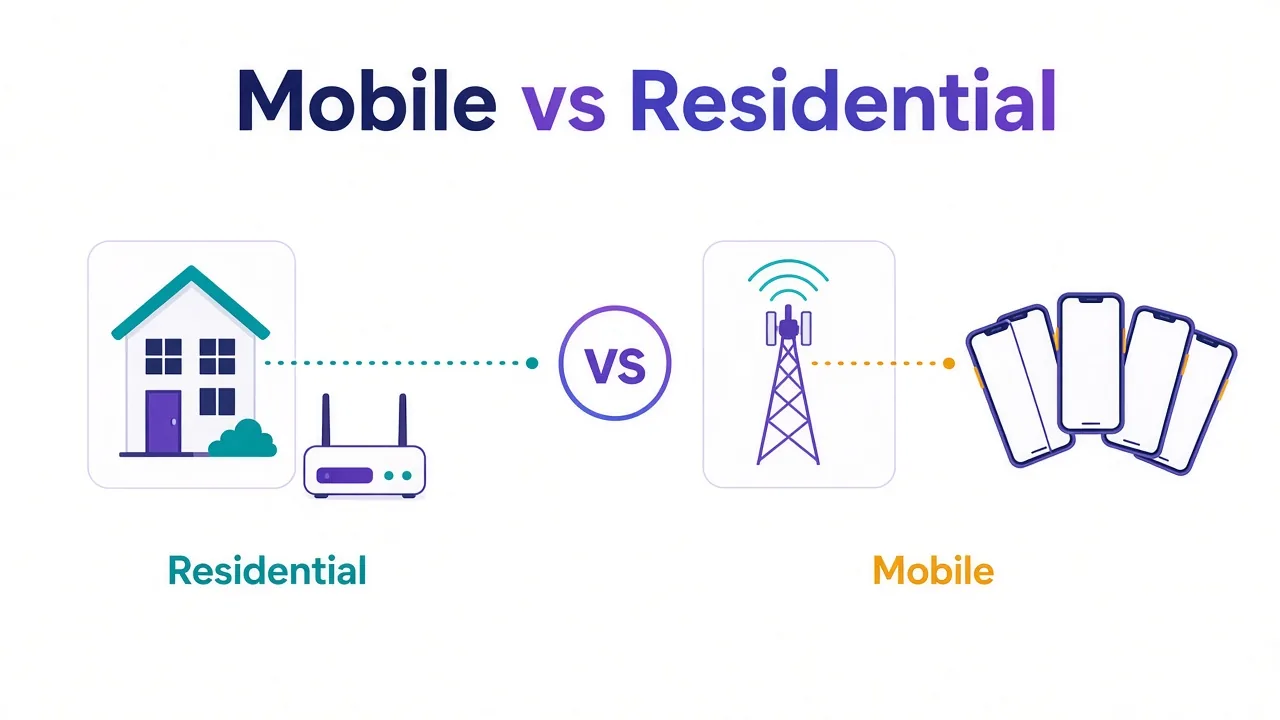
This is where theory meets the market. In practice, the vast majority of residential proxies are IPv4, while most IPv6 proxies come from data centers. The reason is simple: residential proxy pools are built from real consumer devices, and home ISPs around the world still hand out IPv4 to those devices far more consistently than IPv6. Datacenter providers, meanwhile, can mint IPv6 in bulk for almost nothing.
That has a direct consequence for buyers. If your job needs the trust of a residential IP — and most anti-bot-heavy tasks do — you'll almost certainly be using IPv4. Cheap IPv6 is overwhelmingly datacenter IPv6, which carries the same easy-to-detect reputation as any other datacenter address, on top of the compatibility limits. So the IPv4-vs-IPv6 choice is often really a residential-vs-datacenter choice in disguise.
Do IPv6 proxies affect privacy?
Address version also has subtle privacy implications. Because IPv6 blocks are typically allocated in large contiguous prefixes to a single user, activity across thousands of "different" IPv6 addresses can be trivially linked back to the same /64 owner — undermining the appearance of many independent identities. Well-distributed IPv4 addresses, especially residential ones drawn from different ISPs, look far more like genuinely separate users.
Whichever version you pick, remember that the IP is only one signal. Your browser fingerprint, cookies, and behavior can expose or link you regardless of address type. Check what a site actually sees about your connection with our browser fingerprint tool, and treat the proxy as one layer of a larger setup rather than a silver bullet.
IPv4 vs IPv6 proxies at a glance
| Factor | IPv4 proxies | IPv6 proxies |
|---|---|---|
| Availability | Scarce, fully allocated | Effectively unlimited |
| Cost | Higher | Much lower |
| Website compatibility | Works almost everywhere | Only on IPv6-enabled sites |
| Block granularity | Per address | Often per /64 block |
| Best for | Maximum reach and reliability | High-volume tasks on IPv6 targets |
The big catch: website compatibility
Here is the single most important thing to understand before you buy IPv6 proxies. A website can only be reached over IPv6 if it has published an IPv6 address of its own. Many have — Google, Facebook, Netflix, and a large share of major platforms are dual-stack, meaning they answer on both IPv4 and IPv6. But a huge number of sites, including countless smaller targets and some very popular ones, remain IPv4-only. An IPv6 proxy simply cannot connect to them, no matter how cheap or plentiful it is.

Check the target before you buy
If your target site is IPv4-only, IPv6 proxies are useless to you regardless of price. Always confirm a target supports IPv6 (it needs a published AAAA DNS record) before committing to an IPv6 plan.
When IPv6 proxies make sense
Despite the compatibility caveat, IPv6 proxies are an excellent, economical choice in the right circumstances:
- Your targets are confirmed dual-stack. If you're working against Google services, major social platforms, or other IPv6-ready giants, you can exploit the low price at scale.
- You need enormous volume cheaply. For massive, high-frequency requests where each IP only does a little work, the sheer quantity and low cost of IPv6 is hard to beat.
- You control both ends. SEO monitoring of IPv6-enabled properties, testing your own IPv6 infrastructure, or ad verification on modern networks are natural fits.
When IPv4 proxies are the safer choice
For most people, most of the time, IPv4 remains the dependable default:
- Maximum compatibility. IPv4 reaches essentially the entire web, so you never have to audit whether a target supports your address type.
- Sensitive or diverse targets. E-commerce sites, sneaker drops, ticketing, and anything with strong anti-bot defenses generally trust well-distributed IPv4 — especially residential IPv4 — far more than uniform IPv6 ranges.
- Account management. Logging into and managing accounts is safest on stable, reputable IPv4 addresses that don't share a fate with thousands of neighbors.
Price and availability
The cost gap is the headline reason anyone considers IPv6. Because providers can allocate IPv6 almost for free, IPv6 proxies routinely sell for a small fraction of IPv4 prices, sometimes by an order of magnitude, and in effectively unlimited quantities. IPv4, as a finite leased commodity, carries a real per-address cost that has only risen as the shortage deepens.
That said, cheaper-per-IP does not mean cheaper-per-result. If half your IPv6 addresses can't reach the target or get block-listed by the /64, the effective cost of a successful request can exceed IPv4. Always weigh price against real-world success rate on your specific targets, not the sticker price alone.
Common misconceptions about IPv6 proxies
A few myths lead buyers astray, so it's worth clearing them up:
- "IPv6 is newer, so it must be better." Newer doesn't mean more compatible. For proxy work, reach and reputation matter more than protocol modernity, and IPv4 still wins on both for general use.
- "More addresses means harder to block." The opposite is often true. Sites counter IPv6 abundance by blocking entire
/64blocks at once, so thousands of your addresses can vanish in a single ban. - "IPv6 proxies are basically free, so they're always the best value." Low price per IP is meaningless if the addresses can't reach your target or get block-listed quickly. Value is measured per successful request, not per address.
- "My ISP uses IPv6, so every site does too." Your connection supporting IPv6 says nothing about whether a given target does. Compatibility depends on the destination's DNS records, not yours.
So, which one is better?
There is no universal winner — the right answer depends entirely on what you're connecting to. The decision really comes down to a single question: do your targets support IPv6?
The short answer
Choose IPv6 proxies when your targets are confirmed IPv6-ready and you need huge volume at the lowest cost. Choose IPv4 proxies when you need broad compatibility, sensitive-target reliability, or you simply aren't sure what your targets support — which describes most use cases.
For the majority of users juggling mixed or unknown targets, IPv4 is the pragmatic, lower-risk default. IPv6 is a powerful cost optimization once you've verified it will actually work for your job.
How to choose between them
Run through these steps before you buy:
- Audit your targets. Confirm whether each target publishes an IPv6 (AAAA) record. If any critical target is IPv4-only, you need IPv4.
- Weigh volume vs sensitivity. Huge-volume jobs on tolerant, IPv6-ready sites favor IPv6; sensitive, defended, or account-based work favors IPv4.
- Prefer residential for hard targets. Regardless of version, residential IPs outperform datacenter ones on anti-bot-heavy sites — and most residential supply is IPv4.
- Test before scaling. Buy a small amount, measure the real success rate on your targets, and verify the exit address with a quick IP lookup before committing budget.
When you're ready to compare specific networks, our independent proxy reviews note which providers offer IPv4, IPv6, and residential options so you can match the address type to the provider.
The bottom line
IPv4 and IPv6 proxies aren't really competitors so much as tools for different jobs. IPv6 is the abundant, inexpensive future — brilliant for high-volume work on the growing set of sites that support it, but hamstrung by patchy compatibility and block-by-block exposure today. IPv4 is the scarce, pricier, but universally accepted standard that simply works everywhere, which is why it remains the safe default for most proxy users. Identify what your targets support, match the address type accordingly, test before you scale, and you'll get the best of whichever version fits the task. And if you're ever unsure, default to residential IPv4: it costs more, but it spares you the compatibility audits and block-by-block surprises that catch out bargain-hunters chasing cheap IPv6.
Frequently asked questions
Neither is universally better — it depends on your targets. IPv4 works almost everywhere and is the safe default for sensitive or mixed targets, while IPv6 is far cheaper and ideal for high-volume work on sites that support it. If you are unsure what your targets support, choose IPv4.
Yes, usually by a large margin, because IPv6 addresses are almost unlimited while IPv4 addresses are a scarce, leased commodity. However, cheaper per IP does not always mean cheaper per successful request — if many IPv6 addresses cannot reach your target or get block-listed, the effective cost can rise.
Because a site can only be reached over IPv6 if it has published its own IPv6 (AAAA) DNS record. Many sites remain IPv4-only, and an IPv6 proxy simply cannot connect to them no matter how cheap it is. Always confirm your target supports IPv6 before buying an IPv6 plan.
They are rare. The vast majority of residential proxies are IPv4, because home ISPs still assign IPv4 to consumer devices more consistently, while most IPv6 proxies come from data centers. If you need residential trust, you will almost certainly be using IPv4.
Often, yes. Because providers hand out large contiguous IPv6 blocks to one user, sites frequently block an entire /64 prefix at once, wiping out thousands of your addresses in a single ban. IPv4 reputation is judged address by address, so a block is more contained.
Check whether the domain has a published AAAA DNS record — if it does, the site is reachable over IPv6. Online DNS lookup tools can show this in seconds. If there is no AAAA record, the site is IPv4-only and you will need IPv4 proxies.