









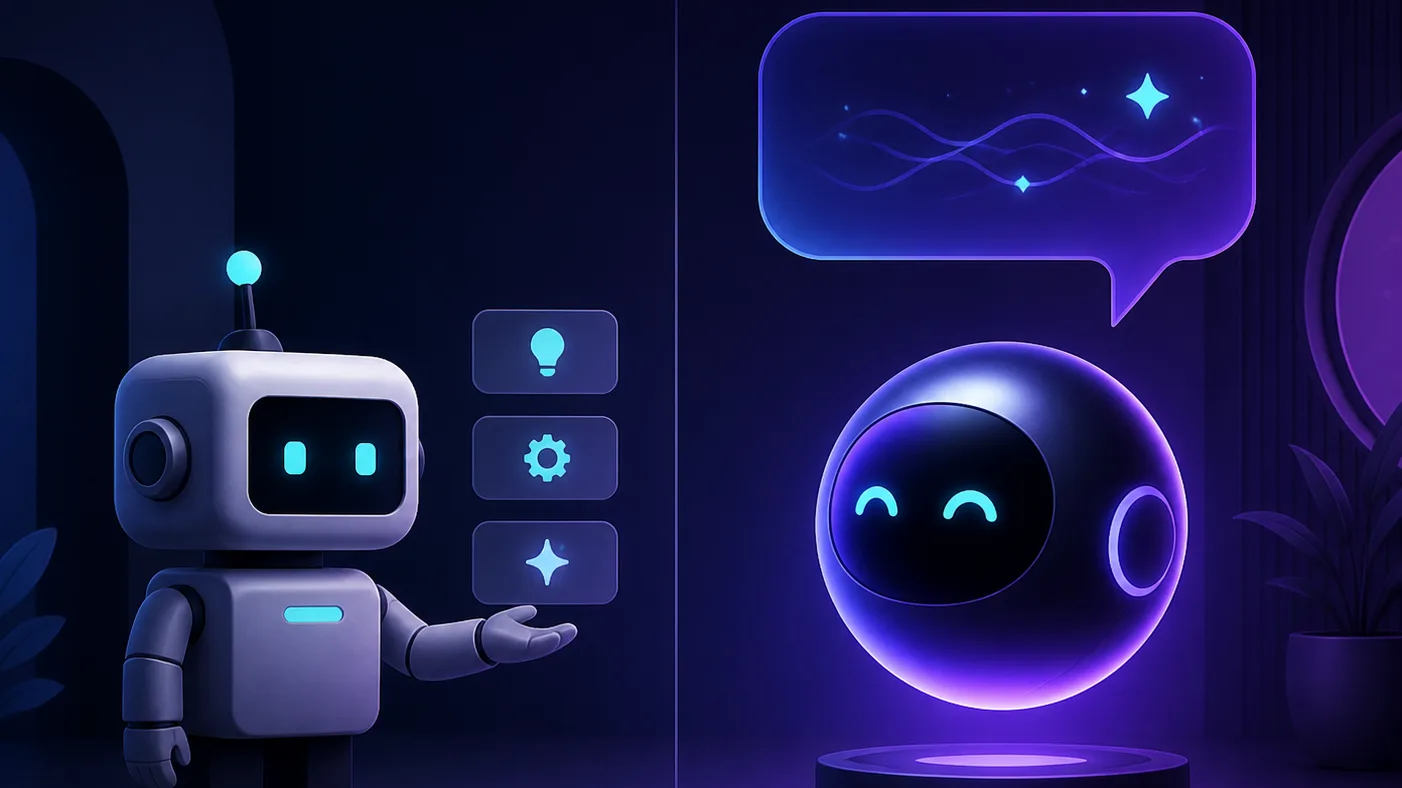
"Chatbot" and "ChatGPT" get used almost interchangeably, but they aren't the same thing — and the difference matters if you're deciding what to build or buy. In short: a chatbot is a broad category of software that holds a conversation, while ChatGPT is one specific, very advanced product built on generative AI. Every ChatGPT is a chatbot, but most chatbots are not ChatGPT. This guide unpacks what each actually is, how they work, where they differ, and when to use one over the other.
The short answer
A chatbot is any program designed to simulate conversation — it can be as simple as a set of scripted menu buttons. ChatGPT is a specific generative-AI chatbot made by OpenAI that produces original, human-like responses using a large language model. Chatbot is the category; ChatGPT is a standout example within it.
What is a chatbot?
A chatbot is a software application that simulates human conversation through text or voice. The term covers an enormous range of sophistication, from the simple automated helpers on a bank's website to voice assistants and cutting-edge AI. What unites them is the goal: let a person interact with a computer using natural conversation instead of forms, menus, or code.
Crucially, "chatbot" says nothing about how the bot works. Many chatbots you meet day to day are quite basic — they follow pre-written scripts, match keywords, or offer a few buttons to click. Others are powered by advanced AI. The word describes the interface (a conversation) and the purpose (automating interaction), not the underlying technology.
Common types of chatbots
- Rule-based (scripted) chatbots follow decision trees: if a user says X, reply Y. They're predictable and cheap but can't handle anything outside their script.
- Menu/button chatbots guide users through predefined choices — the "Press 1 for billing" of the chat world. Reliable for simple, structured tasks.
- Keyword-recognition chatbots scan input for known words and respond accordingly, a step up from pure scripts but easily confused by phrasing.
- AI / NLP chatbots use natural language processing and machine learning to understand intent and respond more flexibly. ChatGPT sits at the most advanced end of this group.
A brief history: from ELIZA to ChatGPT
Chatbots are far older than most people realize. The first, ELIZA, was built at MIT in 1966 and mimicked a therapist by reflecting users' statements back as questions — with no real understanding at all, just clever pattern-matching. Decades of rule-based and keyword bots followed, from customer-service scripts to the AIM chatbot SmarterChild in the early 2000s.
The next leap came with statistical natural language processing and machine learning, which powered voice assistants like Siri, Alexa, and Google Assistant in the 2010s. Then came the transformer architecture in 2017, the breakthrough that made modern large language models possible. ChatGPT, launched by OpenAI in November 2022, was the moment that technology reached the mainstream — reaching a hundred million users faster than almost any product in history and redefining what people expect a "chatbot" to do. Understanding that lineage makes the distinction clearer: ChatGPT is the latest, most powerful chapter in a sixty-year story, not a replacement for the whole idea of a chatbot.
What is ChatGPT?
ChatGPT is a specific conversational-AI product created by OpenAI and launched in late 2022. It's built on the GPT (Generative Pre-trained Transformer) family of large language models — AI systems trained on vast amounts of text that can understand and generate human-like language. Rather than picking from pre-written replies, ChatGPT generates each response word by word based on patterns learned during training.
That generative ability is what sets it apart. You can ask ChatGPT to explain quantum physics, write a poem, draft an email, debug code, brainstorm names, or summarize a document — all in the same conversation, in natural language, without any of those responses being scripted in advance. It's a general-purpose tool, not a bot built for one narrow task, which is why it captured global attention so quickly.
Chatbot vs ChatGPT: the key differences
Because one is a category and the other a product, the cleanest comparison is between traditional (rule-based) chatbots and ChatGPT as the flagship of generative AI:
| Aspect | Traditional chatbot | ChatGPT |
|---|---|---|
| What it is | A category of conversational software | A specific generative-AI product (OpenAI) |
| Core technology | Rules, keywords, or decision trees | Large language model (GPT) |
| Responses | Predefined or template-based | Generated dynamically, original |
| Scope | Narrow, task-specific | Broad, general-purpose |
| Flexibility | Breaks outside its script | Handles open-ended, novel prompts |
| Setup | Manually designed flows | Ready to use out of the box |
| Best for | Predictable, structured tasks | Open-ended, creative, or complex tasks |
How they actually work under the hood
The deepest difference is technical. A rule-based chatbot is essentially a flowchart: developers script questions, answers, and branches in advance. When you type something, the bot matches it to a known pattern and returns the corresponding reply. If your message doesn't fit the script, it fails — hence the familiar "Sorry, I didn't understand that." It never creates anything new; it retrieves what a human already wrote.
ChatGPT works completely differently. Its underlying language model was trained on huge quantities of text and learned the statistical patterns of language — how words, ideas, and structures relate. When you send a prompt, it predicts a coherent response one token (roughly a word-piece) at a time, drawing on those learned patterns. Nothing is pre-scripted; each answer is generated on the fly. That's why it can respond sensibly to questions no one anticipated, and also why it can occasionally produce confident but incorrect answers, a phenomenon known as "hallucination."
Where ChatGPT fits in the chatbot family
It helps to picture chatbots as a spectrum of intelligence. At one end sit simple menu and rule-based bots; in the middle, keyword and basic NLP bots; at the far, most capable end sit generative-AI chatbots like ChatGPT. So ChatGPT isn't the opposite of a chatbot — it's the most advanced kind of chatbot currently available to the public.
A useful analogy
"Chatbot" is like "vehicle" — a broad category that includes bicycles, cars, and jet planes. ChatGPT is like a particular high-performance car: still a vehicle, but far more capable than a bicycle. Calling every chatbot a "ChatGPT" is like calling every vehicle a sports car.
Strengths and limitations of each
Neither is universally better; they excel at different things.
Traditional chatbots are predictable, controllable, and cheap to run. Because every path is defined, they never go off-script, which is exactly what you want for regulated tasks like confirming an order or resetting a password. Their weakness is rigidity: step outside the script and they're useless, and building broad coverage means designing endless branches by hand.
ChatGPT is flexible, knowledgeable, and remarkably capable across topics, handling nuance and open-ended requests that would break a scripted bot. Its trade-offs are the flip side of that freedom: it can hallucinate facts, its knowledge has a training cutoff, responses vary between runs, and running large language models costs more compute than simple rule matching. For high-stakes, must-be-exact answers, that unpredictability needs guardrails.
Real-world examples of each
Concrete examples make the difference obvious. Traditional chatbots are the ones quietly doing structured jobs: the bot on an airline's site that checks your flight status from a fixed set of options, the pizza chain's ordering assistant that walks you through toppings and delivery, a bank's helper that routes you to the right FAQ, or the "Was this article helpful?" widget that collects feedback. Each does one narrow thing reliably, and none of them writes anything original.
ChatGPT, by contrast, shows up wherever open-ended language work happens: a marketer drafting ad variations, a developer debugging a stack trace, a student getting a concept explained three different ways, a founder brainstorming company names, or a support agent summarizing a long ticket thread. The same tool handles wildly different tasks in one conversation — something no scripted bot could do. In practice, many businesses now run both: a scripted bot for transactional flows and a generative assistant for everything messy and human.
When to use a chatbot vs ChatGPT
The right choice depends entirely on the job:
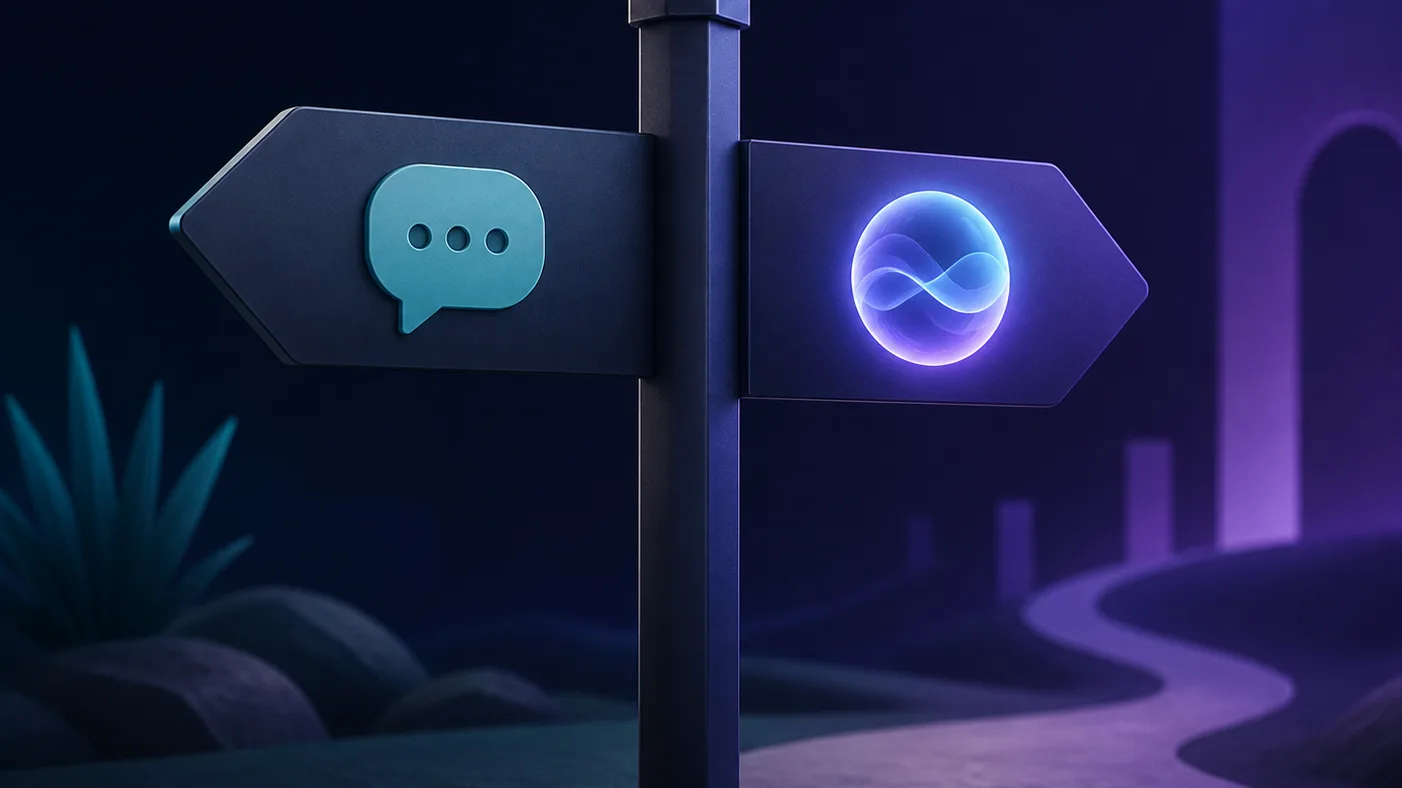
- Use a traditional chatbot for narrow, repetitive, rules-driven tasks where answers must be exact and controlled — order tracking, appointment booking, FAQ deflection, simple lead capture, or anything in a regulated flow.
- Use ChatGPT for open-ended, creative, or knowledge-heavy work — drafting content, brainstorming, explaining concepts, coding help, summarizing, and general research where flexibility matters more than rigid predictability.
- Use a ChatGPT-powered chatbot — increasingly the best of both — when you want conversational flexibility and control over a specific domain, such as a support assistant grounded in your own help docs.
Can you build a chatbot with ChatGPT?
Yes — and this is where the two ideas converge. OpenAI offers the same models behind ChatGPT through an API, so businesses can build their own generative chatbots on top of them. A company can connect the model to its knowledge base, add rules and guardrails, and deploy a support or sales assistant that talks naturally but stays on-topic. OpenAI also lets users create "custom GPTs" — tailored versions of ChatGPT for specific purposes without coding.
The result is a growing class of hybrid chatbots: generative AI for understanding and phrasing, combined with retrieval from trusted sources and business rules for accuracy. This approach — often called retrieval-augmented generation (RAG) — keeps the fluency of ChatGPT while reducing hallucinations by grounding answers in verified data. For most modern customer-facing bots, this hybrid model is quickly becoming the standard.
ChatGPT and its competitors
ChatGPT popularized generative-AI chat, but it's no longer alone. Other major AI assistants — such as Anthropic's Claude, Google's Gemini, Microsoft Copilot, and various open models — offer similar generative capabilities, each with different strengths in reasoning, context length, or integration. This matters for the terminology: "ChatGPT" has become a genericized shorthand for AI chat the way "Google" became shorthand for search, but it's one product among several. When people say they want "a ChatGPT for our website," they usually mean a generative-AI chatbot — which could be built on any of these models, not necessarily OpenAI's.
Common misconceptions
A few myths cause most of the confusion:
- "ChatGPT and chatbot mean the same thing." No — chatbot is the broad category; ChatGPT is one product within it. All ChatGPTs are chatbots, but most chatbots aren't ChatGPT.
- "ChatGPT is always the better choice." Not for every job. For a fixed, must-be-exact flow like a password reset, a simple scripted bot is more reliable and cheaper than a generative model that might phrase things unpredictably.
- "Any AI chatbot is ChatGPT." Many assistants — Claude, Gemini, Copilot — offer similar generative chat. ChatGPT is a brand, not a synonym for all AI chat.
- "ChatGPT knows everything and is always right." It generates plausible language, not guaranteed facts. It can hallucinate and has a knowledge cutoff, so its output needs checking for anything important.
The bottom line
The confusion between "chatbot" and "ChatGPT" comes down to mixing up a category with a product. A chatbot is any software that converses, spanning simple scripted menus to advanced AI. ChatGPT is a specific, generative-AI chatbot from OpenAI that generates original, human-like responses with a large language model — the most capable end of the chatbot spectrum, not a separate thing entirely. Choose a traditional chatbot when you need predictable, controlled answers to structured tasks; reach for ChatGPT (or a ChatGPT-powered assistant) when you need flexibility, knowledge, and natural language across open-ended work. Understanding the distinction is the first step to picking, or building, the right conversational tool for the job. And as generative models keep improving, expect the line between "chatbot" and "ChatGPT-like assistant" to blur further — with the smartest builders combining scripted reliability and generative flexibility rather than choosing just one.
Frequently asked questions
Yes. ChatGPT is a chatbot — specifically, a generative-AI chatbot built by OpenAI on large language models. It sits at the most advanced end of the chatbot spectrum, but it's still a program that holds a conversation, which is the definition of a chatbot.
Chatbot is a broad category of conversational software, while ChatGPT is one specific product within it. Most chatbots use predefined rules, keywords, or menus, whereas ChatGPT generates original responses with a large language model. Every ChatGPT is a chatbot, but most chatbots are not ChatGPT.
Not always — it depends on the task. ChatGPT is far more flexible and knowledgeable for open-ended work, but a simple rule-based chatbot is more predictable, cheaper, and safer for fixed, must-be-exact flows like resetting a password. Many businesses use both.
Yes. OpenAI offers the models behind ChatGPT through an API, so you can build a custom generative chatbot, connect it to your own knowledge base, and add guardrails. OpenAI also lets you create no-code custom GPTs for specific purposes.
Some do, some don't. Rule-based and menu chatbots run on scripts and keyword matching with no real AI, while modern AI/NLP chatbots — including ChatGPT — use machine learning and large language models to understand intent and generate responses. The word chatbot covers both.
No. ChatGPT popularized generative-AI chat, but alternatives like Anthropic's Claude, Google's Gemini, and Microsoft Copilot offer similar capabilities with different strengths. ChatGPT has become a shorthand for AI chat, but it's one product among several.