












"Proxy" and "VPN" both hide your IP address and change your apparent location, so they're often treated as interchangeable — but they work very differently and suit different jobs. The short version: a proxy reroutes the traffic of one app to mask your IP, while a VPN encrypts and reroutes all of your device's traffic for privacy and security. This guide breaks down exactly how each works, where they differ, which is faster, and when to reach for one over the other — or both together.
The short answer
Use a proxy when you need to control the IP or location of a single app at scale and speed — web scraping, multi-account work, price monitoring. Use a VPN when you want to encrypt everything and protect your privacy across your whole device — public Wi-Fi, general browsing, streaming. A proxy changes your address; a VPN changes your address and secures your connection.
What is a proxy?
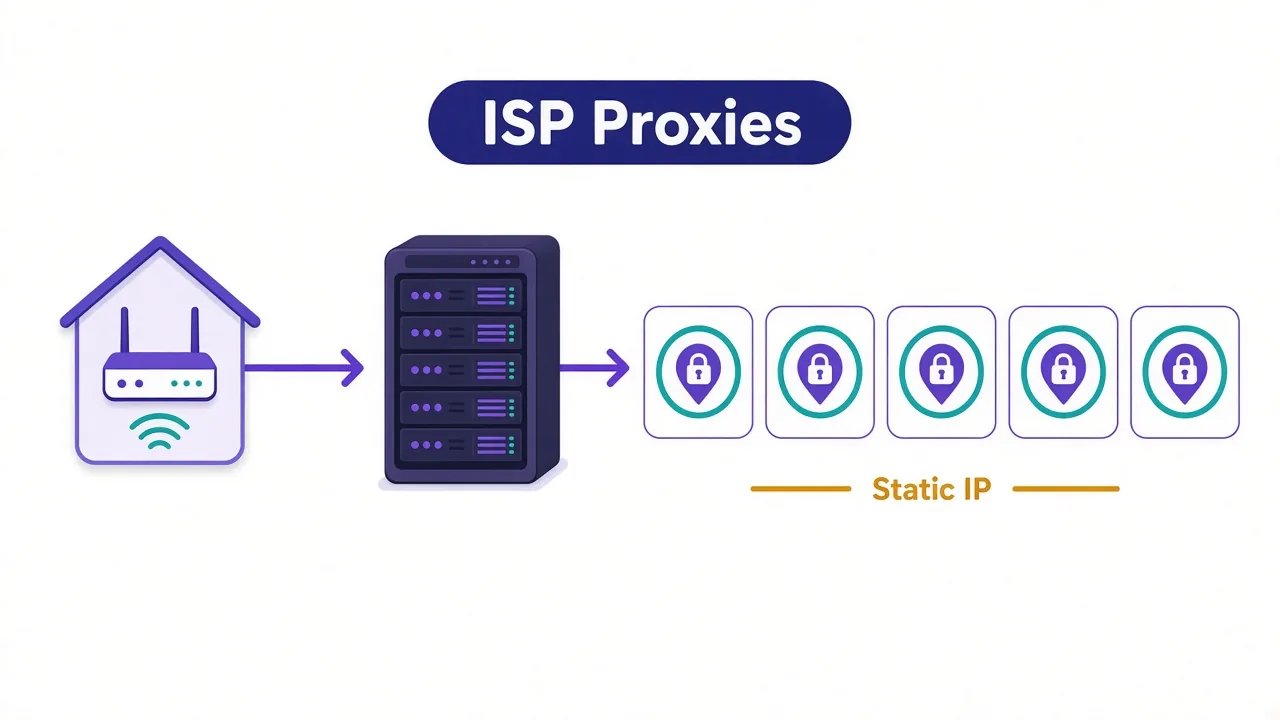
A proxy server is an intermediary that sits between an app and the internet. Instead of connecting to a website directly, your request goes to the proxy first, which forwards it on using its own IP address, then passes the response back to you. The website sees the proxy's IP and location, not yours.
Crucially, a proxy usually works at the application level — you configure a specific program, like a browser or a scraper, to use it, and only that program's traffic is routed through it. Everything else on your device connects normally. Most proxies also don't encrypt your traffic; they simply relay it. That makes them fast and lightweight, which is why they're the backbone of large-scale data work. For a deeper look, see our explainer on how proxy servers work.
What is a VPN?
A VPN (Virtual Private Network) also reroutes your traffic through a server in another location, so websites see the VPN server's IP instead of yours. But it adds two things a basic proxy doesn't: it works at the device level, capturing all of your internet traffic, and it wraps that traffic in strong encryption, creating a secure tunnel between your device and the VPN server.
That encryption is the defining feature. It means no one on your network — not your internet provider, not the operator of a public Wi-Fi hotspot, not an eavesdropper — can read what you're doing online. A VPN is built for privacy and security first, with location-changing as a bonus, which is the reverse of how most proxies are designed.
Proxy vs VPN: the key differences
The two overlap in one respect — both hide your real IP — but diverge on almost everything else:
| Aspect | Proxy | VPN |
|---|---|---|
| Encryption | Usually none | Strong, always on |
| Scope | One app (app-level) | Whole device (system-level) |
| Primary purpose | Change IP / location at scale | Privacy & security |
| Speed | Very fast (no encryption overhead) | Slight overhead from encryption |
| IP addresses | Huge pools, rotating | Fewer, shared server IPs |
| Best for | Scraping, multi-account, automation | Everyday privacy, public Wi-Fi, streaming |
How a proxy and a VPN route your traffic
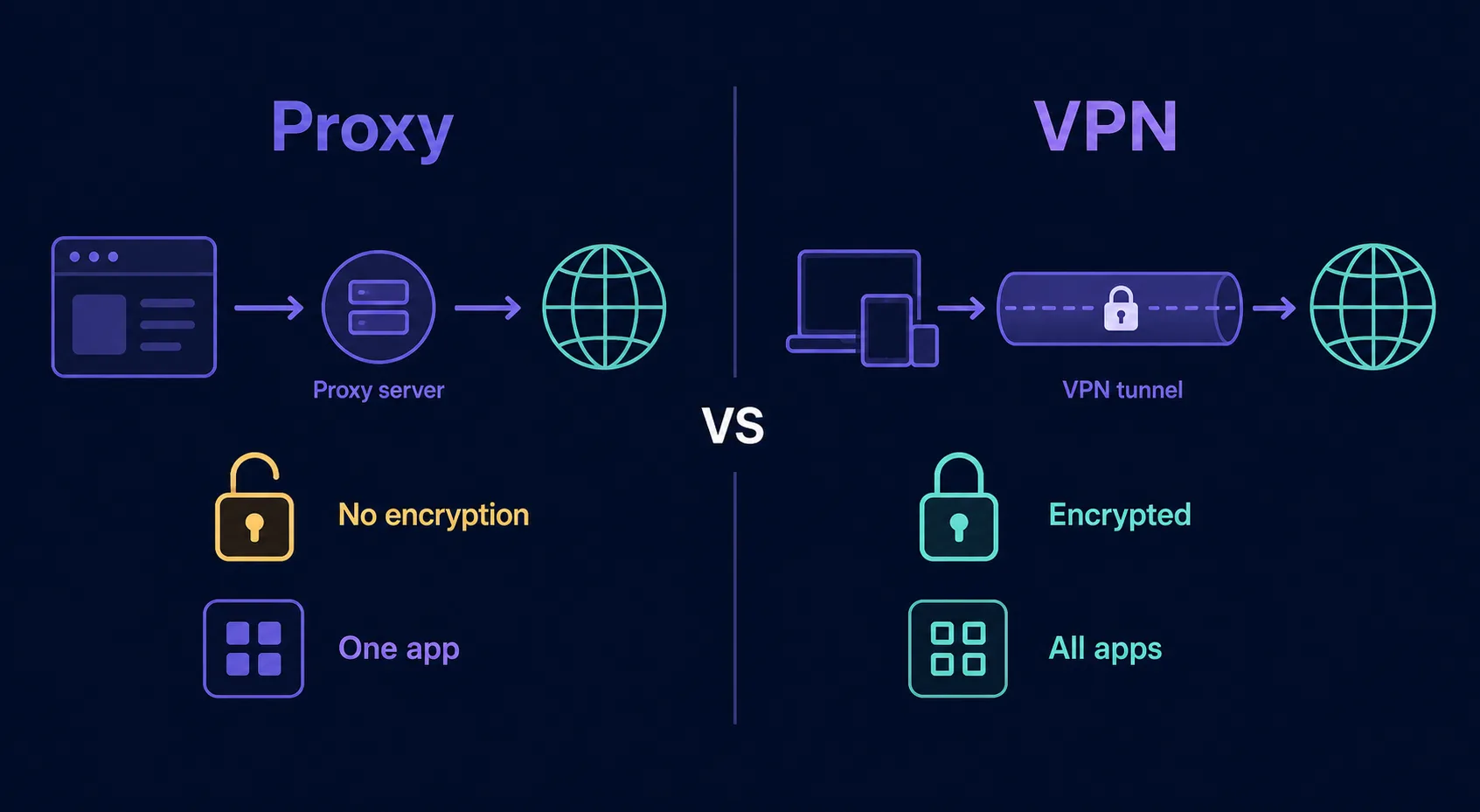
The clearest way to see the difference is to follow your data. With a proxy, only the app you've configured sends its traffic through the proxy server, unencrypted; the rest of your device connects directly. With a VPN, your entire device's traffic enters an encrypted tunnel before it reaches the VPN server and the wider internet.
The core distinction
Both change the IP a website sees. Only a VPN encrypts your connection and covers your whole device. A proxy trades that protection for speed and per-app control.
Encryption: the biggest difference
If you remember one thing, make it this: VPNs encrypt, most proxies don't. When you use a VPN, your traffic is scrambled so that anyone intercepting it sees only gibberish. When you use a standard HTTP proxy, your traffic is relayed as-is — the proxy hides your IP from the destination site, but it doesn't protect the contents of your traffic from your ISP or a snooper on your local network.
There's a nuance: some proxies (HTTPS/SOCKS5 over TLS) do carry encrypted traffic, and a malicious proxy could even see your data. A reputable VPN, by contrast, is built around a verified encryption standard and a no-logs promise. For anything involving sensitive data or untrusted networks, that end-to-end encryption is why a VPN wins.
Scope: one app vs the whole device
The second big difference is coverage. A proxy is surgical: point one browser or one script at it, and only that traffic is affected — ideal when you want, say, your scraper to use a foreign IP while everything else on your machine behaves normally. This per-app control is a feature, not a limitation, for professionals running many isolated tasks.
A VPN is blanket protection: switch it on and every app, background service, and update on your device routes through the tunnel. That's exactly what you want for personal privacy, but it's less convenient when you only need to change the identity of a single tool, or when you want different apps to use different IPs at once.
Speed: which is faster?
Proxies are generally faster, because they don't add the overhead of encrypting and decrypting every packet. For high-volume tasks like scraping thousands of pages, that raw speed and the ability to spread requests across a huge rotating pool of IPs matters enormously — see how proxy rotation works for why. VPNs add a small performance cost from encryption, though on a fast modern provider using protocols like WireGuard it's usually only a few percent — imperceptible for browsing or streaming. In short: proxies win on raw throughput; a good VPN is fast enough that you won't notice the difference in daily use.
When to use a proxy vs a VPN
The right tool comes down to what you're trying to do:
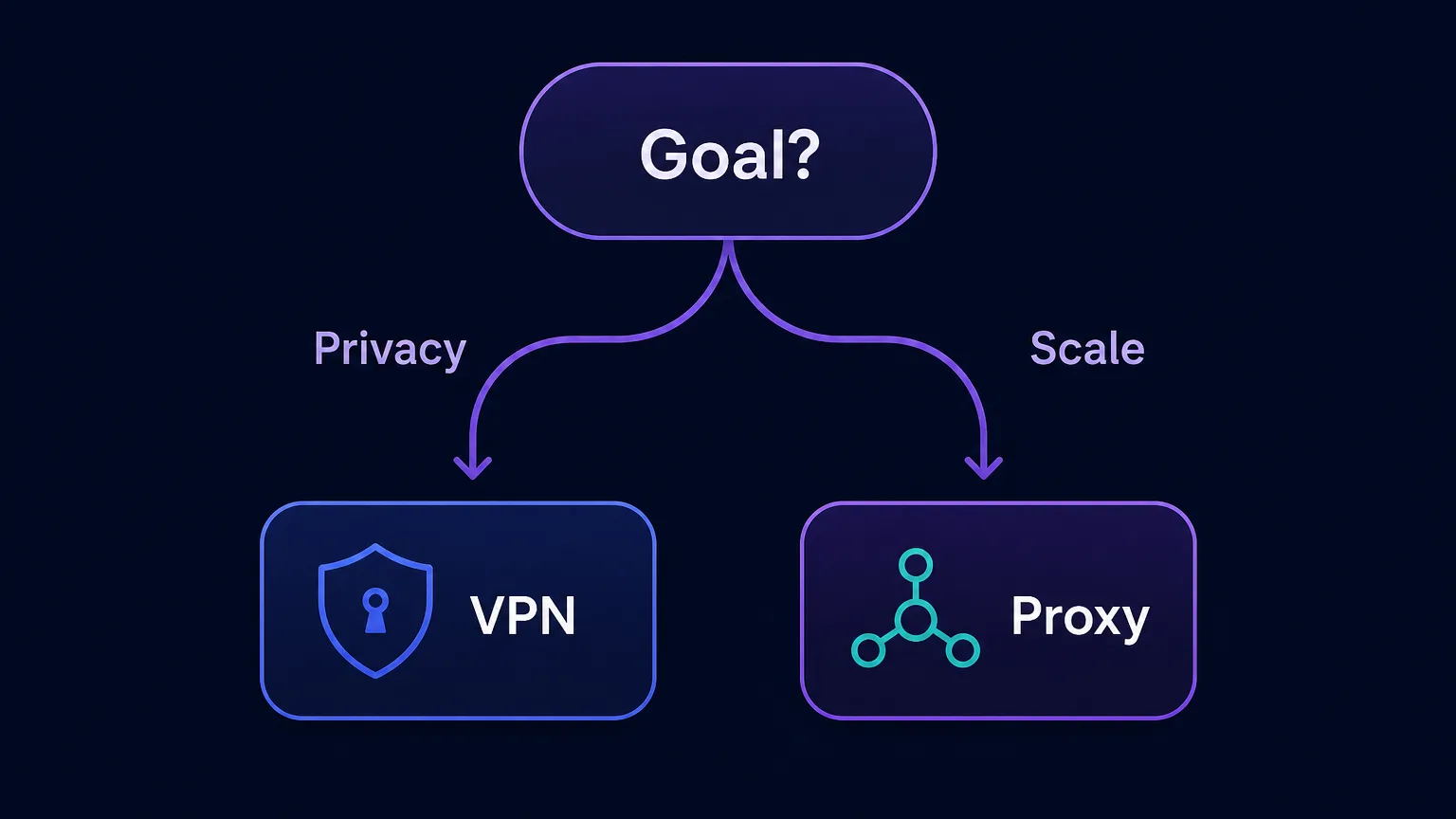
- Use a VPN for everyday privacy, securing public Wi-Fi, stopping your ISP from tracking you, and streaming geo-restricted content on your personal devices — anywhere you want your whole connection encrypted.
- Use a proxy for web scraping, price and market research, running multiple accounts, ad verification, and any large-scale automation where you need many IPs, high speed, and per-app control rather than encryption.
Rule of thumb
If the goal is privacy and security for you, choose a VPN. If the goal is controlling the IP of a tool at scale, choose a proxy. When you're unsure and just want to browse safely, a VPN is the safer default.
Real-world examples
Concrete scenarios make the choice obvious. Imagine you're at an airport and want to check your bank account on public Wi-Fi — that's a VPN job: you want every bit of traffic encrypted so no one on the network can intercept it. The same goes for stopping your ISP from logging your browsing at home, or watching your home streaming library while travelling abroad.
Now imagine you run an e-commerce business and need to track competitor prices across ten countries, collecting thousands of pages a day. That's a proxy job: you want a scraper to cycle through a huge pool of residential IPs at high speed, with each request looking like a different local shopper — encryption is irrelevant, but scale and per-app control are everything. Managing a dozen social accounts, verifying ads by region, or gathering market research all fall in the same camp. The pattern holds: personal protection leans VPN, scaled data work leans proxy.
Which proxy or VPN type should you pick?
Both tools come in varieties worth knowing about. On the proxy side, residential proxies use real home IPs and are hardest to detect, datacenter proxies are fast and cheap, and mobile proxies are the most trusted — our guide to residential proxies covers the trade-offs. On the VPN side, the main variable is the protocol: WireGuard and the providers' own variants (like NordLynx or Lightway) are the modern, fast standard, while OpenVPN remains a battle-tested option. When choosing a VPN, also weigh the no-logs policy, jurisdiction, and how many devices one plan covers. The right sub-type matters as much as the proxy-versus-VPN choice itself: a datacenter proxy and a residential proxy behave very differently, just as a bare-bones VPN and an audited, feature-rich one do.
Can you use a proxy and a VPN together?
Yes, and professionals often do. You can run a proxy inside a VPN connection to get both encryption and per-app IP control, or chain them for extra separation. A common setup pairs a VPN for baseline device encryption with rotating residential proxies inside a scraper or an antidetect browser for the actual data work.
Watch the trade-offs
Stacking a VPN and a proxy adds latency and complexity, and misconfiguration can leak your real IP, so only combine them when you genuinely need both layers. For most people, one or the other is enough — a VPN for privacy, a proxy for scale.
Are proxies and VPNs legal?
In most countries, both proxies and VPNs are perfectly legal tools used every day by businesses and individuals. A handful of nations restrict or ban VPNs, and some services block them, but in the vast majority of places there's nothing unlawful about routing your own traffic through one. As always, legality depends on what you do with the tool: collecting public data or protecting your privacy is fine; committing fraud, breaching a site's terms of service, or accessing systems you're not authorized to use is not — and the proxy or VPN doesn't change that. Choose reputable providers that source their infrastructure ethically, and stay within each platform's rules.
Are free proxies and VPNs safe?
Be very cautious with free versions of either. Free public proxies are typically slow, overcrowded, and often already blocked — and a malicious one can log everything you send through it, since most proxies don't encrypt. Free VPNs are riskier still: running a VPN costs money, so many "free" ones monetize by logging and selling your browsing data or injecting ads, which defeats the entire privacy purpose. There are a few reputable free VPN tiers (usually data-capped), but for anything involving sensitive information or serious data work, a paid, well-reviewed provider is the only safe choice — and the good ones cost only a few dollars a month.
Common misconceptions
- "A proxy is just a free VPN." No — a basic proxy doesn't encrypt your traffic, so it offers far less protection than a VPN despite both hiding your IP.
- "A VPN and a proxy are equally private." Only if the proxy encrypts and is trustworthy. A standard proxy leaves your traffic readable to your ISP and network.
- "VPNs are always slow." Modern protocols like WireGuard trim the overhead to a few percent; you won't notice it for everyday use.
- "You can scrape at scale with a VPN." VPNs offer few shared IPs, so they get blocked fast on defended sites. Rotating proxies are built for that job.
- "A VPN hides you from everyone." It hides your traffic from your ISP and network and your IP from sites, but the VPN provider itself can see your traffic — which is why a trustworthy, audited no-logs provider matters.
The bottom line
Proxies and VPNs solve overlapping but distinct problems. A proxy is a fast, per-app IP-changer built for scale — the right tool for scraping, automation, and multi-account work where you need many addresses and don't need encryption. A VPN is an encrypted, whole-device privacy shield — the right tool for protecting yourself on public Wi-Fi, stopping ISP tracking, and browsing or streaming securely. Choose a VPN when the goal is your own privacy and security; choose a proxy when the goal is controlling a tool's IP at scale; and combine them only when you truly need both. Explore our independent proxy reviews and VPN reviews to find the right one for your use case.
Frequently asked questions
Both hide your real IP, but a VPN also encrypts your traffic and covers your entire device, while a proxy usually just reroutes one app's traffic without encryption. In short, a proxy changes your address for a single app, and a VPN changes your address and secures the whole connection. That encryption and device-wide scope is the defining difference.
Yes, for protecting your data. A VPN encrypts everything so your ISP, network, or an eavesdropper can't read your traffic, whereas a standard proxy leaves it readable and only masks your IP from the destination site. For privacy and public Wi-Fi, a VPN is the safer choice.
Proxies are generally faster because they don't add encryption overhead, which matters for high-volume tasks like scraping across a large rotating IP pool. VPNs add a small cost from encryption, but on a modern protocol like WireGuard it's usually only a few percent — imperceptible for browsing or streaming.
Use a proxy when you need to control the IP of a single app at scale and speed — web scraping, price monitoring, running multiple accounts, or ad verification — where you want many rotating IPs and don't need encryption. Use a VPN when you want to encrypt all your traffic and protect your privacy across your whole device.
Yes. You can run a proxy inside a VPN connection to get both device encryption and per-app IP control, a setup professionals use for scraping and multi-account work. It adds latency and complexity and can leak your IP if misconfigured, so only combine them when you genuinely need both layers.
In most countries both are legal tools used every day, though a few nations restrict VPNs. Legality depends on how you use them: collecting public data or protecting your privacy is fine, while fraud, breaching a site's terms, or unauthorized access is not. Choose reputable providers and stay within each platform's rules.