










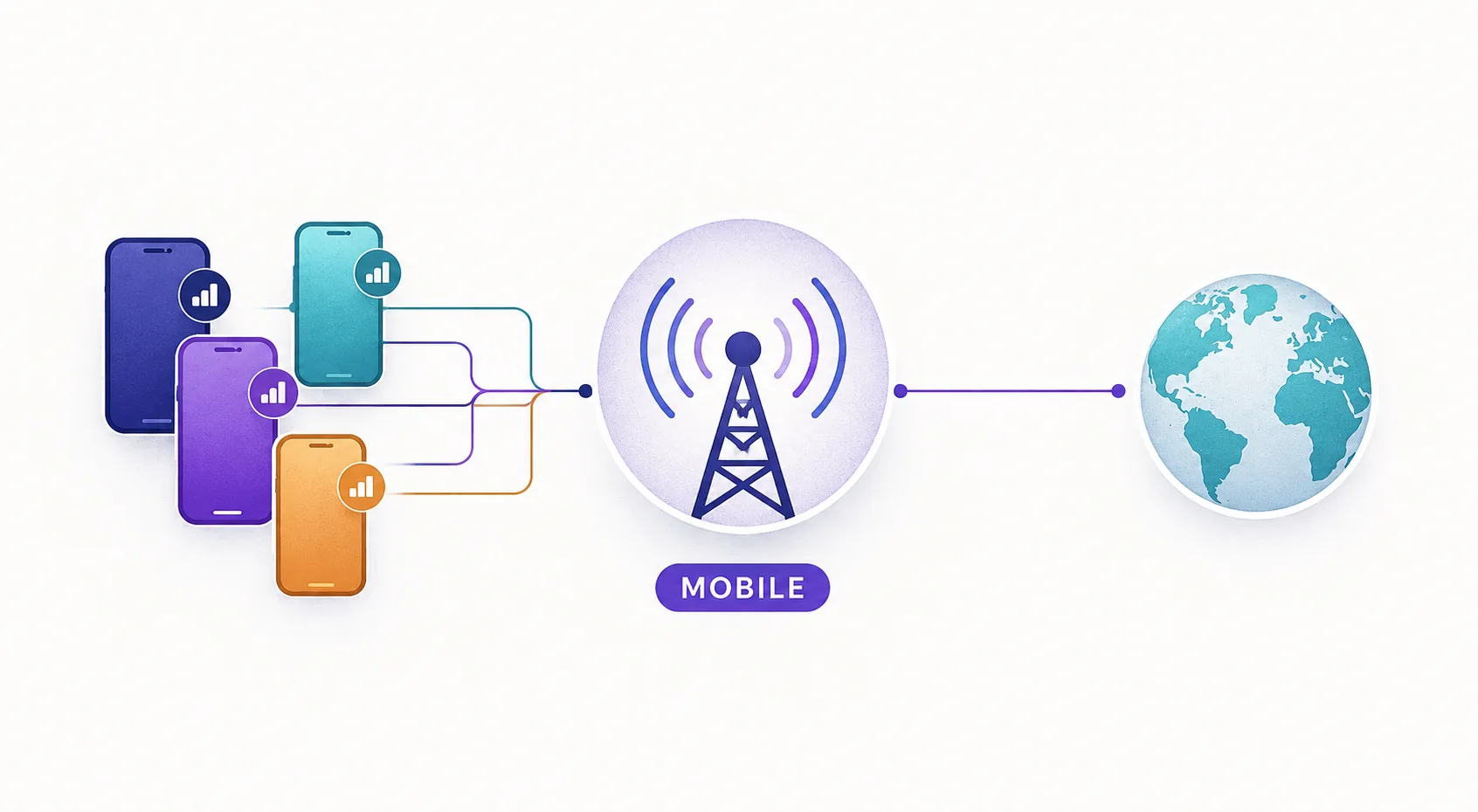
Mobile proxies are the most trusted IP addresses money can buy — and the most expensive. They route your traffic through real 3G/4G/5G connections on carrier networks, which means the address a website sees belongs to Vodafone or T-Mobile rather than a hosting company or a home broadband line. That distinction changes how sites treat you, and on the hardest targets it's the difference between working and being permanently blocked. This guide covers the eight mobile proxy providers we rate highest in 2026, why carrier IPs earn so much trust, what they realistically cost, and — just as importantly — when you genuinely don't need them.
What makes mobile proxies different
The property that makes mobile proxies so powerful isn't speed or pool size. It's carrier-grade NAT (CGNAT). Mobile networks don't have enough IPv4 addresses to give every phone its own, so carriers put hundreds or thousands of real subscribers behind a single public IP.
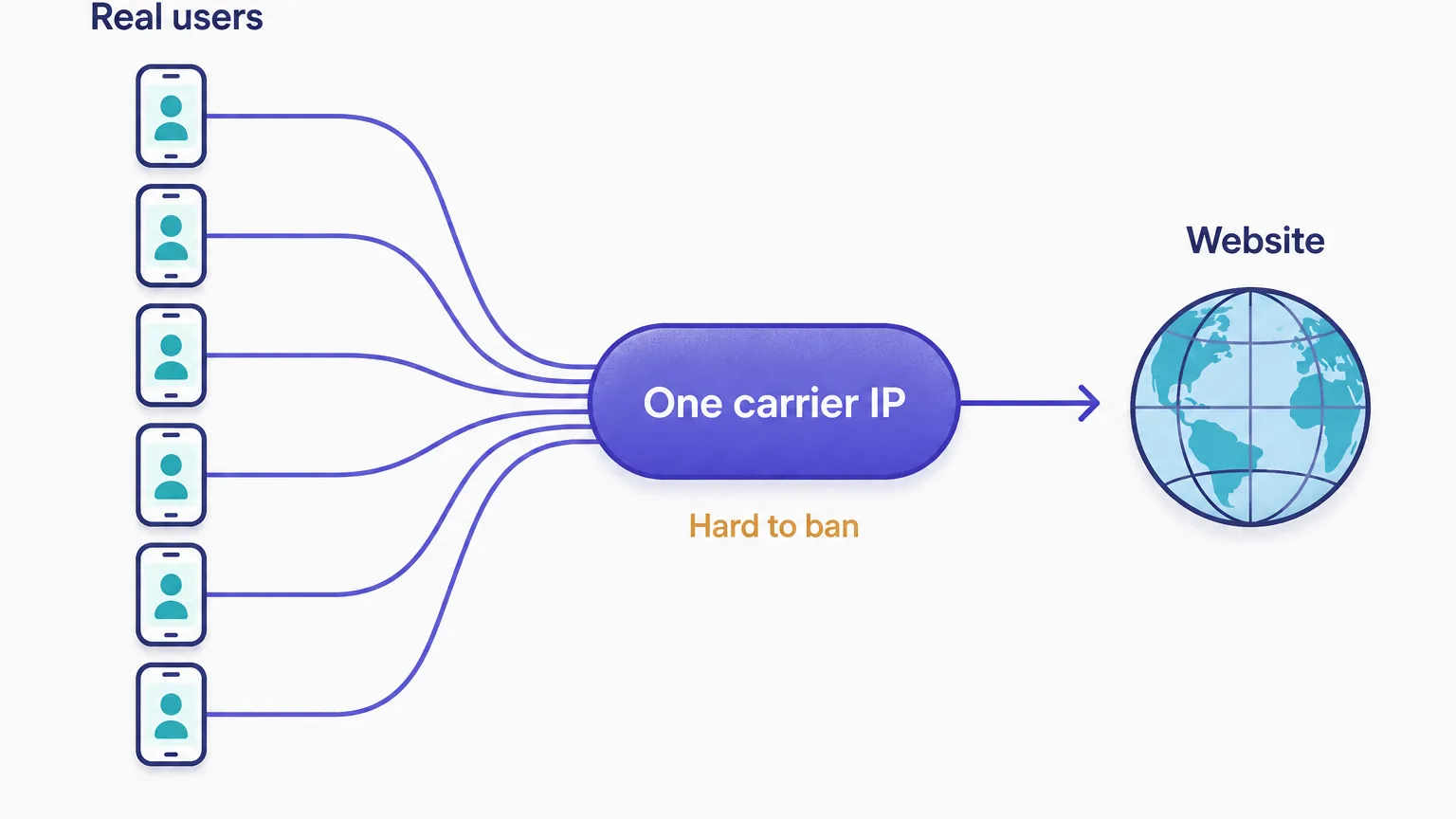
This creates a defensive advantage no other proxy type has. If a website bans a mobile IP because of your traffic, it also bans every genuine customer sharing that address — potentially thousands of real people on their phones. Anti-fraud teams know this, so mobile IPs get graded far more leniently than residential ones and vastly more leniently than datacenter IPs. You're effectively hiding inside a crowd of legitimate users.
Two other properties follow from the architecture. Mobile IPs sit on carrier ASNs, an immediate trust signal that no hosting provider can fake. And they rotate naturally as the network reassigns addresses between towers and sessions, so IP churn looks organic rather than scripted — unlike the deliberate cycling described in our guide to proxy rotation.
Mobile vs residential vs datacenter
Mobile sits at the top of the trust hierarchy, and you pay accordingly:
| Mobile | Residential | Datacenter | |
|---|---|---|---|
| IP source | Cellular carrier (4G/5G) | Home ISP lines | Hosted servers |
| Trust level | Highest | High | Low |
| Ban resistance | Excellent (shared IPs) | Good | Poor |
| Typical cost | $3–10+/GB | $1–8/GB | Under $1/GB |
| Speed | Variable | Moderate | Fastest |
| Pool size | Smallest | Large | Large |
| Best for | Social, app testing | Protected scraping | Easy targets, volume |
Mobile pools are much smaller than they look
Because thousands of subscribers share each address, a mobile network with a huge advertised user base still exposes comparatively few distinct IPs. Providers rarely publish honest mobile-only IP counts, so treat any blended "residential + mobile" pool figure with scepticism — the mobile slice is usually a small fraction of it.
How we evaluated these providers
Mobile proxies are judged on different criteria than residential ones. Raw pool size matters far less; what counts is carrier diversity, how sticky sessions behave, and whether you can control rotation:
- Carrier and ASN diversity — access to multiple real operators per country, not one reseller SIM farm.
- Session control — sticky sessions long enough to hold a login, plus on-demand IP refresh.
- Geographic depth where mobile actually exists, since coverage is far patchier than residential.
- Pricing model honesty — per-GB versus dedicated port, and whether bandwidth expires.
- Sourcing transparency, which matters more here because carrier bandwidth is expensive to obtain legitimately.
Quick comparison
| Provider | From | Countries | Avg. response | Best for |
|---|---|---|---|---|
| NodeMaven | $3.50/GB | 150 | <1s | Best overall |
| Bright Data | $5.04/GB | 195 | 0.7s | Scale & carrier targeting |
| NetNut | $2.95/GB | 195 | 0.6s | Speed & stability |
| Froxy | $2.00/GB | 190 | 0.6s | ASN targeting |
| Proxy-Seller | $2.40 | 200 | <1s | Dedicated ports |
| IPRoyal | $1.75/GB | 195 | 0.6s | Pay-as-you-go |
| GoProxy | $1.80/GB | 195 | 0.6s | Budget breadth |
| SOAX | $4.00/GB | 195 | 0.65s | Ethical sourcing |
1. NodeMaven — best overall for mobile
NodeMaven leads here for the same reason it does well in residential: it treats IP cleanliness as the product. Real-time filtering screens out already-flagged addresses before they reach you, which matters more on mobile than anywhere else because the usable pool is small and a burned carrier IP has few replacements.
Its sticky sessions are unusually long, which suits the account-management work most mobile buyers are doing — dropping identity mid-session on a social platform is how bans happen. Bandwidth doesn't expire on most plans, and city and ISP targeting are granular. At $3.50/GB it's mid-market rather than cheap, and the overall pool is smaller than the incumbents.

Sticky residential and mobile IPs with strong filtering and clean pools.
2. Bright Data — best for scale and carrier targeting
Bright Data operates one of the largest dedicated mobile networks anywhere at roughly 7M+ mobile IPs, and crucially it exposes targeting down to the individual carrier and ASN. If your workflow requires specifically a Verizon IP in Chicago rather than "any US mobile," this is one of very few networks that can reliably deliver it.
The surrounding tooling — Web Unlocker, Scraping Browser — carries over from the residential product, as does the cost profile: premium pricing from $5.04/GB, a dense dashboard, and KYC that can slow onboarding. Platform products bill separately, so model the total before committing.

3. NetNut — best for speed and stable sessions
Mobile connections are inherently more variable than wired ones, so a provider that engineers around that variance is worth paying attention to. NetNut's infrastructure delivers a 0.6s average response and unusually stable sessions, and its product range spans residential, ISP, mobile, and datacenter — useful if you want one vendor across a mixed workload.
Entry pricing around $2.95/GB is competitive, though the best per-unit rates need larger commitments and the dashboard is less polished than some rivals here.

ISP-backed residential proxies built for speed and stability at scale
4. Froxy — best for ASN and city targeting
Froxy's headline feature is precisely the one that matters most for mobile work: city and ASN targeting across 190 countries at $2.00/GB. Being able to pin traffic to a specific carrier's ASN in a specific city is what makes geo-sensitive testing and localised ad verification actually reliable, and few providers at this price point offer that control.
The 10M+ blended pool is modest next to the mega-networks, and as a smaller brand its support depth is less proven than the incumbents — but for targeting precision per dollar, it's the standout.

Residential and mobile proxies with city and ASN targeting
5. Proxy-Seller — best for dedicated mobile ports
Proxy-Seller is the pick when you want a dedicated mobile connection rather than shared rotating bandwidth. Dedicated ports give you a private modem-backed IP nobody else is using, with rotation you control on demand — the model serious account operators typically prefer because it removes the risk of inheriting someone else's damage.
It spans datacenter, ISP, residential, and mobile across 200 countries, so it works as a single-vendor option. Pricing shifts from per-GB to per-port for dedicated mobile, which is usually better value for sustained use and worse for occasional bursts.

Versatile all-rounder spanning datacenter, ISP, residential and mobile.
6. IPRoyal — best true pay-as-you-go
Mobile bandwidth is expensive enough that expiry clocks genuinely hurt. IPRoyal's non-expiring pay-as-you-go traffic from $1.75/GB removes that pressure entirely, which suits the intermittent usage patterns typical of mobile work — heavy for a campaign, dormant for weeks.
Coverage spans 195 countries and a 34M+ blended pool. The catch: there's no free trial, so your first evaluation costs real money, and success rates trail the premium tier on the most aggressively defended targets.

Flexible proxies with true pay-as-you-go.
7. GoProxy — best budget breadth
GoProxy covers residential, ISP, datacenter, and mobile from $1.80/GB across 195 countries with a large 90M+ blended pool — strong breadth for the price if you want mobile available without paying premium rates across your whole workload.
Founded in 2022, it's among the youngest providers here, so it has less operational track record than the established names. Test thoroughly before you build a production pipeline on it.

Broad residential, ISP, datacenter and mobile proxies at competitive rates
8. SOAX — best for ethical sourcing
SOAX foregrounds mobile in its positioning and pairs it with a genuine commitment to ethically sourced, consent-based IPs — which matters more in mobile than any other category, since the cheapest route to carrier bandwidth is usually the least scrupulous one. If your procurement process scrutinises vendors, that transparency is worth real money.
An honest note on the ranking
SOAX carries a mid-tier overall editor score in our directory, below the providers above it. We've included it because ethical sourcing and mobile specialisation are legitimate reasons to choose a provider — but if raw performance is your only criterion, the names higher on this list score better.

Clean, ethically-sourced residential & mobile IPs.
How mobile proxy pricing works
Mobile is sold two ways, and picking the wrong model is the most common way people overspend.
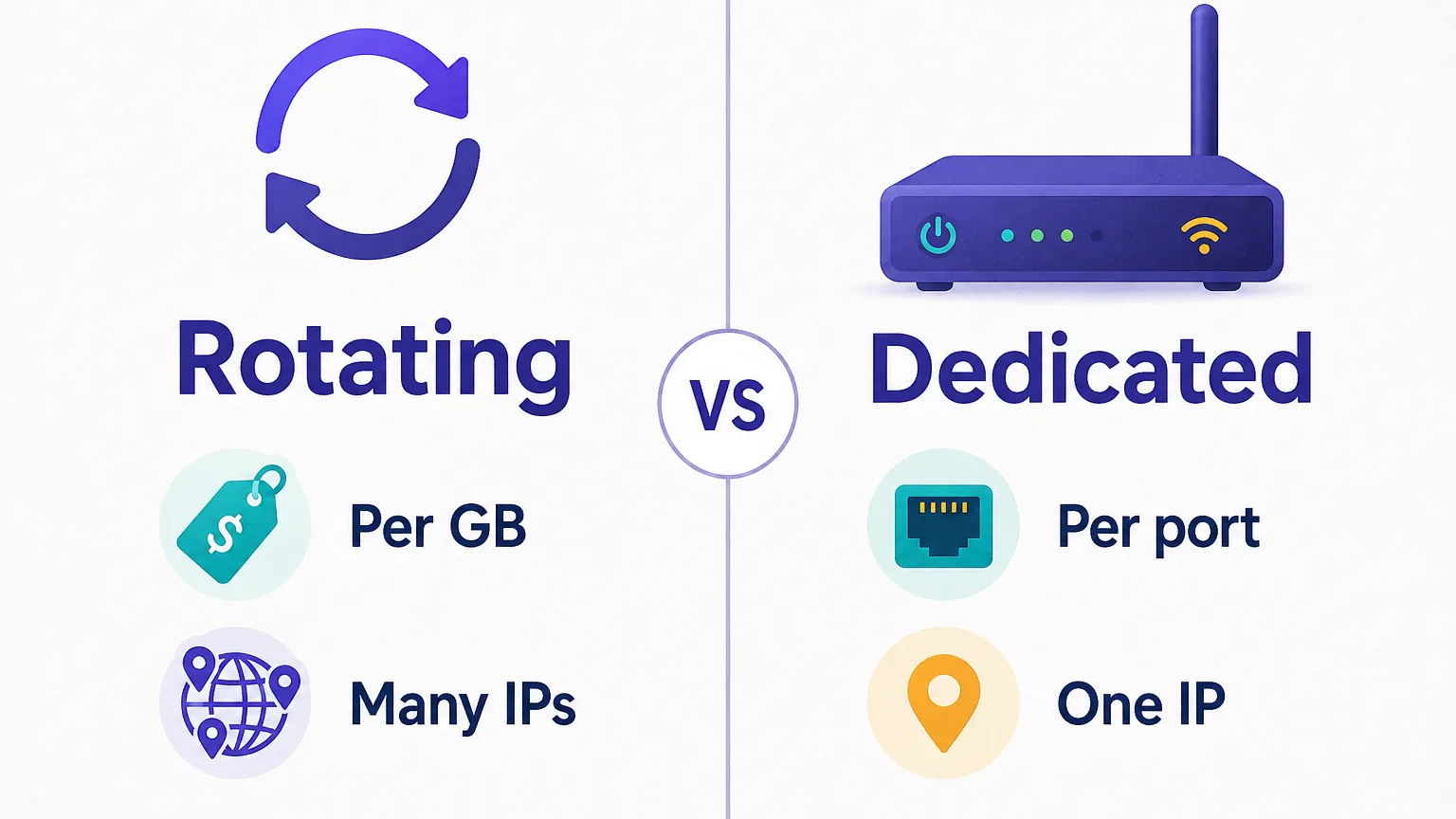
Rotating mobile is billed per gigabyte, typically $3–10+/GB, and gives you access to a shared pool with automatic rotation. It's the right model for scraping and verification work where you want many IPs and don't care which.
Dedicated ports charge a flat monthly fee — often $50–150 per port — for a private modem-backed connection with unlimited or generous bandwidth and rotation you trigger yourself. For sustained account work the maths usually favours this: a single port running continuously is far cheaper than the equivalent gigabytes, and nobody else can burn your IP.
A quick rule for choosing
If you need many different IPs briefly, buy bandwidth. If you need one trusted IP held for a long time, buy a port. Teams running 20 social accounts almost always want ports; teams scraping 100,000 pages want bandwidth.
When you actually need mobile proxies
Mobile earns its premium in a narrow but important set of cases:
- Social media account management. Instagram, TikTok, and Facebook are mobile-first platforms that treat carrier IPs as native and scrutinise everything else harder. This is the single biggest use case — see our guide to proxies for social media automation.
- Mobile app testing. Verifying how an app behaves on real cellular networks across regions requires actual carrier IPs.
- Mobile ad verification. Checking that mobile campaigns render correctly, and catching ad fraud, only works from genuine mobile addresses.
- Targets that block everything else. When residential IPs are already burned on a specific platform, mobile is the remaining escalation.
- Mobile-only content. Some services serve different results, pricing, or features to cellular traffic.
When you don't need them
Most people asking about mobile proxies don't need them, and the honest advice is worth more than the upsell:
- General web scraping. If residential proxies are working, mobile adds cost without adding capability.
- Price monitoring and SEO. Datacenter or residential handles these fine at a fraction of the price.
- Anything high-volume. Mobile bandwidth costs multiples of residential; running bulk collection through it burns budget fast.
- Speed-critical work. Cellular latency is inherently more variable than wired connections.
Escalate, don't start at the top
Work up the ladder: datacenter first, then residential, then mobile only if you're still blocked. Starting with mobile because it's "the best" is the most reliable way to overpay by an order of magnitude for capability you never needed.
Red flags to avoid
- Undisclosed mobile pool sizes. Blended residential+mobile figures hide how few mobile IPs actually exist. Ask for the mobile-only number.
- No carrier information. A provider that can't tell you which operators it has access to probably has one reseller upstream.
- Suspiciously cheap mobile. Carrier bandwidth genuinely costs money. Mobile priced like datacenter usually isn't mobile, or isn't sourced legitimately.
- No rotation control. Being unable to force a new IP on demand is disqualifying for account work.
- Vague sourcing. If a provider won't explain how it obtains cellular bandwidth, assume the answer is unflattering — our piece on ethically sourced proxy IPs covers why this matters.
The bottom line
Mobile proxies buy you the highest trust available, and they buy it through carrier-grade NAT: because thousands of real subscribers share each IP, banning one is expensive for the site, so mobile addresses get graded leniently. For most buyers NodeMaven is the best starting point on clean IPs and long sticky sessions, Bright Data wins when you need specific carriers at scale, and Froxy offers the best ASN targeting per dollar. Choose Proxy-Seller if you want dedicated ports rather than shared bandwidth, and IPRoyal or GoProxy when budget and flexibility lead. Match the billing model to your workload — bandwidth for many brief IPs, ports for one held identity — and be honest about whether you need mobile at all. If residential is still working on your targets, save your money.
Frequently asked questions
A mobile proxy routes your traffic through a real 3G, 4G or 5G cellular connection, so websites see an IP address belonging to a mobile carrier rather than a hosting company or home broadband line. Because carriers place thousands of real subscribers behind each address via carrier-grade NAT, these IPs are treated as the most trustworthy type available.
Carrier bandwidth genuinely costs money to obtain legitimately, and the usable pool of distinct mobile IPs is far smaller than residential because subscribers share addresses. Expect roughly $3-10+ per GB for rotating mobile, or $50-150 per month for a dedicated port. Mobile priced like datacenter proxies is a red flag.
They are more trusted and harder to ban, but not better for every job. Mobile wins on mobile-first platforms like Instagram and TikTok, app testing and mobile ad verification. For general scraping, price monitoring or SEO, residential proxies do the same work at a fraction of the cost.
Buy bandwidth if you need many different IPs briefly, such as scraping or verification work. Buy a dedicated port if you need one trusted IP held for a long time, such as running social accounts. Teams managing around 20 accounts almost always get better value from ports.
Yes. Mobile IPs change naturally as the carrier reassigns addresses between towers and sessions, so rotation looks organic rather than scripted. Most providers also let you force a new IP on demand — the ability to trigger rotation yourself is essential for account work, and its absence is disqualifying.
NodeMaven is the strongest all-round starting point thanks to real-time IP filtering and long sticky sessions from about $3.50/GB. Bright Data is better if you need targeting down to a specific carrier or ASN at scale, and Froxy offers the best ASN and city targeting per dollar at around $2.00/GB.