









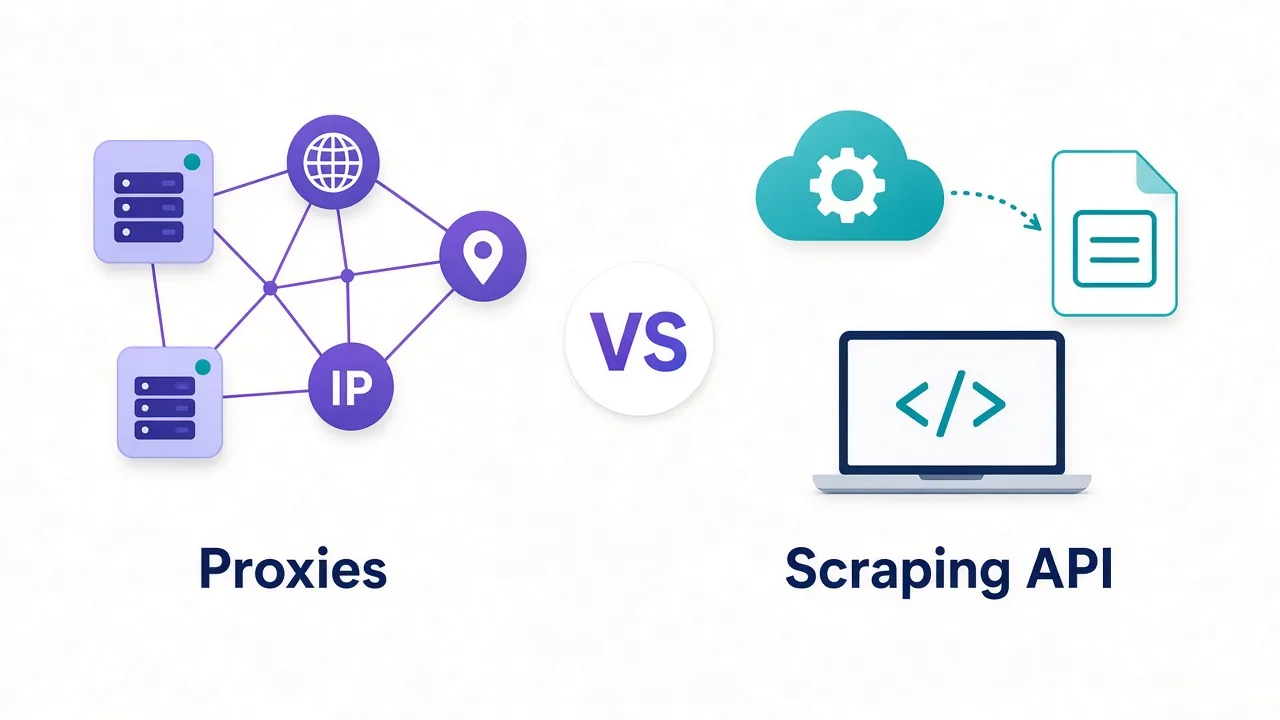
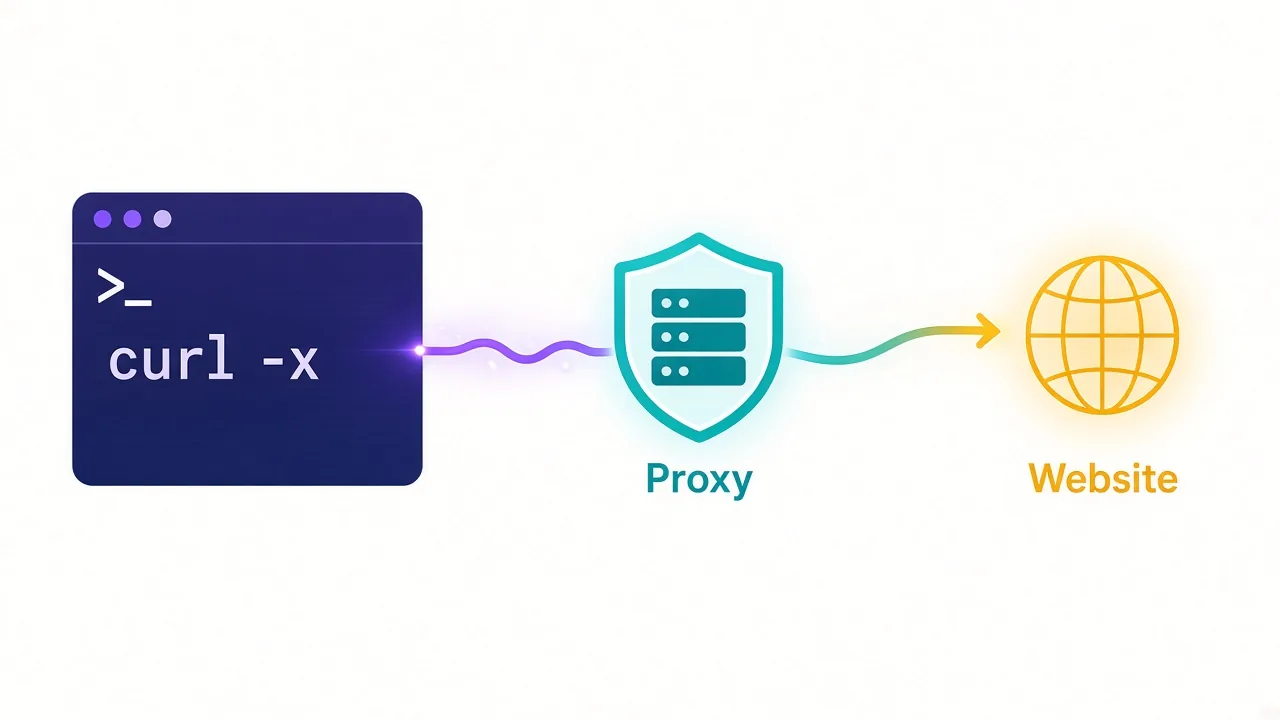
You open Webshare's pricing page and see ten free proxies.
Next you see a $2.99 plan, residential from $3.50, and ISP from $0.30.
Suddenly the "cheap" brand has three different bills, and none of them look like the one you budgeted for.
Sound familiar? Webshare pricing is simple once you know which product line you're on. The free tier, the datacenter list and the residential GB meter are not the same deal.
Here's how Webshare bills in October 2026, what each plan really costs, and when a cheaper or premium alternative fits better.
How does Webshare pricing actually work?
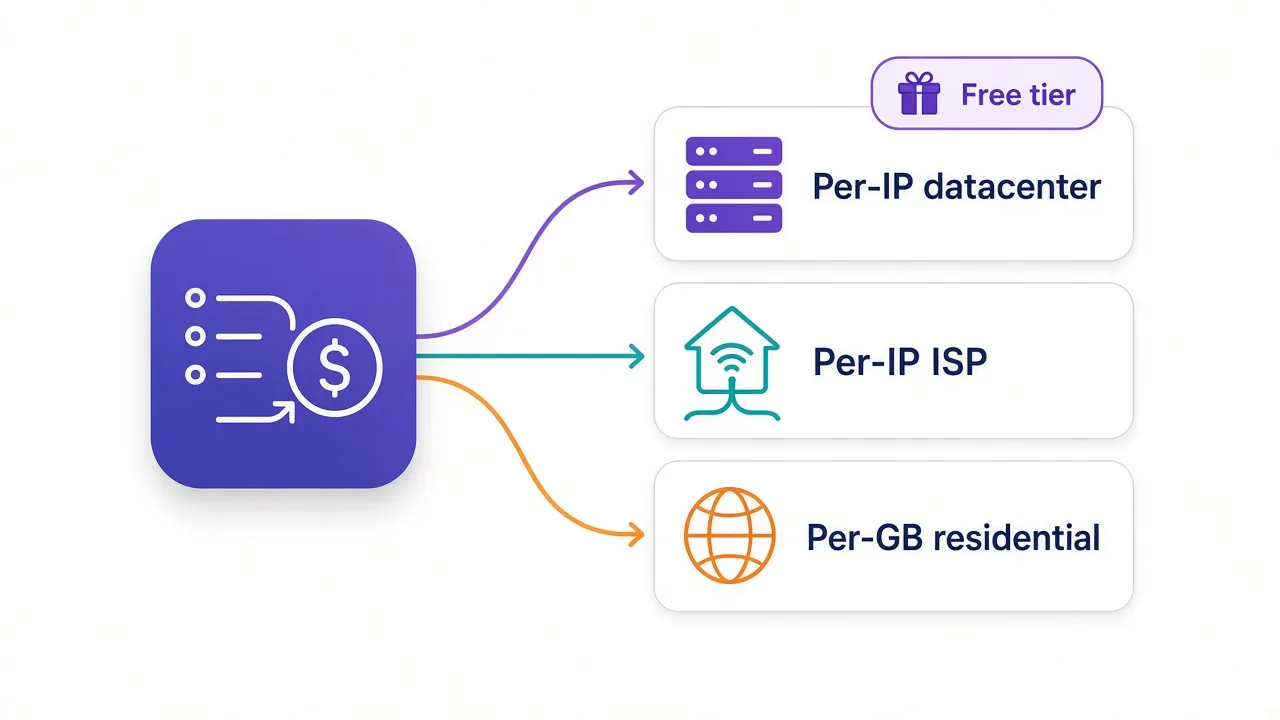
Webshare sells three proxy lines, and each one bills differently.
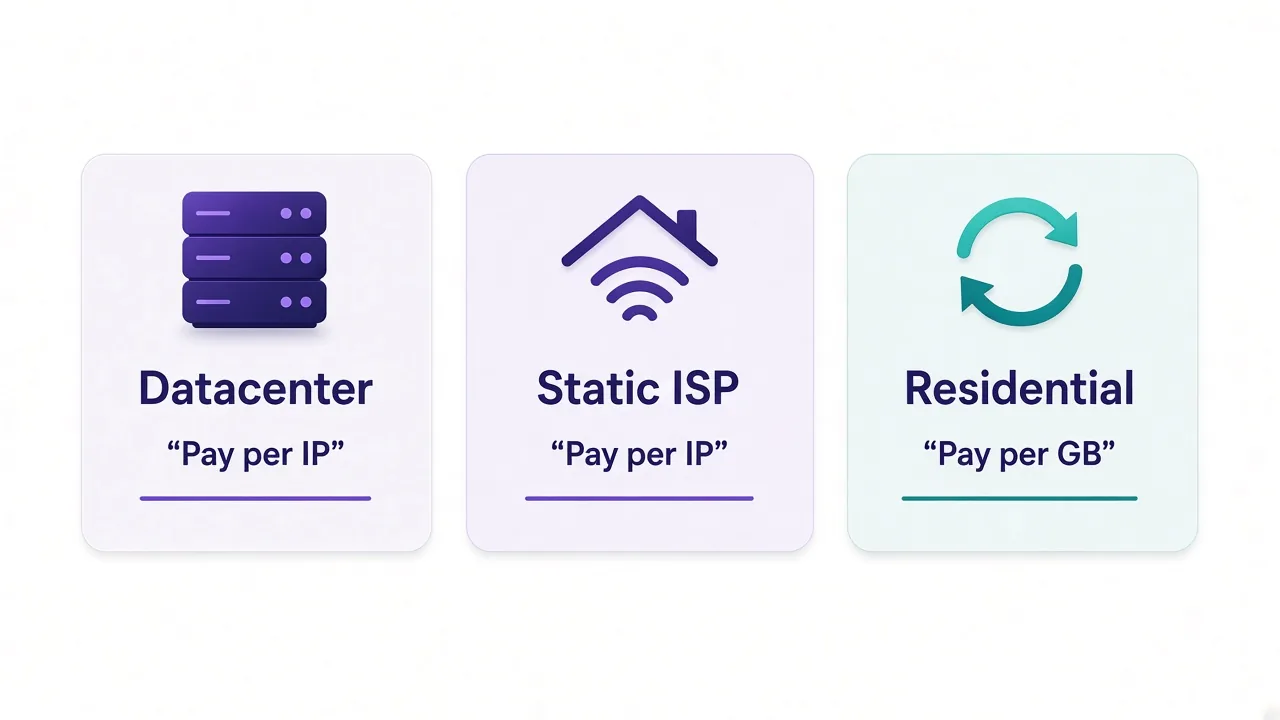
Proxy Servers (datacenter) charge per IP each month. You pick how many proxies you want. Bandwidth sits in a band from 250 GB up to unlimited, subject to their Fair Usage Policy.
Static Residential (also called ISP proxies) also charge per IP each month. The IP stays yours. Bandwidth goes up to unlimited on the same fair-usage rules.
Rotating Residential charge per gigabyte. You buy a monthly GB bucket. IPs rotate from an 80M+ pool, with country, city, state, ZIP and ASN targeting.
So which meter are you on?
If you buy by the IP, unused bandwidth does not refund as cash. If you buy by the GB, unused traffic does not roll into next month on the published plans. Mix those up and your "cheap" month stops looking cheap.
Three product lines, three bills
Datacenter and ISP = pay per proxy. Rotating residential = pay per GB. The free tier is datacenter only.
There's a reason the free tier sits front and centre. We'll come back to what it does and what it quietly doesn't. First, the free plan itself.

The most affordable way to start with proxies.
What's included in the free Webshare plan?
Webshare's free plan is permanent. No credit card. No expiry date on the offer itself.
You get 10 datacenter proxies and up to 1 GB of bandwidth per month. HTTP and SOCKS5 both work. That's enough to wire a scraper, test auth and see if the dashboard fits how you work.
What you do not get is residential traffic, ISP IPs or serious concurrency. One busy crawl will burn the gigabyte. Shared free IPs are also the most reused ones on the network, so tough sites will notice them faster.
Is free still worth starting on?
Yes, if your goal is a smoke test. No, if you already know you need clean residential IPs for Amazon, Instagram or a sneaker drop. In that case skip straight to rotating residential or ISP and budget for it.
As of October 2026, 33 of the 44 published proxy providers in our directory advertise a free trial or free tier.
Webshare's version is unusual because it never expires into a sales call. That's the upside.
The catch is the product type: free means datacenter.
How much do Webshare datacenter proxies cost?
Paid Proxy Server plans start at $2.99 per month for 100 proxies ($0.0299 each). Volume discounts step the per-proxy price down as you buy more.
List prices from Webshare's pricing page as of October 2026:
| Proxies | Price / proxy | Monthly total |
|---|---|---|
| 10 (free) | $0 | $0 |
| 100 | $0.0299 | $2.99 |
| 250 | $0.0299 | $7.47 |
| 500 | $0.0284 | $14.20 |
| 1,000 | $0.0269 | $26.91 |
| 2,500 | $0.0254 | $63.54 |
| 5,000 | $0.0239 | $119.60 |
| 10,000 | $0.0224 | $224.25 |
| 15,000 | $0.0209 | $313.95 |
| 25,000 | $0.0209 | $523.25 |
| 40,000 | $0.0194 | $777.40 |
| 60,000 | $0.0179 | $1,076.40 |
| 100,000 | $0.0179 | $1,794.00 |
At the top end, Webshare lists datacenter from about $0.018 per proxy on its product comparison page. Bandwidth for these plans runs from 250 GB toward unlimited under fair use. Thread caps sit between 500 and 3,000 depending on the tier.
Webshare also splits datacenter into shared, private and dedicated access. Shared is the cheap entry.
Private and dedicated cost more and put fewer (or zero) other customers on your IP.
If a site already flags shared ranges, paying for private often beats buying twice as many shared IPs.
Who is this for? Soft targets, high-throughput jobs and anyone who cares more about cost per request than looking like a home user. For a deeper split on when datacenter fails, see our guide to residential vs datacenter proxies.
What about Webshare static residential (ISP) proxies?
Static residential proxies on Webshare are ISP-issued IPs. Same address every session. Registered to providers like AT&T, Sprint and Cox, not a cloud block.
Entry pricing is $0.30 per proxy, or $6 per month for 20 proxies. That plan includes up to unlimited bandwidth under fair use. There's no free ISP tier.
Volume brings the unit price down. Around 1,000 proxies, Webshare lists about $0.27 each.
The comparison page shows about $0.24 near 3,000 proxies.
By 10,000 proxies the headline rate reaches $0.225 per proxy (25% off the entry rate).
Why pay more than datacenter for a static IP?
Because login flows and account work break when the IP changes mid-session. ISP proxies keep the identity.
They also sit in residential ASN space, so many sites treat them kinder than AWS or DigitalOcean ranges.
Speed can reach up to 1 Gbps on Webshare's ISP marketing page, closer to datacenter than peer-to-peer residential.
The honest trade-off: you're still on a smaller pool than rotating residential.
Webshare cites up to about 60,000 ISP IPs on the comparison page, versus 80M+ rotating. Fine for dozens of accounts. Awkward if you need a fresh home IP on every request.
How much do Webshare rotating residential proxies cost?
Rotating residential is the bandwidth meter. Official list prices as of October 2026:
| Monthly GB | Price / GB | Monthly total |
|---|---|---|
| 1 GB | $3.50 | $3.50 |
| 10 GB | $2.75 | $27.50 |
| 25 GB | $2.60 | $65.00 |
| 50 GB | $2.45 | $122.50 |
| 100 GB | $2.25 | $225.00 |
| 250 GB | $2.00 | $500.00 |
| 500 GB | $1.75 | $875.00 |
| 1,000 GB | $1.50 | $1,500.00 |
| 3,000 GB | $1.40 | $4,200.00 |
Pool size on the residential page is 80M+ IPs across 195 countries, with city, state, ZIP and ASN targeting in the username. Webshare lists uptime at 99.97%.
Is $3.50/GB cheap?
Bright Data starts around $5.04/GB and Oxylabs around $8.00/GB in our directory (October 2026). Webshare's entry residential rate sits mid-low against those.
Against DataImpulse at $1.00/GB pay-as-you-go, it is not the budget king. IPRoyal starts around $1.75/GB with non-expiring traffic.
So Webshare wins on "easy and mid-priced," not on "cheapest GB in the room."
Don't mix the meters
A $2.99 datacenter plan is not "cheaper residential." If the target needs home IPs, budget the GB column, not the proxy-count column.
What drives a Webshare bill up?
List price is the floor. Four things push the real cost higher.
Wrong product line. Buying datacenter for a site that fingerprints hosting ASNs burns money twice: once on the subscription, again on wasted retries.
Concurrency and threads. Plans advertise thread caps between 500 and 3,000.
Push past what your tier allows and you'll hit limits, queue, or need a higher plan. High concurrency add-ons show up on the product comparison page for a reason.
Location and sticky behaviour. Rotating residential lets you pin country, city, ZIP or ASN. Narrow pools mean fewer available IPs.
Sticky-style flows on a rotating product still consume bandwidth while you hold the session.
ISP static avoids that dance, but you pay per IP whether you use it or not.
Fair usage and renewals. "Unlimited" bandwidth on datacenter and ISP plans is subject to Webshare's Fair Usage Policy. Auto-renew is on by default. Miss a renewal payment and Webshare emails a manual checkout link within 48 hours.
One more billing quirk people miss: the refund window is short.
Webshare offers refunds within two days of payment.
Usage must stay under 1 GB on proxy-server or static plans, or under 0.1 GB on rotating residential.
You also need fewer than 1,000 proxies used.
Blow past that and you're in normal subscription territory.
Remember the free-tier tease from earlier? Free exists to prove the dashboard and the API. It is not a permanent substitute for paid residential. Treat it as a lab bench, not a production pool.
Webshare pricing vs cheaper and premium alternatives
Here's a side-by-side using official Webshare list prices and our directory starting prices as of October 2026. Directory figures are starting residential or headline entry rates, not custom enterprise quotes.
| Provider | Best known for | Entry signal (Oct 2026) | Free trial / tier | Editor rating |
|---|---|---|---|---|
| Webshare | Cheap datacenter + free tier | DC from $2.99/100 IPs; res. from $3.50/GB; ISP from $0.30/IP | Yes (10 free DC proxies) | 4.1 |
| DataImpulse | Lowest residential GB | From $1.00/GB | No | 4.1 |
| IPRoyal | Non-expiring residential traffic | From about $1.75/GB | No | 4.2 |
| Smartproxy (Decodo) | Beginner-friendly mid-tier | From about $3.50/GB | Yes | 4.4 |
| Bright Data | Hard targets + unlocker tools | From about $5.04/GB | Yes | 4.3 |
So when does Webshare win on price?
For datacenter volume and ISP entry cost, often. For raw residential dollars per GB, DataImpulse and IPRoyal usually undercut it.
Against aggressive anti-bot stacks, Bright Data and similar premium platforms still charge more for a reason: unlocker tooling and larger clean pools.

Transparent pay-as-you-go residential proxies with no minimums
DataImpulse is the price anchor if your job is straightforward residential scraping and you want pay-as-you-go near $1/GB. Leaner feature set. No free trial in our directory. Fine when you already know the workflow.

Flexible proxies with true pay-as-you-go.
IPRoyal sits a step up. Residential from about $1.75/GB, traffic that does not expire, sticky sessions that can run for days. Better when your projects arrive in bursts and you hate watching unused GB vanish at month-end.

Powerful proxies without the enterprise price tag.
Smartproxy (now Decodo) starts near Webshare's residential entry rate, around $3.50/GB, with a friendlier dashboard and a free trial. Pick it when onboarding comfort matters more than squeezing the last cent per GB. We also keep a longer Decodo alternatives roundup if you're already leaving that ecosystem.

Bright Data is the premium lane. Higher starting price, KYC, Web Unlocker and scraping browser products. Overkill for soft targets. Worth it when CAPTCHAs and bans are the real cost, not the proxy invoice.
Who should buy which Webshare plan?
Use the job, not the marketing badge.
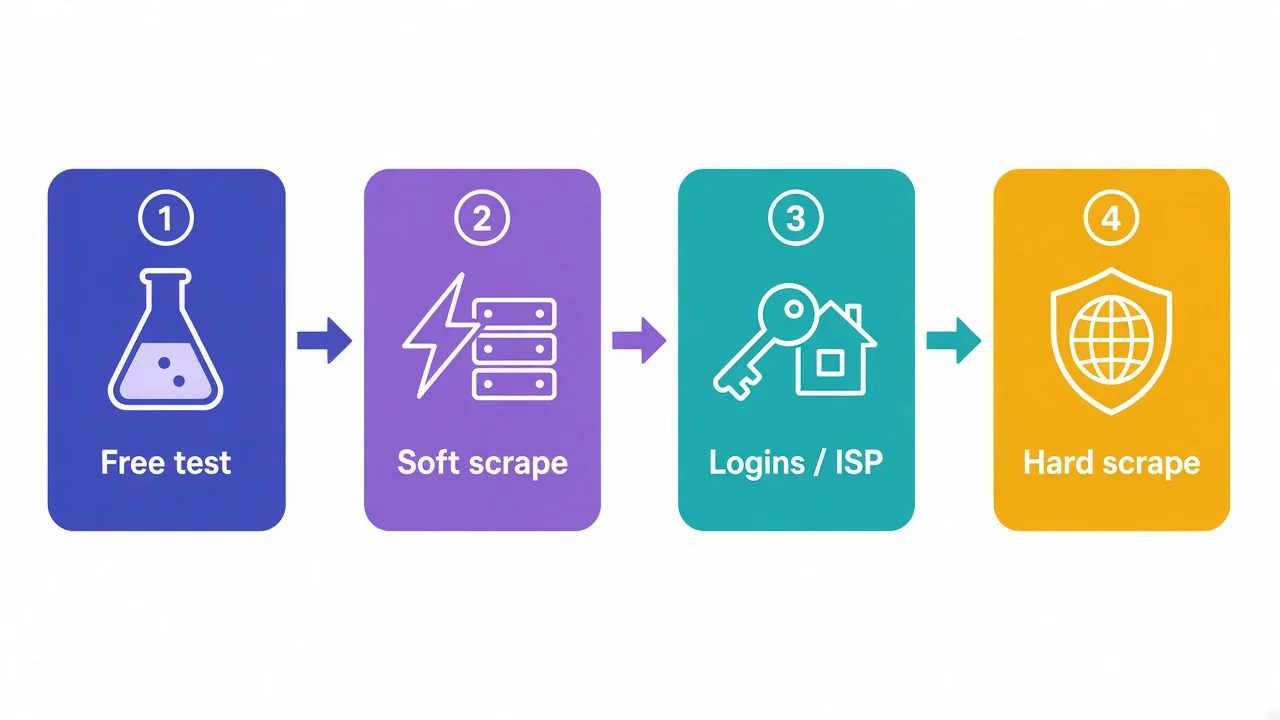
- Learning the dashboard or wiring a first script: free 10-proxy tier.
- Price checks, light SEO, soft sites: paid datacenter from $2.99.
- Account logins, ad verification, long sticky identity: static residential / ISP from $6 for 20 IPs.
- Protected e-commerce, social research, geo tests: rotating residential from $3.50 for 1 GB.
- Heavy residential volume on a tight budget: compare DataImpulse or IPRoyal before you scale Webshare past 100 GB.
- Hardest anti-bot targets: budget Bright Data-class tooling; Webshare alone may not be enough.
Still torn between ISP and rotating?
Ask one question: does the session break if the IP changes? If yes, buy ISP. If you need a new home IP every request, buy rotating and watch the GB counter.
Decision rule
Start with the target site's defence level. Then pick the product line. Only then pick how many IPs or GB.
That closes the loop from the intro: the product line you pick matters more than the headline number on the pricing tile.
The honest catch with Webshare pricing
Webshare builds for self-serve buyers who want speed and a low entry price. That shape creates a few sharp edges.
Support is lighter than enterprise vendors. Our directory notes self-serve docs and dashboard strength, not a dedicated account manager on the cheap tiers.
That's fine if you can read an API page. It's frustrating if you want someone to tune rotation for you.
Residential success on the hardest sites trails premium networks. Webshare's own cons list in our directory calls out the lack of advanced unlocker or CAPTCHA tooling. You're buying IPs, not a scraping platform.
Shared datacenter IPs are easy for mature anti-bot systems to spot. Private and dedicated help, but they cost more per IP. The $2.99 plan is a bargain for soft work. It isn't a stealth package.
And the free tier? Great for learning. Dangerous as a production habit. Ten reused IPs and 1 GB will not carry a real scrape calendar.
None of that makes Webshare a bad buy. It makes it a precise buy. Cheap where datacenter and ISP entry shine. Average where residential GB wars are fought. Light where enterprise hand-holding starts.
So, should you actually buy Webshare?
Buy Webshare if you want a permanent free sandbox, rock-bottom datacenter pricing or ISP IPs from $0.30 without a sales call.
Skip it (or pair it) if your main pain is residential dollars per successful request. DataImpulse and IPRoyal usually win that race. If your pain is CAPTCHAs and bans on locked-down sites, look at Bright Data-class platforms instead.
You don't need the biggest plan on the page. You need the right meter for the job.
Compare live cards in our proxy directory, or start on Webshare's free tier tonight and decide with real traffic tomorrow.
Frequently asked questions
Paid datacenter plans start at $2.99/month for 100 proxies. Static residential (ISP) starts at $0.30/proxy ($6 for 20). Rotating residential starts at $3.50/GB. Prices are Webshare list rates as of October 2026.
Yes — 10 datacenter proxies and up to 1 GB/month, permanently free. No credit card and no expiry. The free tier is datacenter only, not residential or ISP.
On datacenter and ISP entry prices, Webshare is usually cheaper. On residential GB, DataImpulse (from $1/GB) and IPRoyal (from about $1.75/GB) undercut Webshare's $3.50/GB entry, while Bright Data starts higher around $5.04/GB (directory, October 2026).
Datacenter and static residential (ISP) bill per proxy each month. Rotating residential bills per gigabyte in a monthly bucket. Mixing those meters is the most common pricing mistake.
Webshare offers refunds within two days of the original payment. Usage must stay under 1 GB on proxy-server or static plans (or under 0.1 GB on rotating residential), with fewer than 1,000 proxies used.
Match the product line to the job, then pick size. Free datacenter to test; paid datacenter for soft targets; ISP/static for logins; rotating residential when you need home IPs at scale.