








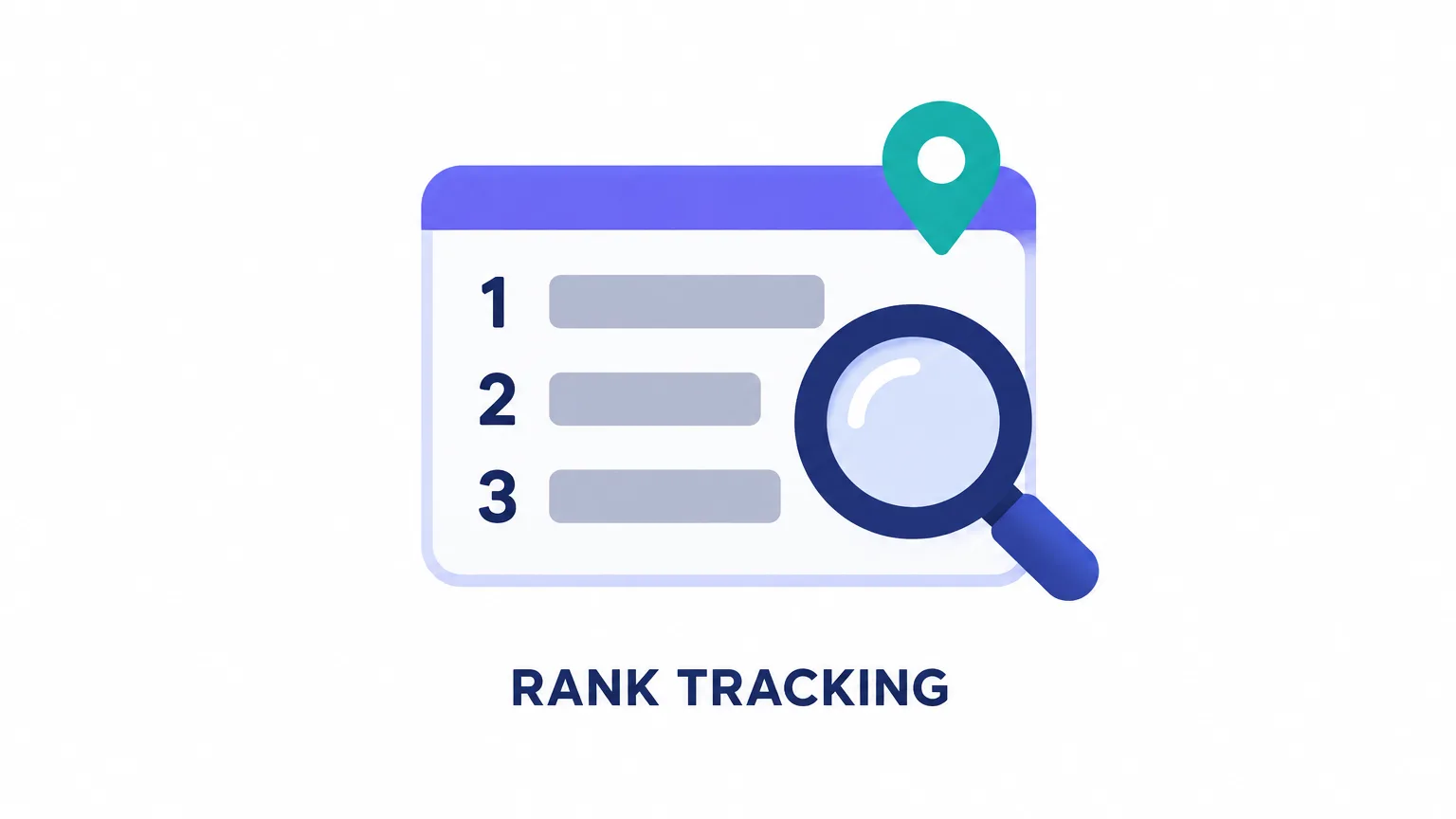
Rank tracking looks simple — search a keyword, record the position — but doing it accurately at scale is one of the hardest scraping jobs there is. Search engines personalise results by location, device, and history, and they defend their result pages aggressively. Check a keyword from the wrong place, or from an IP the engine distrusts, and you don't get an error: you get a plausible-looking ranking that's simply wrong. This guide covers the seven proxy providers we rate highest for SEO tracking in 2026, why location precision decides your data quality, the volume maths that drives your bill, and when a SERP API beats raw proxies.
Why rank tracking needs proxies
Three forces make unproxied rank tracking impossible beyond a handful of keywords.
Volume triggers blocks. Search engines rate-limit by IP aggressively. A few dozen automated queries from one address brings CAPTCHAs; a few hundred brings a block. Any real tracking programme needs its requests spread across many addresses.
Results are localised. The same keyword returns genuinely different results in different countries, cities, and even postcodes — especially for anything with local intent. Without control over where your query appears to come from, you're measuring your office's results, not your customer's.
Results are personalised. Search history, language settings, and device type all shape what appears. Accurate tracking means querying as a neutral, logged-out visitor from a specific place, consistently, every time.
Wrong data is worse than no data
A blocked request is obvious and you retry it. A query answered from the wrong location returns a real ranking for the wrong market, and it flows into your reports looking exactly like a correct one. Bad rank data quietly misdirects content and budget decisions for months.
Location is the whole game
For SEO, the proxy's location isn't a way around blocks — it is the measurement. A client ranking third in Manchester might be eleventh in London and invisible in New York.
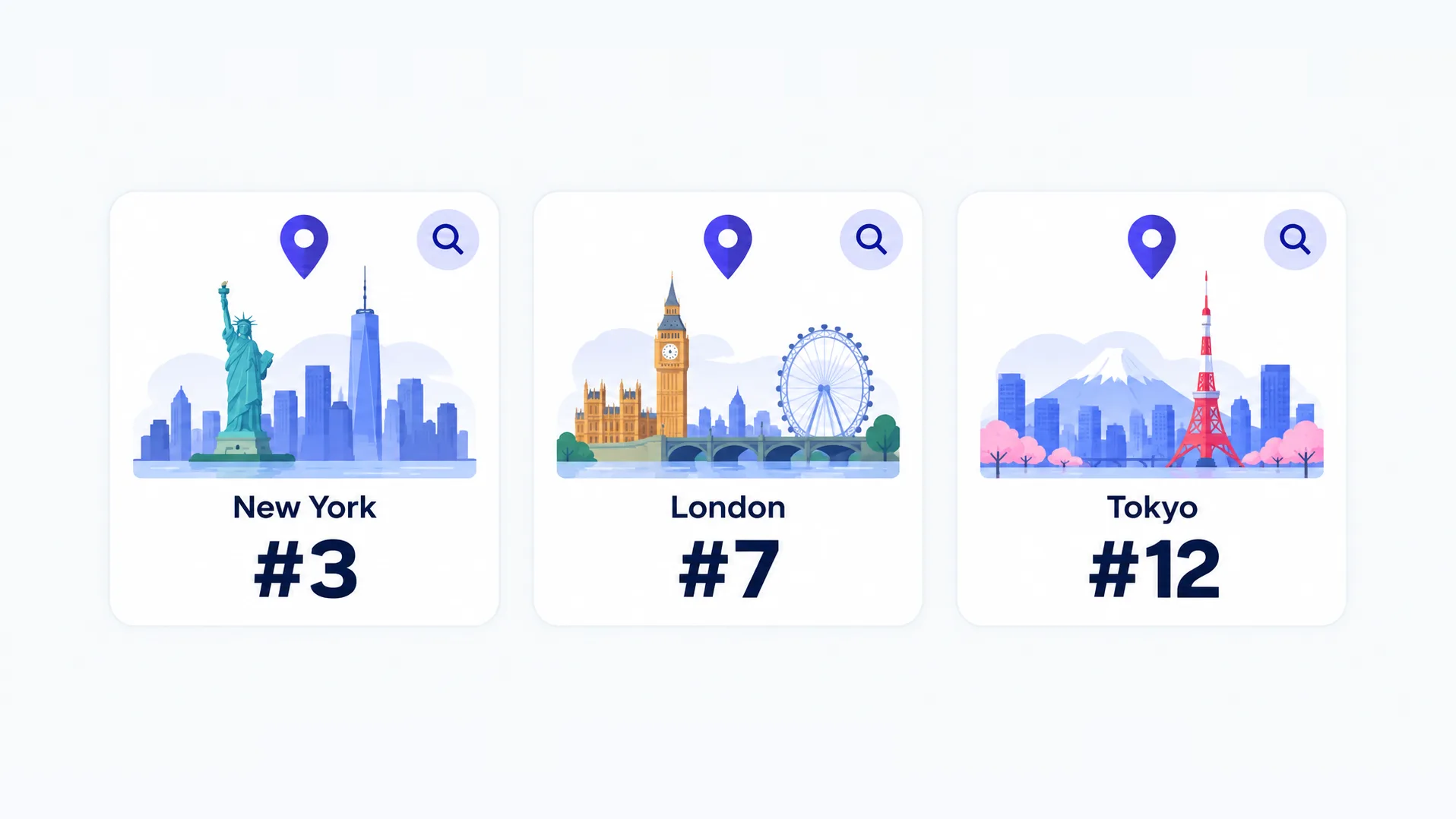
How precise you need to be depends on intent. National keywords usually need country-level targeting. Anything with local intent — "plumber near me", "dentist", any query that triggers a map pack — needs city or postcode precision, because results change street by street. If you track local SEO, the ability to target a specific city or ZIP is not a nice-to-have; it's the difference between a usable dataset and a misleading one.
Match the device, too
Mobile and desktop results differ, sometimes dramatically, and most searches now happen on mobile. Decide which you're tracking, keep it consistent, and label it in your reports — mixing the two in one time series produces rank "movements" that never happened.
Datacenter or residential for SERP tracking?
This is the decision that most affects both cost and data quality, and the honest answer is that it depends on the engine and your volume.
| Datacenter | Residential | |
|---|---|---|
| Cost | Under $1/GB or per IP | $2–8/GB |
| Speed | Fastest | Moderate |
| Blocked by major engines | Quickly, at volume | Rarely |
| Geo precision | Usually country/city | Down to city, ASN, sometimes ZIP |
| Best for | Low volume, lenient engines | Sustained tracking, local SEO |
Datacenter IPs are cheap and fast, and they work for modest volumes and less defended search engines. But the major engines identify hosting ranges easily and throttle them hard, so sustained tracking at scale generally needs residential addresses. The pragmatic setup many teams land on is a mix: datacenter for high-volume, low-sensitivity checks, residential for the keywords and locations that have to be right.
The volume maths that drives your bill
Rank tracking costs are easy to underestimate, because the request count multiplies rather than adds.
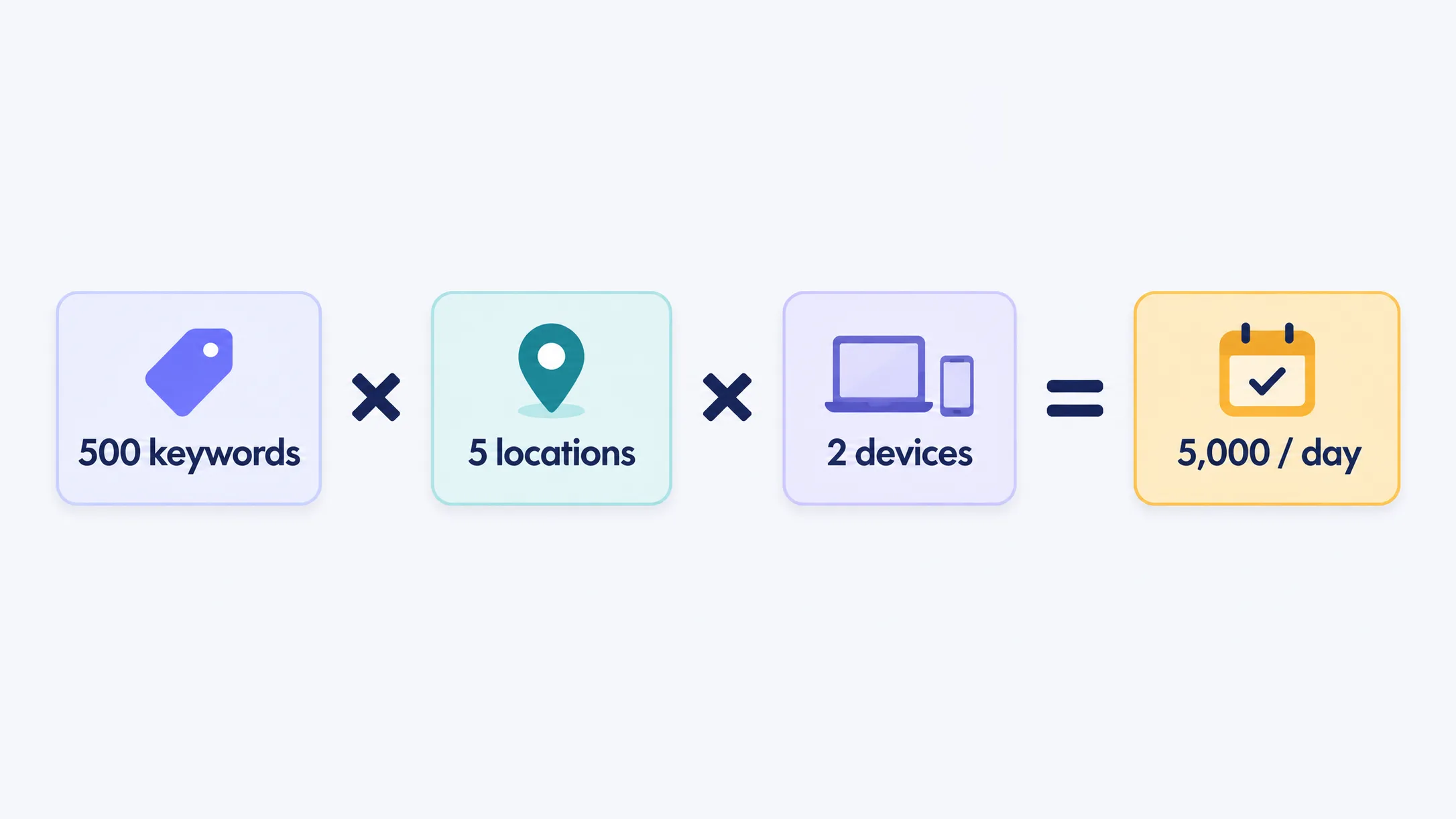
Five hundred keywords tracked across five locations on two device types is 5,000 SERP requests per day, or roughly 150,000 a month. A SERP page with images blocked is around 300–500 KB, so that's in the region of 50–75 GB a month. At $3/GB you're looking at $150–225; at $8/GB, considerably more.
Two levers cut that sharply. Frequency is the biggest: most keywords genuinely don't need daily checks — a volatile head tracked daily and a long tail tracked weekly can halve total volume with no real loss of insight. Payload is the second: block images and unnecessary assets so each request transfers the minimum.
Raw proxies or a SERP API?
You can buy proxies and build your own parser, or buy an API that returns structured results. For SEO work the calculation leans further toward APIs than in most scraping projects, because SERP layouts change constantly — new features appear, snippets get restyled, and every change breaks a parser written against the old markup.
Raw proxies are much cheaper per request and give you full control, but you own the rotation logic, the CAPTCHA handling, and the parsing maintenance forever. SERP APIs cost more per request and return parsed positions and SERP features directly. If you have engineers who already maintain scrapers, buy proxies. If rank data is an input to your work rather than your product, an API usually costs less once you count the maintenance.
The best proxies for SEO tracking
1. Froxy — best overall for rank tracking
Froxy is built around exactly the capability SEO tracking depends on: granular targeting down to city and ASN across 190 countries, with both rotating and sticky sessions, and its listing calls out SEO rank tracking and localized scraping as core use cases. At $2.00/GB with residential and mobile IPs in the same account, it's the most directly suited option here for tracking rankings across many locations without overpaying.
Its 10M+ pool is modest next to the enterprise networks, and as a smaller brand its support depth is less proven — but for location-accurate rank data per dollar, it leads.

Residential and mobile proxies with city and ASN targeting
2. Oxylabs — best for enterprise SERP volume
Oxylabs pairs a 100M+ residential network with dedicated SERP scraping products, which matters when you need structured search results rather than raw HTML at serious scale. SOC 2 compliance and account management suit agencies whose clients ask procurement questions, and success rates on defended targets are among the best available.
It's the most expensive option here at $8.00/GB with scraper APIs billed separately — check our Oxylabs pricing breakdown before modelling costs.

Premium proxies built for enterprise scraping.
3. Bright Data — best for tooling and coverage
Bright Data offers a dedicated SERP API alongside its 72M+ residential network, with targeting down to city and ASN or carrier and 99.99% uptime. Web Unlocker handles CAPTCHAs and blocks automatically, which removes most of the anti-bot work from a tracking pipeline. For international programmes spanning many countries, its coverage is hard to beat.
Premium pricing from $5.04/GB, a dense dashboard, and KYC onboarding are the trade-offs.

4. Smartproxy — best value all-rounder
Smartproxy (rebranding as Decodo) hits the balance most in-house SEO teams need: a 55M+ residential pool across 195 countries with city and ASN targeting, ready-made scraping APIs including search, the fastest average response here at 0.55s, and a free trial — all from $3.50/GB. Speed matters more than usual when you're re-querying thousands of keywords on a schedule.
Its pool is smaller than the enterprise networks, and the very hardest targets can trail the top tier.

Powerful proxies without the enterprise price tag.
5. Nimble — best managed SERP pipeline
Nimble goes furthest toward removing engineering work: AI-driven unblocking plus managed SERP and Maps APIs that return structured data rather than pages to parse. For teams that want rank data as a feed rather than a scraping project — and especially those tracking map-pack results — that trade is often worth the platform pricing.
It's more than you need if all you want is rotating IPs, and pricing is premium at around $8.

AI-driven web data platform with residential proxies and managed data pipelines
6. MangoProxy — best for local and ZIP-level tracking
MangoProxy's standout for SEO is free country, state, city, ZIP, and ASN targeting across a 90M+ pool in 180 countries, at $2.00/GB with a 0.5s average response. ZIP-level precision is exactly what local SEO and map-pack tracking need, and many providers either can't do it or charge extra for it.
There's no free trial, and its pool is Brazil-heavy, so verify coverage in your specific target markets before committing.

Residential, ISP, datacenter and mobile proxies with a Brazil-heavy 90M+ pool
7. ScraperAPI — best simple drop-in
ScraperAPI handles rotation, retries, and CAPTCHAs behind a single endpoint, priced from $0.30 and integrated with roughly a one-line change. For teams that want to stop maintaining anti-bot logic and just receive pages, it's the lowest-friction option here.
Its coverage spans about 50 countries, noticeably narrower than the residential networks — check your target markets are included before you commit to it for international tracking.

Web scraping API with automatic proxy rotation, retries and CAPTCHA handling
Comparing the picks
| Provider | From | Geo precision | Countries | Best for |
|---|---|---|---|---|
| Froxy | $2.00/GB | City, ASN | 190 | Best overall |
| Oxylabs | $8.00/GB | City | 195 | Enterprise volume |
| Bright Data | $5.04/GB | City, ASN | 195 | Tooling & coverage |
| Smartproxy | $3.50/GB | City, ASN | 195 | Value all-rounder |
| Nimble | ~$8 | City | 195 | Managed SERP feed |
| MangoProxy | $2.00/GB | City, ZIP, ASN | 180 | Local & map pack |
| ScraperAPI | $0.30 | Country | 50 | Simple drop-in |
Getting accurate rank data
- Pin each tracked location to its own proxy pool. A London ranking must be queried from a London IP every time, or your time series mixes markets.
- Always query logged out. A signed-in session returns personalised results that reflect one account's history, not the market.
- Keep device type consistent and track mobile and desktop as separate series rather than one blended number.
- Rotate per request. Rank tracking has no identity to preserve — unlike account work, you want each query to look like a different visitor, as covered in our guide to proxy rotation.
- Query at a consistent time. Results shift through the day; sampling at the same hour makes your series comparable.
- Verify the exit location with our IP lookup tool before a big run, and spot-check rankings manually from a real browser in that market.
- Throttle. Aggressive querying burns IPs and invites blocks; pacing is cheaper than replacing a flagged pool.
Mistakes that corrupt rank data
- Country-level targeting for local keywords. A national IP can't tell you how you rank in a specific city's map pack.
- Letting the proxy pick the location. "Any US IP" produces results from wherever the pool happens to route you, which is not a stable measurement.
- Mixing mobile and desktop in one series, then reporting phantom movements.
- Ignoring silent failures. A blocked or soft-served page can parse into "not ranking" — monitor your success rate, not just your output.
- Using datacenter IPs at volume on major engines. They get throttled quickly, and partial data skews everything downstream.
- Tracking everything daily. Frequency multiplies cost directly; tier your keyword list instead.
If your success rate is falling over time rather than suddenly, the cause is usually accumulating IP reputation damage — our guide on why proxies get banned covers the patterns behind it.
Is scraping search results legal?
Collecting publicly visible search results is common industry practice — every rank tracker, SEO platform, and visibility report is built on it, and the data involved is public rather than personal. The nuances are practical rather than criminal: search engines' terms of service generally restrict automated querying, so scraping can breach a contract even where it breaks no law. Keep request rates modest so you're not burdening the service, collect only public result data rather than anything personal, and use a provider that sources its IPs transparently — the reasoning in our piece on ethically sourced proxy IPs.
The bottom line
SEO tracking asks a proxy for something specific: not just access, but the ability to ask a search engine a question from a precise place, repeatedly, without being throttled. Froxy is our top pick for combining city and ASN targeting with fair $2.00/GB pricing and explicit rank-tracking focus. Step up to Oxylabs or Bright Data when volume, coverage, or SERP tooling justify premium rates, choose Smartproxy for the best all-round value, and Nimble when you'd rather receive a structured feed than maintain parsers. For local SEO and map-pack work, MangoProxy's ZIP-level targeting is the differentiator; for the simplest integration, ScraperAPI. Whatever you choose, pin each location, query logged out, keep device type consistent, and spot-check against a real browser — a rank number that looks reasonable but came from the wrong place is the most expensive kind of error in SEO reporting.
Frequently asked questions
Froxy is our top pick, combining city and ASN targeting across 190 countries with fair $2.00/GB pricing and an explicit focus on rank tracking. Oxylabs and Bright Data are stronger at enterprise volume with dedicated SERP products, while Smartproxy offers the best all-round value.
For sustained tracking on major search engines, usually yes. Datacenter IPs are cheaper and faster but get throttled quickly at volume because hosting ranges are easy to identify. Many teams use a mix: datacenter for high-volume low-sensitivity checks and residential for keywords and locations that must be accurate.
That is usually correct behaviour rather than a bug. Search results are localised, so the same keyword genuinely ranks differently by country, city and even postcode, and mobile results differ from desktop. The problem case is a proxy that lands in an unintended location, which returns a real ranking for the wrong market.
A SERP page with images blocked is roughly 300-500 KB. Tracking 500 keywords across five locations on two devices is about 5,000 requests a day, or 50-75 GB a month, which costs roughly $150-225 at $3/GB. Tiering how often you check each keyword is the biggest lever on that bill.
If rank data is an input to your work rather than your product, usually yes. SERP layouts change constantly and break parsers, so an API that returns structured positions removes ongoing maintenance. Raw proxies are far cheaper per request and make sense if you already have engineers maintaining scrapers.
Collecting publicly visible search results is standard practice across the SEO industry, and the data is public rather than personal. Search engines' terms generally restrict automated querying, so it can breach a contract even where no law is broken. Keep request rates modest, collect only public result data, and choose a provider transparent about IP sourcing.