









You are already on Bright Data, or one quote away from signing.
Then finance asks why residential sits near the top of the market. Or a teammate says Oxylabs and Smartproxy clear the same targets for less.
Sound familiar? Bright Data is still the enterprise default for hostile sites and heavy tooling. It isn't the only serious option.
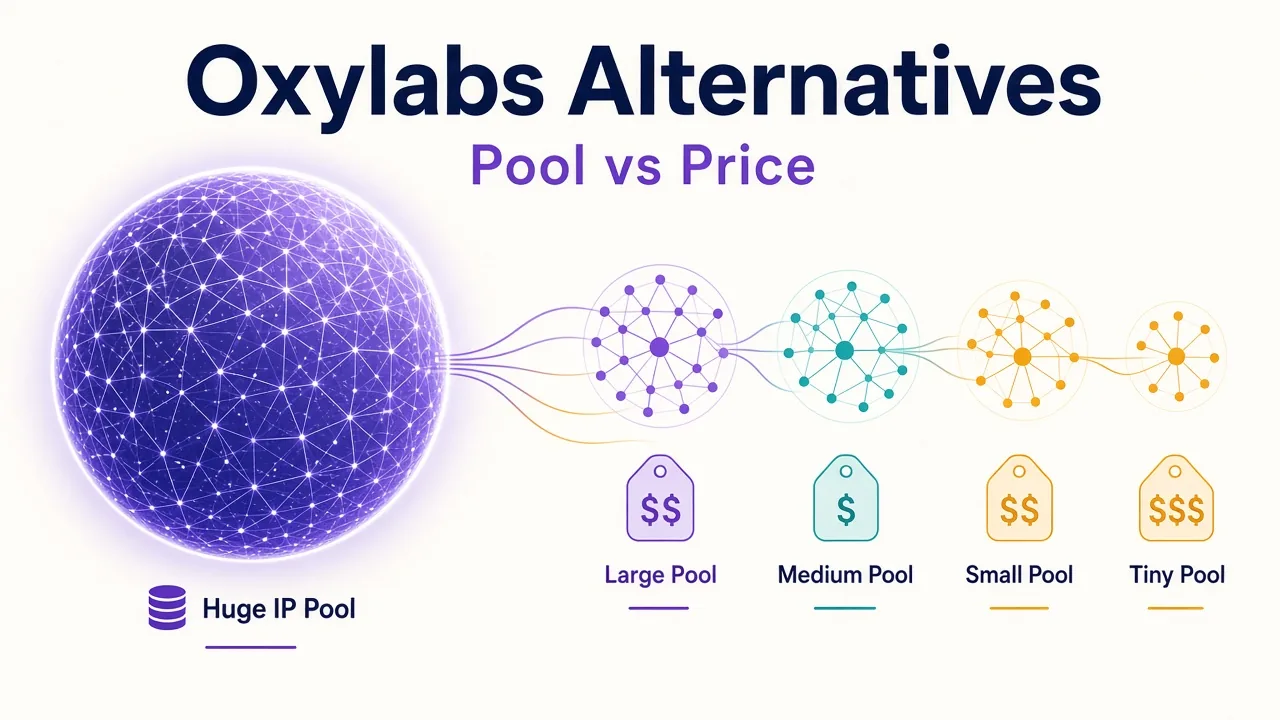
As of October 2026, our proxy directory lists 44 published providers. Several match Bright Data on pool quality, pricing model, unblock rates, or tooling. Rarely all four at once.
So which Bright Data alternatives are worth comparing, and which ones only look cheaper until your success rate drops?
We'll start with why teams leave, then walk the real shortlist.
Why teams look past Bright Data in the first place
Bright Data wins on scale. The directory lists a 72M+ residential network, broad country coverage, and platform products like Web Unlocker and the Scraping Browser.
That package is exactly why enterprises stay.
It's also why smaller teams feel stuck. Per-GB rates sit at the premium end. The dashboard has a real learning curve. KYC can slow a first trial.
If you only need sticky residential for account work, you're paying for a data platform you barely open.
If you scrape soft targets, you may not need residential at all. A strong datacenter pool can do the job for pennies.
The catch most switchers miss? A lower sticker price doesn't always mean a lower bill.
We'll get to that trap. First, pin down what "alternative" has to mean.
What a Bright Data alternative actually has to match
People search "Bright Data alternatives" and expect one winner. There isn't one.
Bright Data sells several products under one brand. Residential, ISP, mobile, datacenter, plus unlocker-style APIs. An alternative only helps if it matches the job you run today.
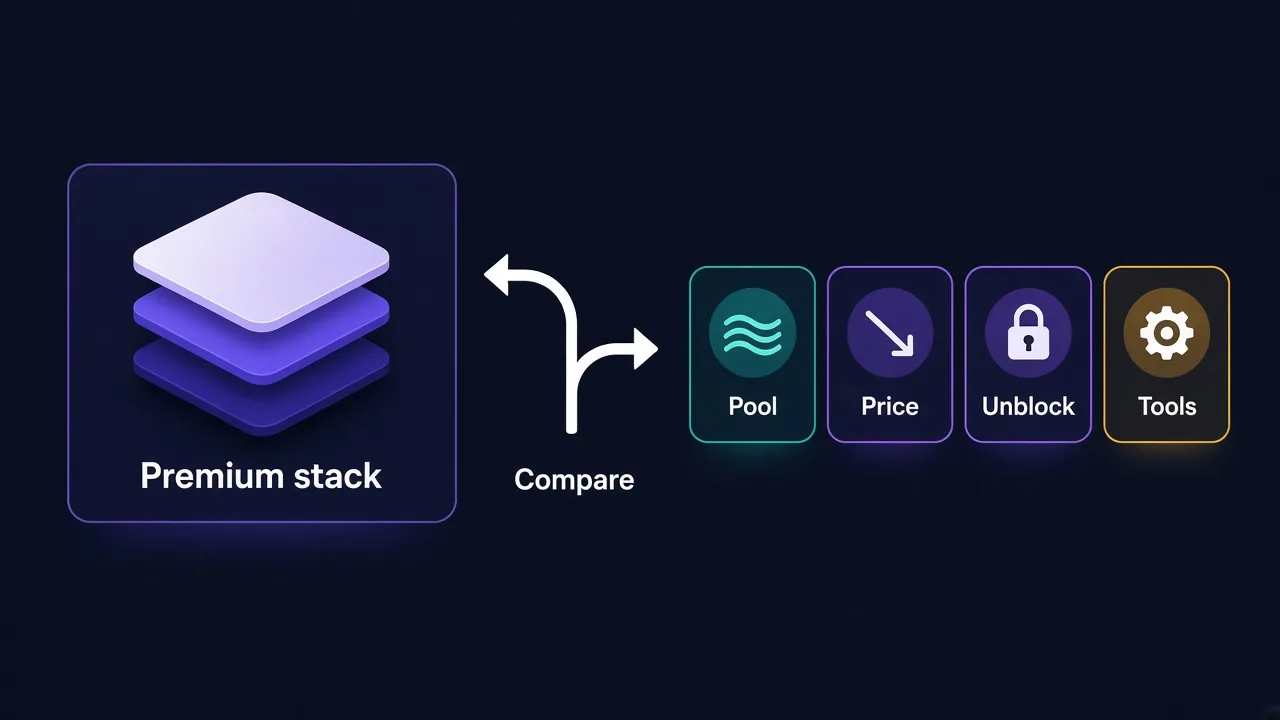
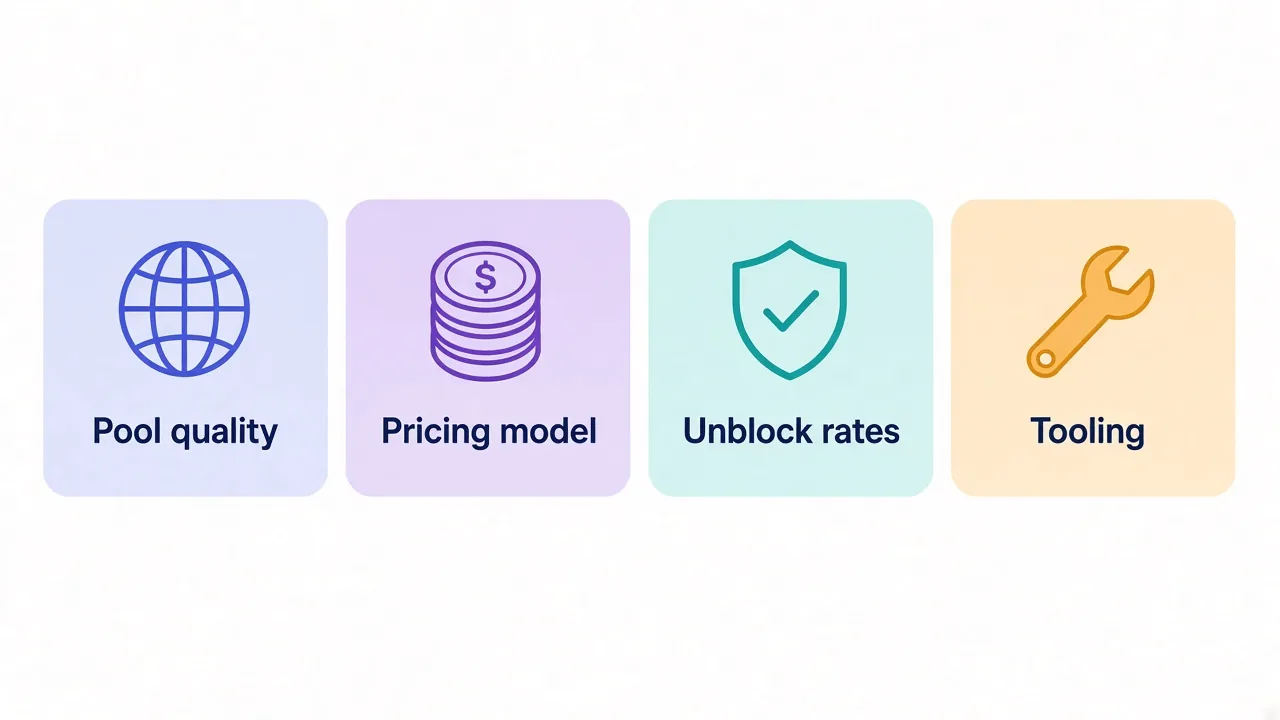
Compare four pillars, not vibes:
- Pool quality: size, freshness, geo depth, and how noisy the shared ranges feel
- Pricing model, from pay as you go to commits and whether unused GB expire
- Unblock rates on your targets, not a blog leaderboard
- Tooling depth, from raw proxies to scraper APIs and unlockers that cut ops work
Our directory's own alternatives map for Bright Data points first to Oxylabs as the closest enterprise rival. That matches how most large teams shop.
For mid-market and budget buyers, the shortlist widens fast. Think Smartproxy (now Decodo), NetNut, SOAX, and IPRoyal. Quality-focused picks like NodeMaven and Live Proxies belong there too.
Quick rule
Match the pillar you are failing on. Paying less per GB while burning twice the retries is not a win.
Ready for the enterprise twin?
Oxylabs: the closest enterprise rival
If Bright Data feels right except for a second vendor option, start here.
Oxylabs is the provider most teams put on the same slide. The directory lists a 100M+ residential pool, strong success rates on defended targets, and SOC 2 paperwork security teams like.
You'll also get scraper APIs and AI-assisted proxy management. That matters when rotation tuning eats engineering time.
Best for: high-volume collection where uptime and support beat sticker price.
Honest drawback: residential starts near the top of the market (about $8/GB in our listing). Casual volume will feel punitive.
Think of Oxylabs as a peer, not a discount aisle. You're switching for redundancy, contract leverage, or a support style you prefer, not because it is "cheap Bright Data."
One practical pattern we see: keep Bright Data on the unlocker path, and put Oxylabs on a second residential pool for failover. Dual-homing costs more on paper. It saves weekends when one ASN range gets noisy.
If your security team already likes Bright Data's KYC posture, ask Oxylabs for the same paperwork early. Procurement stalls kill more migrations than bad IPs do.

Premium proxies built for enterprise scraping.
What if you want premium results without the enterprise tax?
Smartproxy (Decodo): enterprise results without the enterprise tax
Smartproxy (rebranded as Decodo) is the all-rounder we'd recommend most often to teams leaving Bright Data's complexity.
You still get a capable residential network (about 55M+ in our directory), city and ASN targeting, and scraper tooling. Onboarding is self-serve. The dashboard's easier than the enterprise giants.
Pricing lands mid-market, roughly from about $3.50/GB on residential, with a free trial to test before you commit.
Best for: teams that need serious residential performance and clean ops, without a sales gauntlet.
Honest drawback: the pool is smaller than Bright Data or Oxylabs. On the hardest anti-bot stacks, you may see a small success gap. The Decodo rename also confuses invoices and docs for a while.
If your Bright Data bill is mostly raw residential (not Web Unlocker), this is often the first place to run a side-by-side.
Watch naming in contracts. Some invoices still say Smartproxy. Product pages say Decodo. Same company. Confirm SKUs with support so renewals do not create a second unused account.
Also test city targeting on your real geos. Mid-market pools can look fine globally and thin out in the one metro your checkout flow needs.

Powerful proxies without the enterprise price tag.
NetNut: when ISP-backed speed is the real need
Some "Bright Data is too expensive" complaints are really "our sessions feel slow or flaky."
NetNut competes on an ISP-direct backbone. The pitch is lower latency and stabler sessions at scale. The directory lists about 85M+ residential IPs, plus ISP, mobile, and datacenter options.
Best for: performance-critical scrapes and long sessions where jitter hurts more than headline GB price.
Honest drawback: entry pricing sits above pure budget vendors. Value shows up at meaningful volume, not on a weekend experiment.
Is your Bright Data use heavy on sticky sessions? Put NetNut on the bake-off next to Oxylabs. Don't skip measuring both.
Measure p95 latency and session drop rate, not only average speed. Averages hide the spikes that break checkout flows.
Ask how the plan you will buy enforces sticky sessions. Marketing "sticky" and contract "sticky" aren't always the same length.

ISP-backed residential proxies built for speed and stability at scale
SOAX: clean IPs and geo precision over raw pool size
Bright Data sells "largest network" energy. SOAX sells the opposite bet.
The residential pool is smaller (about 8.5M+), but the vendor positions the IPs as clean and ethically sourced. Geo targeting goes down to city, ISP, and carrier. Mobile coverage is a real strength.
Best for: social workflows, localized research, and jobs where a precise exit beats a giant shared pool.
Honest drawback: high concurrency on one city can feel tight. About $4/GB isn't bargain basement.
Is your Bright Data spend wasted on a mega-pool you never geo-filter well? SOAX can feel sharper even when the brochure number is smaller.
Pair SOAX with careful concurrency caps. Clean pools stay clean when you don't hammer one carrier from fifty threads.
For mobile-heavy social work, compare SOAX mobile against Bright Data mobile on the same app surfaces. Mobile is where "large pool" claims diverge fastest.

Clean, ethically-sourced residential & mobile IPs.
Still thinking about cost first?
IPRoyal: pay-as-you-go value without wasted GB
Here's the trap we teased earlier.
Teams leave Bright Data for a cheaper $/GB, then buy a fat monthly commit. Traffic sits unused. The "savings" vanish.
IPRoyal built its offer for that pattern. Residential starts around $1.75/GB in our listing, with true pay-as-you-go and traffic that doesn't expire. Ethical sourcing via Pawns.app is a plus for buyers who care.
Best for: sneakers, ticketing, bursty scrapes, and small teams that hate wasting prepaid GB.
Honest drawback: mid-sized pool (about 34M+), leaner unlocker tooling, and no free trial. On the hardest targets, premium networks can still edge it.
Use IPRoyal when you need flexible residential without platform bloat. Don't expect Bright Data's Web Unlocker clone in the box.
Budget buyers should still bank a small Bright Data or Oxylabs test wallet for the one target that refuses mid-tier pools. Hybrid stacks beat purity contests.
If traffic never expires, label projects in your own tracker. Flexible GB is easy to lose across five side quests.

Flexible proxies with true pay-as-you-go.
The cheaper trap
Compare cost per successful request on your targets. A low $/GB with more blocks can cost more than a premium pool that finishes clean.
Who else belongs on a short Bright Data shortlist?
Not every alternative needs a full bake-off. A few deserve a seat for specific jobs.
NodeMaven leans on clean sticky residential and mobile IPs, with real-time filtering and non-expiring bandwidth on most plans. Strong when account work fails on noisy shared pools.
Sticky residential and mobile IPs with strong filtering and clean pools.
Live Proxies runs curated private pools focused on US, UK, and EU. Smaller than mega-networks, often quieter for social and sneaker logins that punish overused ranges.

Curated, private residential pools for US, UK and EU targets
DataImpulse is transparent pay-as-you-go residential with a low flat $/GB and no minimums. Ideal when you want honest metering without enterprise theater.

Transparent pay-as-you-go residential proxies with no minimums
Webshare is not a Bright Data twin. It's the escape hatch when you realize you never needed residential. Fast datacenter, a real free tier, and self-serve provisioning. Use it for soft targets; step up when anti-bot gets serious.

The most affordable way to start with proxies.
Want the wider residential field? See our best residential proxy providers roundup. For static identity work, read what ISP proxies are.
How Bright Data's own tiers change the comparison
Sometimes the "alternative" is still Bright Data, just a different meter.
Their stack mixes raw proxies with success-based APIs. Residential commits drop the effective $/GB as you lock spend. Datacenter and ISP sit on different rates. Platform products bill separately.
That means two teams can both "use Bright Data" and live in different cost worlds.
Before you rip out integrations, answer three questions:
- Are you paying for residential GB, unlocker successes, or both?
- Is unused commit balance dying at month end?
- Would a lower Bright Data tier, or a single product cut, fix the pain?
We break the plan math in Bright Data pricing. Read that before you rewrite every connector.
An alternative only wins if it beats your real Bright Data mix, not the list price on a landing page.
Side-by-side tip
Run the same 1–2 target scripts for a week on Bright Data and one challenger. Log success rate, GB used, and engineering time. That triad decides the switch.
A decision rule: which alternative for which job?
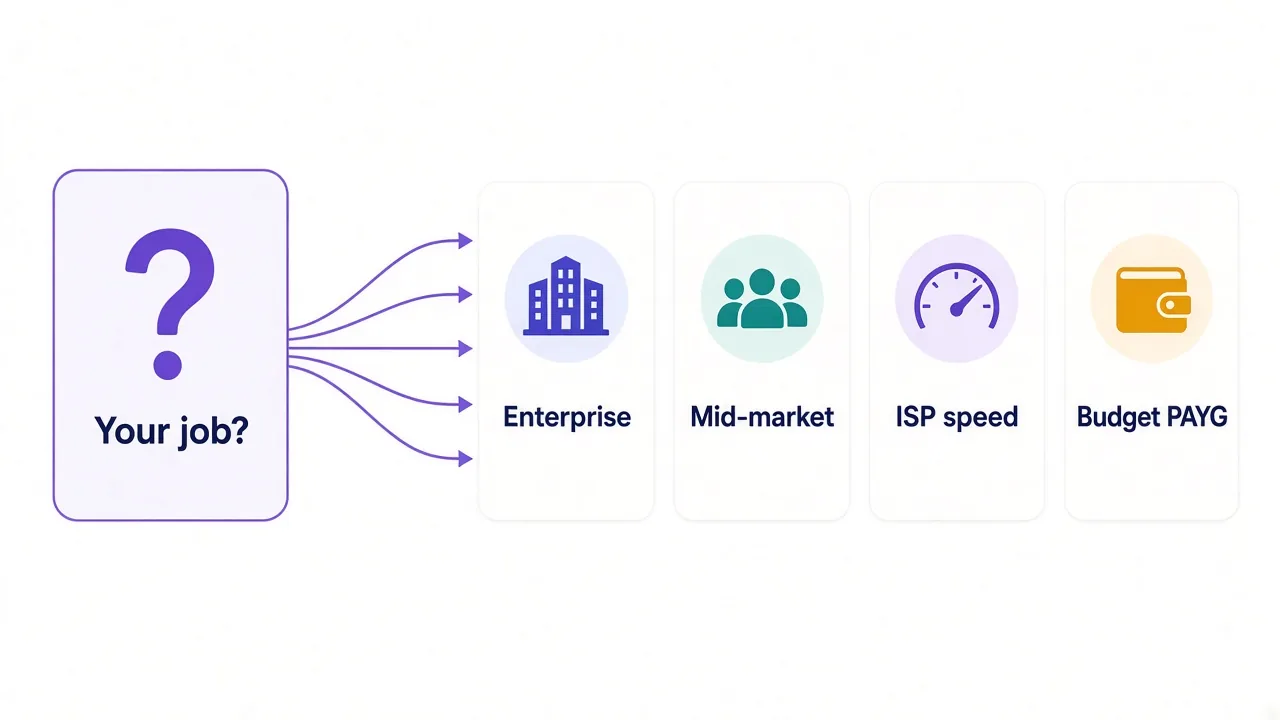
Skip the feature matrix dump. Use the job.
| Your situation | Start with | Why |
|---|---|---|
| Enterprise scale, hostile sites, need a peer vendor | Oxylabs | Closest match on pool, compliance, and support |
| Strong residential without enterprise complexity | Smartproxy / Decodo | Mid-market price, clean dashboard, trial-friendly |
| Latency and sticky stability matter most | NetNut | ISP-backed backbone for steadier sessions |
| Precise geo or mobile-heavy social work | SOAX | Clean pool and carrier-level targeting |
| Bursty volume, hate unused GB | IPRoyal or DataImpulse | True pay-as-you-go and flexible traffic |
| Account logins on quiet Western IPs | NodeMaven or Live Proxies | Cleanliness over mega-pool marketing |
| Soft targets, speed, and low cost | Webshare datacenter | You may not need a Bright Data alternative at all |
Still unsure? Ask what broke first: price, success rate, tooling, or support. Fix that pillar. Ignore the rest until it hurts.
Write the failing pillar on a sticky note. Then refuse demos that only pitch the other three. Vendors love to sell features you didn't ask to fix.
And remember residential vs datacenter before you replace like with like. Wrong proxy type is a more expensive mistake than wrong brand.
Same goes for session type. Sticky vs rotating mistakes create "bad provider" myths. Fix the session model before you blame the ASN.
So, should you actually switch?
Start with the job, not the brand war.
Stay on Bright Data when hostile targets, compliance, and unlocker-class tooling are load-bearing.
Add Oxylabs when you need a true enterprise peer. Move to Smartproxy / Decodo when you want serious residential without the platform tax.
Reach for NetNut, SOAX, IPRoyal, or the boutique clean-IP vendors when one pillar (speed, geo, or flexible pricing) is the real pain.
Next step: open the proxy directory, pull the cards for your shortlist, and run a week of identical scripts. Log success rate, GB used, and the minutes your team spends babysitting blocks.
Your logs will settle the argument faster than any blog will.
Frequently asked questions
Oxylabs is the closest enterprise peer. Smartproxy (Decodo) fits mid-market residential. NetNut, SOAX, and IPRoyal cover speed, geo precision, and pay-as-you-go value.
Not reliably. Both sit at the premium end for residential. Teams pick Oxylabs for redundancy, support style, or contract leverage more than a bargain sticker.
Yes. Smartproxy rebranded as Decodo. Listings and docs may still show either name during the transition.
When you mostly buy raw residential or soft-target capacity and do not use unlocker-class tooling. Measure cost per successful request before you switch.
Only for soft targets where datacenter IPs work. It is not a residential or unlocker substitute for hostile sites.
Match pool quality, pricing model, unblock rates on your targets, and tooling. Run the same scripts for a week and compare success rate, GB used, and ops time.