











Quick facts
- Main job
- Change your IP
- Types
- Residential, datacenter, mobile, ISP
- Encryption?
- Usually no (unlike a VPN)
- Billing
- Per GB or per IP
- Best for
- Scraping & data at scale
A proxy server — usually just called a “proxy” — is a middleman between your device and the internet. Instead of connecting to a website directly, your request goes to the proxy first, which forwards it on and sends the reply back to you. Crucially, the website sees the proxy's IP address and location, not yours.
That simple redirection is what makes proxies so useful: they let you change or rotate the IP address you appear to browse from. Businesses use huge pools of proxy IPs to collect public data, verify ads across countries, and manage many accounts — all without a single address getting flagged.
In one sentence
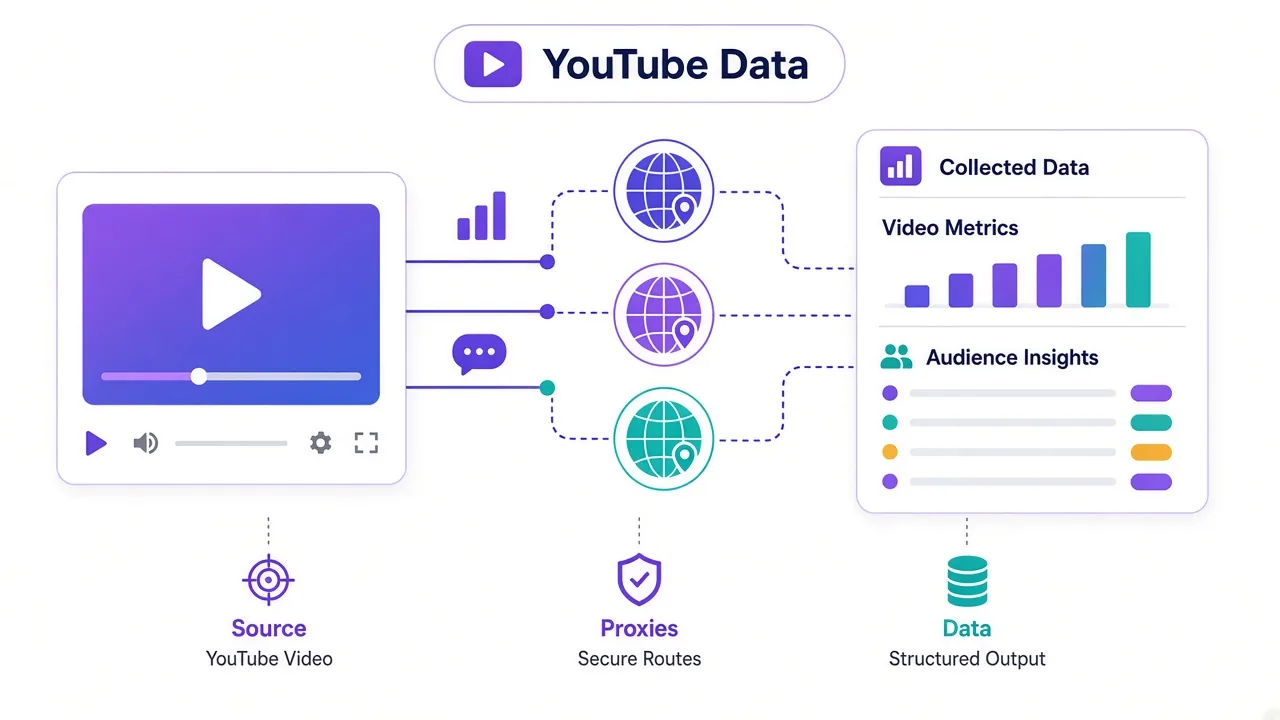
When you send a request through a proxy, the proxy strips your real IP, makes the request on your behalf using its own IP, and relays the response back to you. To the destination site, the traffic looks like it came from the proxy. Toggle the diagram to see the difference:
See it in action
You
Real IP
Proxy server
Its IP
Website
Sees proxy IP
One important nuance: most proxies change your IP but don't encrypt your traffic. If you need your data scrambled from your ISP and network — not just your IP hidden — that's a job for a VPN. Proxies are about identity and scale; VPNs are about encryption and privacy.
Not all proxies are equal. The biggest differences come down to where the IP addresses originate — which decides how trusted, fast and affordable they are. Explore the four main types:
Real IPs issued by ISPs to home devices. They look like genuine people, so they're the hardest to block — but pricier and a little slower.
As a rule of thumb: start with datacenter for speed and cost, and move up to residential or mobile when a target starts blocking you. See the full proxy directory to compare real providers of each type.
Beyond the IP type, you choose how the IP behaves during a session:
Rotating
A new IP on every request or on a short timer, drawn from the pool. Ideal for large-scale scraping where you want to spread requests so none of them trip a rate limit.
Sticky (static)
The same IP held for a set period (or indefinitely). Essential when a task must look like one continuous user — logging in, filling a cart, or checking out. See sticky sessions.
Proxies and VPNs both change the IP a website sees, but they're built for different jobs:
| Proxy | VPN | |
|---|---|---|
| Encrypts traffic | Usually no | Yes, all of it |
| Scope | One app or browser | Whole device |
| Number of IPs | Thousands to millions | Usually one at a time |
| Speed | Very fast | Fast |
| Best for | Scraping, ads, multi-accounting | Everyday privacy & security |
New to VPNs? Read our companion guide, What is a VPN and how does it work?
Proxies also differ by protocol — the “language” they speak. The two you'll meet most are:
HTTP proxies understand web traffic and can read and modify headers, which makes them the default for browsing and web scraping. They tunnel HTTPS without decrypting it.
Best for: standard web scraping and browsing.
SOCKS5 forwards any kind of TCP or UDP traffic without interpreting it, so it works far beyond web browsing — apps, torrents, gaming — and supports authentication.
Best for: non-web protocols and app-level proxying.
Proxies power a huge range of legitimate business tasks that need many IPs and locations:
Web scraping
Collect public data at scale without a single IP getting rate-limited or blocked.
Ad verification
Check that ads render correctly and safely across different countries and devices.
Price & retail monitoring
Track competitor pricing and buy limited releases from many locations.
SEO & SERP tracking
See search rankings as they appear in specific regions.
Account management
Give each account its own IP so platforms don't link them together.
Market research
Aggregate reviews, listings and trends without triggering anti-bot defenses.
Browse tools by goal on our use cases hub, or learn how blocks happen with the CAPTCHA explainer.
The “best” proxy depends entirely on your target and budget. Work through this checklist — it saves your progress in your browser:
Your VPN checklist
Loading… — saved in your browser.
Want the shortlist done for you? We score every provider on these criteria — browse the proxy directory, compare two head to head, or grab current proxy deals.
Getting your first proxy running is quick:
- 1
Pick the right proxy type
Match the type to your target: datacenter for speed on tolerant sites, residential or mobile for tough ones. Compare providers on the DriftProxy directory.
- 2
Get your proxy credentials
From the provider dashboard, grab the endpoint (host), port, and username/password — or a single backconnect gateway that rotates IPs for you.
- 3
Configure your app or browser
Enter those details in your scraper, browser or tool's proxy settings (HTTP or SOCKS5), including authentication.
- 4
Test that it's working
Confirm your IP changed with our IP lookup tool, then check success and error rates on your actual target before scaling up.
Ready to check what you've learned? Take this quick 4-question quiz.
Test your knowledge
1 / 4What does a proxy mainly do?
Using a proxy is legal in most places. What matters is how you use it: scraping publicly-available data is generally fine, but breaking site terms, laws, or accessing private data can be illegal. When ethically sourced and used for permitted purposes, proxies are a legitimate tool.
Usually not. Standard HTTP and SOCKS5 proxies reroute your traffic but don't encrypt it, so the proxy operator and your network can still see unencrypted requests. For confidentiality, rely on HTTPS at the site level or use a VPN, which encrypts everything.
Use a VPN for everyday privacy and security, since it encrypts all of your device's traffic. Use a proxy for app-level IP changes at scale — web scraping, ad verification, managing accounts — where you need many IPs and speed more than encryption.
Residential proxies use real ISP-issued home IPs, so they look like genuine users and are hard to block, but cost more and are slower. Datacenter proxies come from hosting servers — fast and cheap, but easier for tough sites to detect.
A rotating proxy automatically changes the IP address used for your requests, either on every request or on a timer, spreading traffic across a large pool. This is the standard way to scrape at scale without tripping rate limits or bans.
Big enough that each IP stays under your target's rate limits for your request volume. Larger pools mean fewer requests per IP and lower block rates. Quality and targeting often matter more than raw pool size, though.
Was this guide helpful?
Ready to choose a proxy?
Independently scored, no pay-to-rank.