











You found a list of 5,000 free proxies. You loaded it into your script, hit run, and watched most of them time out.
The ones that did connect were slow, and a few sent back pages that looked a little off. Sound familiar?
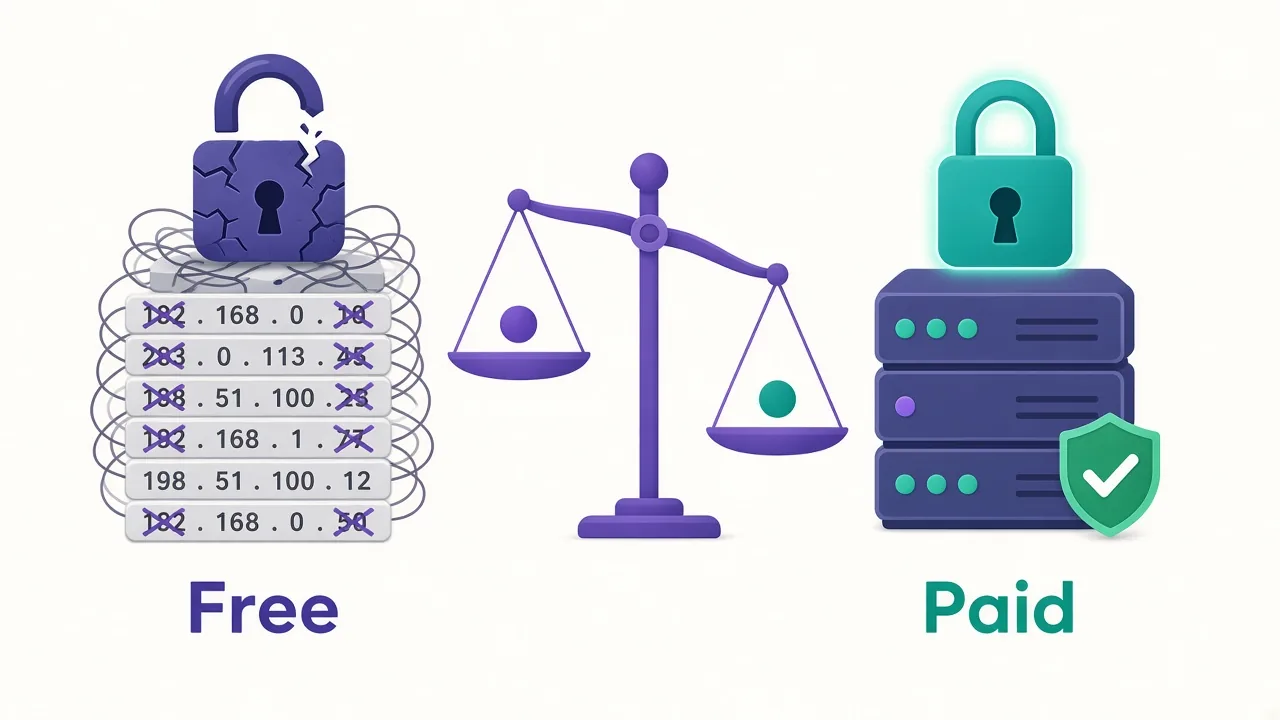
Here's the plain answer on free vs paid proxies. A free proxy costs nothing up front. A paid one buys you IPs that work, stay clean and don't read your traffic.
That's the short version. The real question is what "free" charges you instead, and whether you need to pay at all.
There's one situation where a free proxy is the right call, and a free option most people skip. We'll get to both.
What does "free proxy" really mean?
Most free proxies aren't a product. They're open proxies: servers that forward traffic for anyone who connects, with no login.
Some are set up on purpose by people who want to see what flows through them. Plenty are misconfigured servers, routers and old VPS boxes that the owner never meant to share.
Scanners find them, and aggregator sites publish them as long lists of IP and port pairs. That's where most "free proxy lists" come from.
There's a second, smaller group. Some paid providers run a free tier with a handful of shared IPs and a small data cap. Those are a different animal, because a real company with a reputation stands behind them.
So from here on, "free proxy" mostly means the first kind. Public, anonymous, and run by someone you'll never meet. If you're new to how a proxy forwards traffic, that glossary entry covers the basics in two minutes.
Why do most free proxies die within hours?
Because nobody is paid to keep them alive.
Researchers at Georgetown University tested more than 107,000 listed open proxies. Over 50 days, they sent 13 million requests through them. They found that more than 92% of the open proxies on aggregator sites didn't respond to proxy requests at all.
Think about what that means for your list of 5,000. You might get a few hundred that answer. A day later, that number shrinks again.
The reasons are boring. An owner notices the strange traffic and closes the port. A cloud host kills a server for abuse. A home router reboots and gets a new IP.
Then there's load. Thousands of people grab the same public list at the same time, so the proxies that do work are crowded. Pages crawl, and requests stall halfway.
The hidden cost
Free lists cost you time. You'll spend more effort testing, filtering and replacing dead IPs than you spend on the task you wanted to do.
What can a free proxy owner see and change?
This is the part most people skip, and it's the part that matters most.
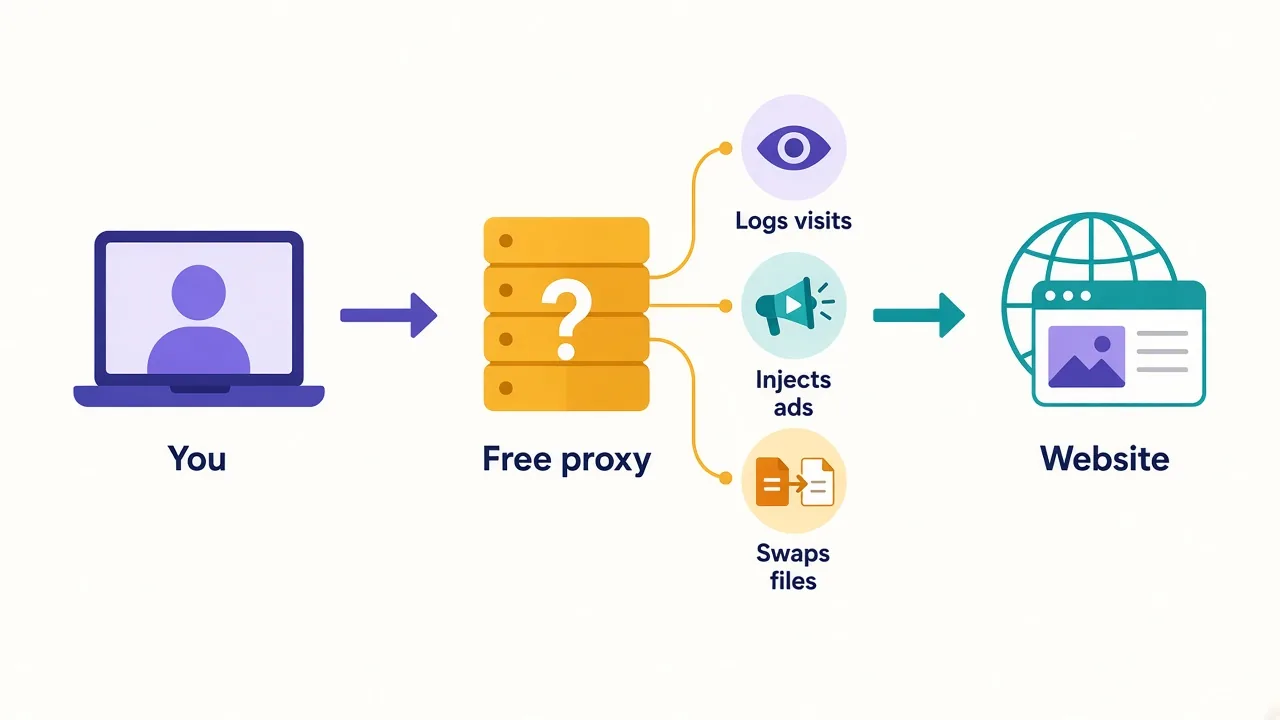
A proxy sits in the middle of every request you send. Whoever runs it sees where you go, when, and how much data moves. On plain HTTP pages, they also see everything on the page, including anything you type.
And they can change it. The same Georgetown study caught open proxies injecting ads into pages and adding JavaScript that mined cryptocurrency in the visitor's browser. That's called cryptojacking.
It got worse with downloads. The researchers found proxies that swapped or modified files in transit, including binaries that came back with remote access trojans inside. They also detected TLS man-in-the-middle attacks, where the proxy tries to break into encrypted connections.
So does HTTPS save you? Mostly, yes. With HTTPS, the proxy sees the site's name and the timing, but not the page or your password.
The catch is the certificate warning. A man-in-the-middle proxy has to show your browser a fake certificate. If you click through that warning, or your script ignores certificate errors, you've handed over the keys.
Never do this on a free proxy
Don't log in to anything, don't download files, and never turn off certificate checks in your code. If a site throws a certificate warning through a free proxy, stop there.
Why do websites block free proxy IPs first?
Say your free proxies do work. Will the site you're targeting let them in?
Often, no. Public proxy lists are public to the people who build anti-bot systems too. Blocklists scrape the same aggregator sites you do.
Most open proxies also sit on hosting networks. Every IP belongs to an ASN, the network block that tells a site who owns the address. A site can look it up and see a cloud host instead of a home internet provider.
Then there's the shared history. Hundreds of strangers have pushed spam, scrapers and credential stuffing through the same IP before you. The site doesn't know you're different. It sees one more request from a known bad address.
That's why free proxies tend to hit a CAPTCHA or a 403 on the first request to Google, Amazon or Instagram. It isn't bad luck. The IP was burned before you found it.
If blocks are already your problem, our guide to why proxies get banned walks through the other signals sites check.
So what are you really buying with a paid proxy?
You're not paying for the IP address. You're paying for everything around it.
Here's how the two compare on the things that decide whether your task works.
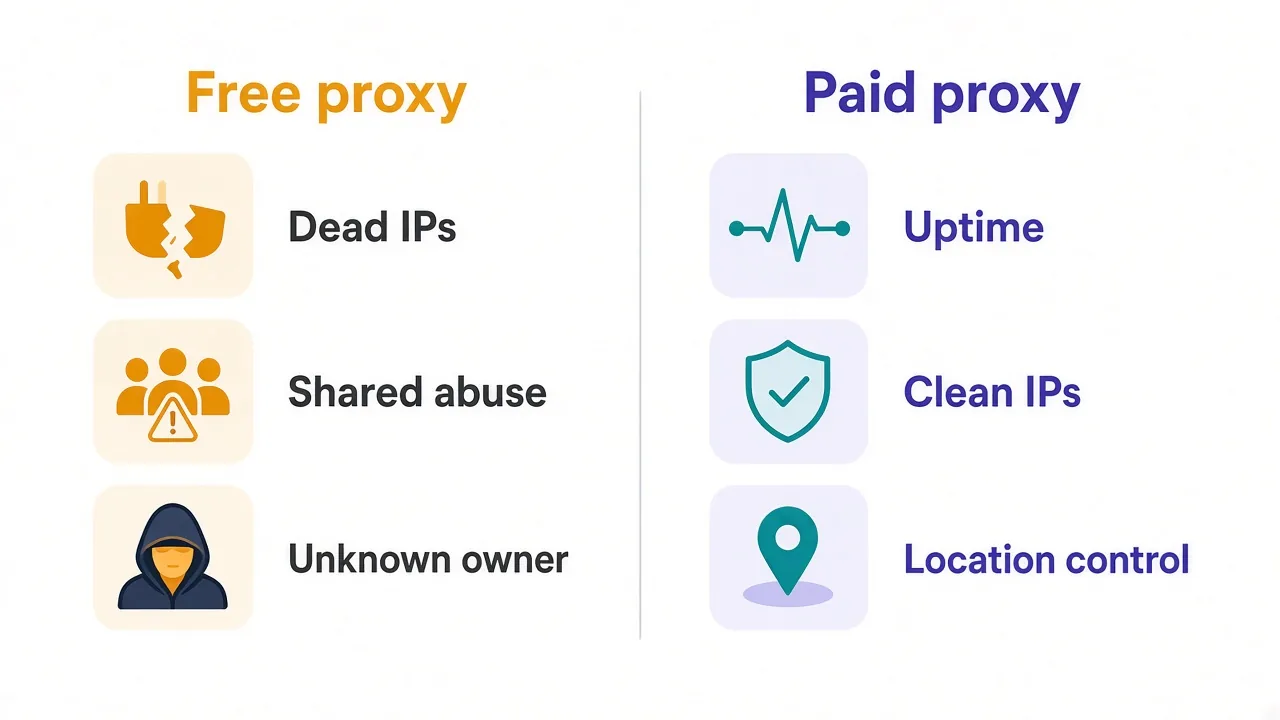
| What you care about | Free proxy | Paid proxy |
|---|---|---|
| Will it connect? | Rarely, and not for long | Yes, with uptime the provider is paid to keep |
| Who runs it? | Unknown | A company with terms, support and a reputation |
| Who else uses the IP? | Anyone with the list | Other customers, or only you on dedicated plans |
| IP reputation | Often blocklisted | Usually monitored, with flagged IPs swapped out |
| Login | None, open to all | Username and password or IP allowlist |
| Location control | Whatever the list has | Pick country, often city or carrier |
| Session control | None | Rotating or sticky sessions on request |
| Risk to your data | Real | Low, with a known operator |
The login row matters more than it looks. An open proxy has no login, so anyone can use it, which is why it's crowded and abused. A paid proxy locks the door, so the IP's history is mostly yours.
Session control is the other big one. A paid pool lets you choose a sticky session (the same IP for a set time, like 10 minutes). Or you can take a fresh IP on every request.
With a free list, you get whatever survived.
Is a cheap paid proxy just a free one with a price tag?
Not usually. But paid proxies aren't all the same either, and the type matters more than the price.
There are four main kinds you'll see on pricing pages.
- Datacenter proxies come from cloud servers. They're fast and cheap, and sites spot them easily.
- Residential proxies route through real home connections. They're harder to block and usually billed per GB.
- ISP proxies are static IPs registered to home internet providers but hosted in data centers. You get speed plus a residential look.
- Mobile proxies use carrier networks. They're the hardest to block and the most expensive.
A cheap datacenter plan from a real provider still beats a free list. The IPs connect, they're not on every public blocklist, and nobody's injecting ads into your pages.
What it won't do is pass a tough target. If you need help picking a type, our residential vs datacenter comparison covers that call in detail.
One honest warning about the cheap end. Some low-cost residential pools source their IPs through apps that users never clearly agreed to. Ask how a provider gets its IPs, and read our take on ethically sourced proxy IPs before you buy on price alone.
When is a free proxy good enough?
Remember that one situation where free is the right call? Here it is.
A free proxy is fine when nothing you send matters and nothing you get back needs to be trusted.
That covers a short list of jobs.
- Checking how a public page looks from another country, once.
- Learning how proxies work in a script or a browser setting.
- Testing your own code's retry and timeout handling against flaky connections.
- Reading a public news page over HTTPS with no login.
Notice what's missing. No accounts, no logins, no downloads, no scraping at any real volume, and nothing tied to your business.
If your task touches money, accounts or customer data, free is the expensive option. A banned account or a stolen session costs far more than a month of proxies.
How do you test a free proxy without getting burned?
Going to try one anyway? Fair enough. Here's how we'd do it.
- Use a throwaway browser profile or a fresh virtual machine, with no saved logins.
- Connect only to HTTPS sites, and never click through a certificate warning.
- Check what the site sees with our IP lookup tool. If your real IP shows, the proxy is transparent and useless for privacy.
- Compare the page to the same page without the proxy. Extra ads or scripts mean the proxy is tampering.
- Don't download anything, and close the session when you're done.
Step three catches more than people expect. Some free proxies are transparent proxies, which pass your real IP along in a header. You think you're hidden, and the site sees you anyway.
For a fuller checklist, including speed and leak checks, see how to check if your proxy is working.
Scripts need extra care
Many scraping tutorials set verify=False to silence certificate errors. Through a free proxy, that one line lets a man-in-the-middle read everything.
Is there a free option that doesn't carry these risks?
Yes, and it's the one most people skip: the free trial from a paid provider.
As of October 2026, 33 of the 44 proxy providers we list in the DriftProxy directory offer a free trial. That's three out of four.
A trial gives you the real product. Clean IPs, a login, location targeting and support, for a limited time or a small amount of data.
The catch? Trials are short and capped, and some ask for a card or a business email. Read the terms before you sign up, so a trial doesn't roll into a paid plan you forgot about.
Used well, a trial answers the question that matters. Does this provider's pool get past your target? A free list can't tell you that, because its IPs are burned before you start.
Plan the test before you start the clock. Pick your hardest target, run a few hundred real requests, and note your success rate. Then compare two or three providers the same way.
How much should you expect to pay?
Less than you might think for small jobs, and more than you'd like for hard ones. The bill depends on how you're charged.
- Per GB is common for residential and mobile pools. Heavy pages with images and scripts burn through data fast.
- Per IP is common for datacenter and ISP proxies. You pay a monthly fee for each address.
- Per request is how scraping APIs bill. They bundle proxies, retries and unblocking into one call.
So which model is cheapest? It depends on the job. Logging into ten accounts all day suits a few static IPs. Crawling a million product pages suits per-request or per-GB billing.
Two habits keep the bill down. Block images and fonts in your scraper when you don't need them.
And use sticky sessions only when you need to stay logged in, because rotation is better for spreading requests. Our explainer on sticky vs rotating proxies covers when each one fits.
Prices change often. Check the live starting price on each provider's directory page, not a number in an old blog post.
What's the real price of a free proxy?
Add it up and free gets expensive.
You pay in time, testing lists where most entries are dead. You pay in blocks, because the IPs were flagged before you found them. And you pay in risk, because a stranger can watch and change your traffic.
A paid proxy moves those costs to someone whose job is to handle them. That's the trade. You're buying back your time and your peace of mind, with the IPs thrown in.
None of this means you need the biggest plan. Most small projects run fine on a modest datacenter or ISP plan, and only hard targets need residential or mobile IPs.
So, should you pay for a proxy?
If the task matters, yes.
Use free proxies only for throwaway tests on HTTPS pages, with no logins and no downloads. For anything tied to accounts, money or real scraping, pay for a proxy from a provider you can name.
You don't have to pay to find out which one works. Start with a free trial on your hardest target, and compare two or three before you commit.
Browse the proxy providers we've reviewed and filter for free trials. You'll know which one fits within a day.
Frequently asked questions
Free proxies aren't safe for anything sensitive. A 2018 Georgetown study caught open proxies injecting ads, adding crypto-mining scripts and tampering with downloaded files. Use them only for throwaway tests on HTTPS pages, with no logins.
Most free proxies are open servers nobody is paid to maintain, so they go offline or get overloaded. In one large study, more than 92% of listed open proxies didn't respond at all.
A paid proxy gives you IPs that connect reliably, a login that keeps strangers off them, and a known operator. You also get location targeting, rotating or sticky sessions, and support when something breaks.
Yes, most paid providers offer a free trial. As of October 2026, 33 of the 44 proxy providers in the DriftProxy directory list one, usually capped by time or data.
Yes, for almost any real task. Even a low-cost datacenter plan connects reliably, isn't on every public blocklist, and won't tamper with your pages. It still won't get past the toughest targets, which need residential or mobile IPs.