










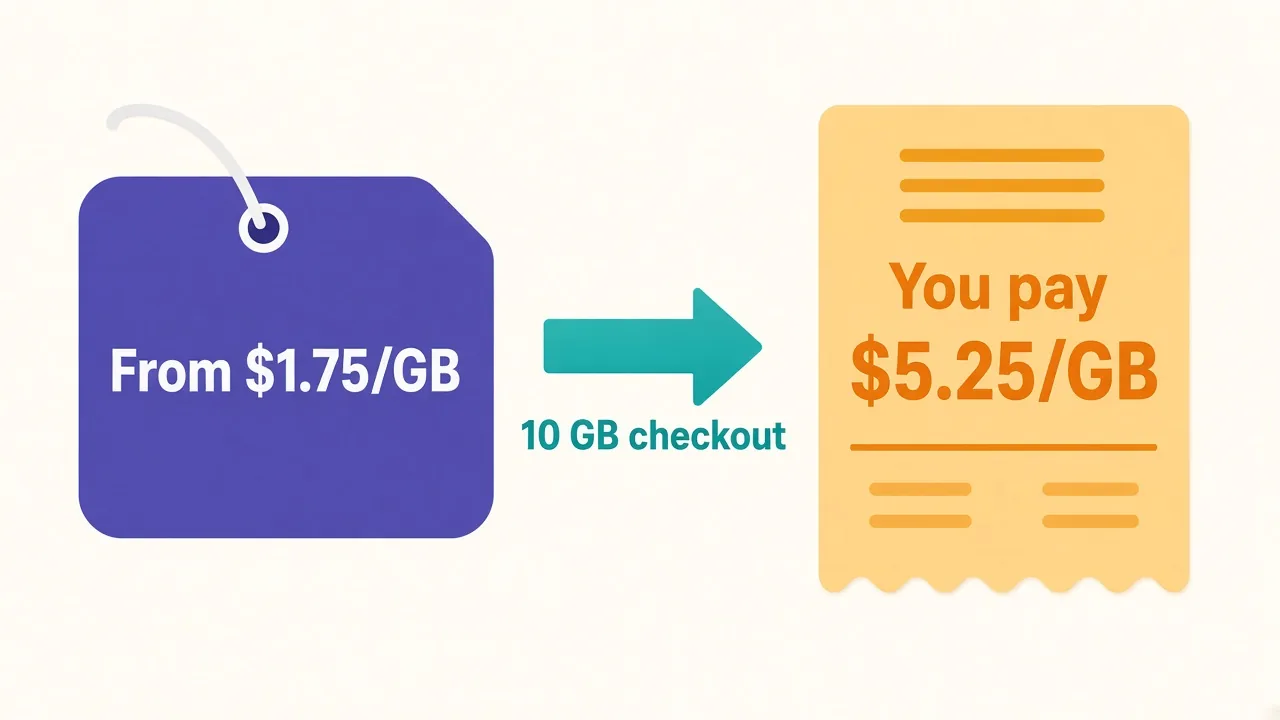
You found residential proxies at $1.75 a GB. Then checkout asked for $7.
Or you bought the cheapest plan on the page, burned half the traffic on retries, and still got blocked.
Sound familiar? "Cheap residential" is a real buying category. It is also a marketing phrase that hides the volume you have to purchase.
For most people buying 10 to 50 GB, Geonode or DataImpulse currently publish lower rates than the household names. The number that matters is the checkout price, not the banner.
There's a second trap too, and it has nothing to do with the sticker rate. We'll get there. First, you need a plain definition of cheap.
What does "cheap residential" actually mean right now?
A residential proxy routes your request through a real household IP. Websites see a home connection instead of a cloud server.
That's why these IPs usually cost more than datacenter proxies. If you want the type basics, start with our guide to residential vs datacenter proxies.
Cheap, in this post, means a published residential rate you can actually buy at a normal volume. Think 5, 10 or 50 GB. Not a custom 10 TB quote that only sales can unlock.
We checked public pricing pages on 24 November 2026. Prices move, and some "from" rates only apply at huge volumes.
Below, we'll show both the headline and the 10 GB and 50 GB checkout math. That gap is the whole story for a lot of buyers.
One more filter: every provider here already has a listing in the DriftProxy directory. If a brand isn't in that set, it isn't on this shortlist.
What about unlimited plans? They're only cheap if you really move a lot of traffic. A daily or monthly fee can wipe out the savings on a light job.
Why can the lowest per-GB price still drain your budget?
Here's the trap we teased at the start. The second way a cheap plan gets expensive is failed requests.
You pay for traffic that goes through the proxy. That includes the request, the response, redirects and every retry.
Say a page is about 500 KB of HTML. A thousand successful pages use roughly half a GB. Fail half of them, retry once, and you just paid for a lot of nothing.
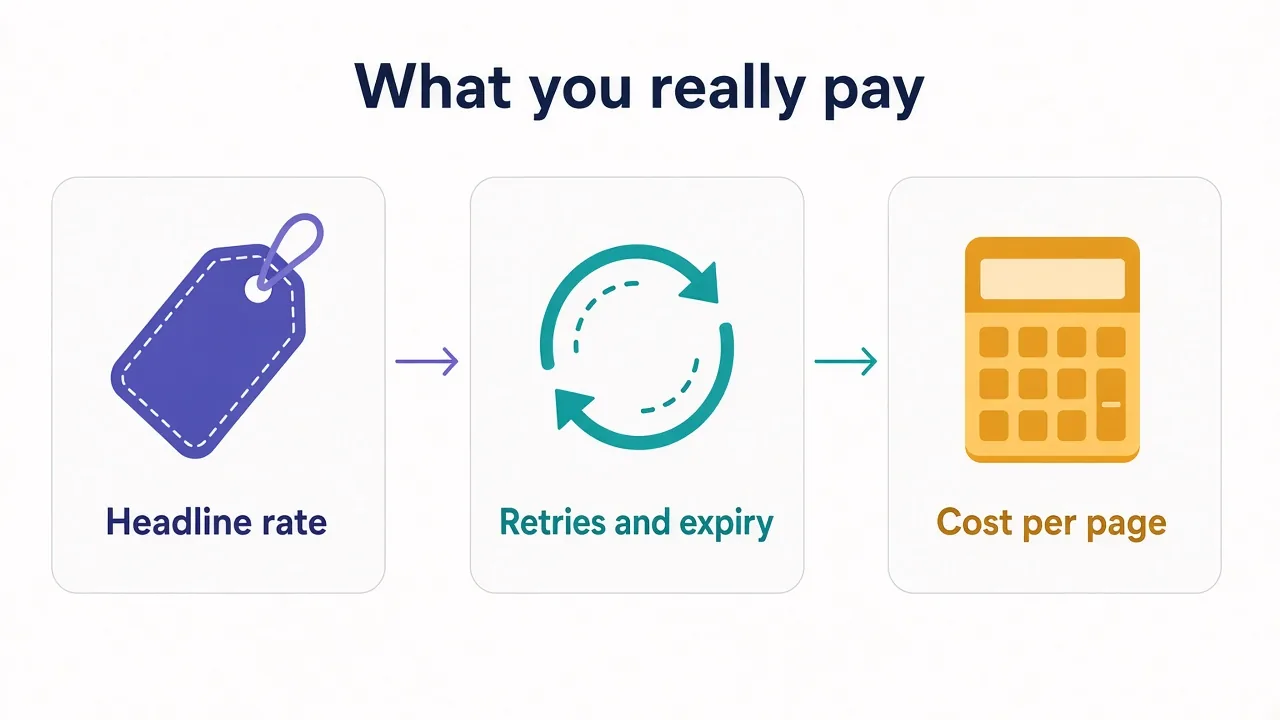
So the number that matters is cost per successful page.
Not cost per GB.
A $0.80 pool that fails often can cost more than a $2 pool that works the first time. We can't invent success rates for your targets. Your sites decide that.
That's why a cheap plan still needs a short test on the pages you actually hit.
We'll give you a simple routine later.
Cost per successful page
Divide what you spent by the number of useful responses, not by the gigabytes on the invoice. Retries, images and redirects all count as paid traffic.
Retries aren't the only leak.
Plans can expire unused traffic in 30 days, or set a $50 minimum. Others advertise $0.77 a GB, then charge $3 on the starter pack.
Seen that last one before? Keep reading. The comparison table makes it hard to miss.
Pay-per-GB, a minimum top-up, or a subscription: which is cheaper?
Three billing models show up again and again on budget residential pages. The cheapest one depends on how you work, not on which logo looks friendliest.
Pay-per-GB means you buy traffic and draw it down. It fits uneven work. The fine print is expiry, and whether extra targeting costs more.
DataImpulse, Proxy-Cheap and several others use this shape. The rate can stay low even on a small purchase, or it can drop only after you buy a huge bundle.
A minimum top-up is pay-per-GB with a floor. PacketStream is $1 a GB, but the smallest public buy is $50.
If you'll use those 50 GB over time, the rate is still $1 a GB, because the balance does not expire.
If you needed 5 GB and never come back, you prepaid a lot of idle traffic.
A monthly subscription can undercut pay-as-you-go on the same network. Geonode's 10 GB plan is $7.92 a month, and unused bandwidth rolls over until you cancel.
That's cheap if you keep the plan while you use the leftover. Cancel too soon and you should read the rollover rules first.
Pay-per-IP static residential is a different product. You rent an address for a week or a month. Useful for long logins, not for wide crawls. Don't compare it one-for-one with rotating per-GB plans.
Unlimited sounds perfect. LunaProxy sells unlimited residential plans priced by the day. Geonode's unlimited product starts at $1,800 a month for a 200 Mbps cap.
That only wins if you would have burned far more on a metered bill. For a 10 GB research job, it's the wrong aisle.
Want the models in more depth? Our explainer on residential proxy pricing models walks through the trade-offs.
Which cheap residential proxy providers are worth comparing?
We narrowed this to seven directory listings with public residential prices. No padded list of 20 brands. The point is what you'll pay at volumes people actually buy.
All figures below are list prices we read on official pages on 24 November 2026, before tax. Promotions and bonuses can end. Recheck the cart before you buy.
| Provider | About 10 GB | About 50 GB | The catch |
|---|---|---|---|
| Geonode (monthly) | $7.92 ($0.792/GB) | $34.65 ($0.693/GB) | Smaller 7.5M+ pool; leftover rolls over until you cancel |
| Geonode (pay as you go) | $8.80 ($0.88/GB) | $38.50 ($0.77/GB) | Smallest published PAYG pack is 10 GB |
| DataImpulse | $1/GB on public Intro and Basic rates | $50 for 50 GB ($1/GB) | Intro is $5 for 5 GB and one-time for new customers; Basic starts at a $50 top-up |
| Proxy-Cheap | $12 ($1.20/GB) | $60 ($1.20/GB) | The $0.78/GB rate starts at 51 GB |
| PacketStream | $50 minimum (50 GB at $1/GB) | $50 ($1/GB) | Peer-to-peer exits can vary; unused balance does not expire |
| PYPROXY | $16 for 5 GB paid, plus 3 GB bonus ($2.00/GB effective) | $120 for 50 GB paid, plus 30 GB bonus ($1.50/GB effective) | Effective rates include a launch bonus that can end; crypto checkout |
| LunaProxy | $26 ($2.60/GB) | 45 GB is $108 ($2.40/GB) | The $0.77/GB rate is a high-volume tier, from 3,000 GB |
| IPRoyal (subscription) | $52.50 ($5.25/GB) | Not a published 50 GB card | The $1.75/GB rate starts at 10 TB (10,000 GB) |
Read the volume, not just the "from" price
A headline like $0.77 or $1.75 a GB is often a bulk tier. If you only need 10 GB, the starter pack is the price that counts.
So who should you actually open first? Start with the two lowest published rates at normal volume, then see who fits your billing style.
Geonode: is the lowest published rate the right buy?
On Geonode's residential product page, the 10 GB monthly plan is $7.92, or $0.792 a GB. The 50 GB plan is $34.65, or $0.693 a GB.
Pay as you go is a little higher: $8.80 for 10 GB and $38.50 for 50 GB. There is also a $5 trial that includes 10 GB for three days.
Those are the lowest published 10 GB and 50 GB rates in this set.
Why isn't everyone already there?
Geonode says the pool is 7.5 million residential IPs active each month, across 150+ countries. That's smaller than the giants, and the company is unusually direct about it.
If you need a rare city, test before you scale. Country, city, ZIP and ASN targeting are available when matching IPs are online.
Billing is clean. No credit multipliers. Pay-as-you-go bandwidth stays until you use it. Monthly leftover rolls over while the subscription stays active.
You get HTTP, HTTPS and SOCKS5, plus rotating or sticky sessions. Sticky can be set from a few minutes up to 24 hours, though a home device can drop earlier.
Pick Geonode if your volume sits in the 10 to 50 GB range and you can live with a smaller pool. Skip it as a blind buy for an obscure geography you haven't tested.

Unlimited-bandwidth residential proxies priced by concurrency
DataImpulse: is a flat $1/GB the simpler deal?
DataImpulse's residential page is easy to like. The public rate is $1 a GB on the Intro and Basic tiers, and traffic never expires.
New customers can start with a one-time Intro of $5 for 5 GB. The repeat Basic top-up is $50 for 50 GB. An Advanced pack is $800 for 1 TB, which works out to $0.80 a GB.
Country targeting comes at no extra cost. HTTP(S) and SOCKS5 are available, with rotating or sticky sessions. The product page also lists a 7-day refund policy.
The company advertises a first-party pool of 90 million+ IPs in 195 countries. Treat large pool claims with the usual care, and test on your targets.
Is $1 a GB always cheaper than Geonode? Not at 10 GB.
Geonode's monthly 10 GB plan is $7.92. DataImpulse's clean $1 rate still needs a $5 Intro or a $50 Basic top-up, depending on where you are as a customer.
At 50 GB, they land in the same neighborhood: $50 at DataImpulse versus $34.65 on Geonode's monthly 50 GB plan. The difference is the billing style.
DataImpulse has no monthly subscription and unused gigabytes don't expire. That's the better fit if your work comes in bursts, with quiet months in between.
Want a closer look at the tiers? Our DataImpulse pricing breakdown goes through the plans in more detail.

Transparent pay-as-you-go residential proxies with no minimums
Proxy-Cheap, PacketStream, PYPROXY and LunaProxy: who fits which job?
The next four are still budget residential options. They just win in different situations.
Proxy-Cheap: better once you buy a little more traffic
Proxy-Cheap's rotating residential page lists three pay-as-you-go bands. 3 GB and up is $1.50 a GB. 4 GB and up is $1.20 a GB. 51 GB and up is $0.78 a GB.
So 10 GB costs $12, and 50 GB costs $60. That's more than Geonode or DataImpulse at those sizes. At 51 GB, the rate drops under a dollar and starts to look sharp.
You get user and password auth, sticky or rotating sessions, and 100+ threads on those cards. The page also advertises 50 million+ residential IPs.
The name is doing a lot of work here.
This is a broad budget suite, not a specialist network. Fine for testing and moderate collection. Less of a bet if your targets fight back hard.

Budget proxies across residential, datacenter, ISP and mobile
PacketStream: a flat $1/GB, if you can start at $50
PacketStream's public rate is simple: $1 a GB, metered at the gateway, with no subscription. Purchased balance does not expire.
The catch is the $50 minimum. You can't buy 5 GB at $1 and walk away. You prepay 50 GB, then use it at your own pace.
That can still be cheap. Use the traffic over a year, and you paid $1 a GB. Need a tiny one-off test and nothing else? The floor is steep. DataImpulse's $5 Intro is a gentler first step.
The other catch is the network itself. Exits come from people who share bandwidth through the PacketStream app. Performance can vary more than it does on a tightly run first-party pool.
Rotating and sticky sessions are available. PacketStream recommends HTTPS, and also lists SOCKS5 and HTTP. Refund requests for remaining balance have a 24-hour window after purchase.
Choose PacketStream if $50 is an acceptable start and you like a single flat rate. Don't choose it if you need predictable performance on a hard target.

Peer-to-peer residential bandwidth at roughly a dollar per gigabyte
PYPROXY: low effective rates, with a sale attached
PYPROXY's rotating residential page, on 24 November 2026, priced a 2 GB starter at $5, or $2.50 a GB.
A 5 GB purchase was $16 and included 3 GB of bonus traffic. That delivered 8 GB at an effective $2.00 a GB.
A 50 GB purchase was $120 plus 30 GB of bonus traffic, or 80 GB at $1.50 a GB. At the top published tier, 3,000 GB paid plus 1,500 GB bonus came to $0.67 a GB effective.
Those "real rates" include a launch bonus. Sales end. If you use this provider, look at the delivered gigabytes in the cart, not only the sticker.
Traffic does not expire while your plan is active, and there is no monthly subscription. Checkout on the page we read was cryptocurrency, with cards listed as coming soon.
The network is advertised at 90 million+ IPs in 195+ countries, with HTTP(S) and SOCKS5. As with other budget pools, test before you commit serious volume.
PYPROXY fits buyers who are fine with crypto, want traffic that hangs around, and will actually use a bonus-heavy pack. It is not the lowest 10 GB price in this group once Geonode and DataImpulse are in the mix.

Budget residential, ISP and datacenter proxies with a huge pool
LunaProxy: cheaper at volume than on the starter packs
We checked LunaProxy's public residential pricing page on 24 November 2026. The 5 GB pack was $3.30 a GB, or $16.50. The 10 GB pack was $2.60 a GB, or $26.
A 45 GB pack was $2.40 a GB, or $108. The rate then fell with volume: $1.65 a GB at 120 GB, and $1.20 at 280 GB.
At 1,000 GB it was $0.88. At 3,000 GB it was $0.77.
The homepage also promotes a lower "from" figure. Treat that as a promo or a volume hook, and trust the pack you see at checkout.
At 10 GB, $26 is well above Geonode's $7.92 and DataImpulse's $1 rate.
LunaProxy gets more interesting in the hundreds of gigabytes. It also fits if you want an unlimited plan priced by the day.
The listing is built around a large advertised pool, SOCKS5 support and optional unlimited tiers. Validate performance on your targets, especially if the low "from" price is what brought you in.
Large residential pool with unlimited plans, SOCKS5 and budget per-GB rates
Why isn't IPRoyal cheap for most people?
IPRoyal is the name a lot of "cheap residential" roundups still lean on. The $1.75 a GB figure is real. It just isn't the price most people pay.
On IPRoyal's residential pricing page on 24 November 2026, a 1 GB subscription was $7.00 a GB. 2 GB was $5.95 a GB. The 10 GB "most popular" card was $5.25 a GB, or $52.50.
Pay as you go was slightly higher: $7.35, $6.25 and $5.51 a GB at those same sizes. The $1.75 a GB subscription rate, and $1.84 on pay as you go, starts at 10 TB. That's 10,000 GB.
Rates between 10 GB and 10 TB are not published as fixed cards on that page. You either stay on the small packs, or you talk to sales and check the dashboard.
Traffic does not expire, and there's no monthly minimum on pay as you go. The network is advertised at 64 million+ IPs in 195+ countries, with sticky sessions of up to seven days.
None of that makes a 10 GB order cheap.
$52.50 is about seven times Geonode's 10 GB monthly plan, and several times DataImpulse's $1 public rate.
So when does IPRoyal still make sense? When you already like the dashboard, you want a familiar mid-tier brand, or you really are buying huge volume. For a tight budget at 10 or 50 GB, it shouldn't be your first click.
We break the full plan list down in our IPRoyal pricing guide, and the IPRoyal alternatives shortlist covers other directions besides price.

Flexible proxies with true pay-as-you-go.
How should you compare cheap providers without falling for pool size?
Pool size is the easiest number to put on a homepage, and one of the weakest ways to pick a budget proxy.
A provider can advertise 90 million or 200 million IPs. Your job might only need clean exits in two countries, at the hours you actually run.
Compare these instead:
- The price at your real volume, after minimums and bonuses.
- Whether unused traffic expires.
- Session controls: rotate every request, or hold a sticky IP for a login.
- Geo targeting at the level you need, country or city, and whether it costs extra.
- Protocols you can actually use, including SOCKS5 if your tools need it.
- Cost per successful page on a short test, not the brochure success rate.
Free lists are a different product again. They can be fine for learning. They rarely survive a production run. Our look at free vs paid proxies explains why.
And don't mix up cheap datacenter with cheap residential.
Webshare, for example, is well known for low-cost datacenter plans and a free starter tier. Its residential product is a separate, usually pricier, buy.
Our Webshare pricing breakdown keeps those lines clear.
When is a cheap residential proxy the wrong buy?
Budget residential is the right tool for a lot of public-data work. Price checks, SEO and geo tests, light research, ad checks. It is the wrong tool when the target, or the risk, is heavier than the discount.
If the site uses a serious anti-bot stack, a cheap rotating pool may just donate traffic to retries. You may need a premium network, or a scraping API that handles the unblocking for you.
If you're signing into accounts, IP quality and sticky sessions matter more than the lowest GB rate. A slightly dearer, cleaner pool can be cheaper than a banned account.
If you need a formal SLA, compliance paperwork or 24/7 hands-on support at scale, the enterprise vendors exist for that. They're not in this cheap set on purpose. Our Bright Data vs Oxylabs comparison is the place to start when budget is no longer the first filter.
Use them for work you're allowed to do
Residential proxies are a routing tool. They don't make blocked, unpaid or terms-breaking access legal. Stay inside the law and the site's rules, and collect only public data you have a right to collect.
Sometimes you don't need residential at all. High-volume, low-sensitivity tasks can run cheaper on datacenter IPs. Start with the target, then pick the type, then pick the plan.
How do you test a cheap plan before you scale?
Pricing pages can't tell you what your job will cost. A short test can. Here's a routine that works on any of the providers above.
- Buy the smallest bundle or trial they offer. Geonode's $5 trial and DataImpulse's $5 Intro are built for this.
- Run a few hundred real requests against your actual target, at the time of day you'll work.
- Record data used, successful responses, blocks and average response time.
- Work out cost per successful page, including retries.
- Repeat with a second provider and compare those numbers, not the homepages.
Pro tip
Keep the first test HTML-only if that's how you'll scrape. Downloading images and scripts can multiply bandwidth, and it will skew a comparison that was supposed to be about the pool.
If both cheap plans fail the same target, stop stacking budget traffic.
That's your cue to step up, not to buy a bigger pack of the same pool.
So, which cheap residential proxy should you actually buy?
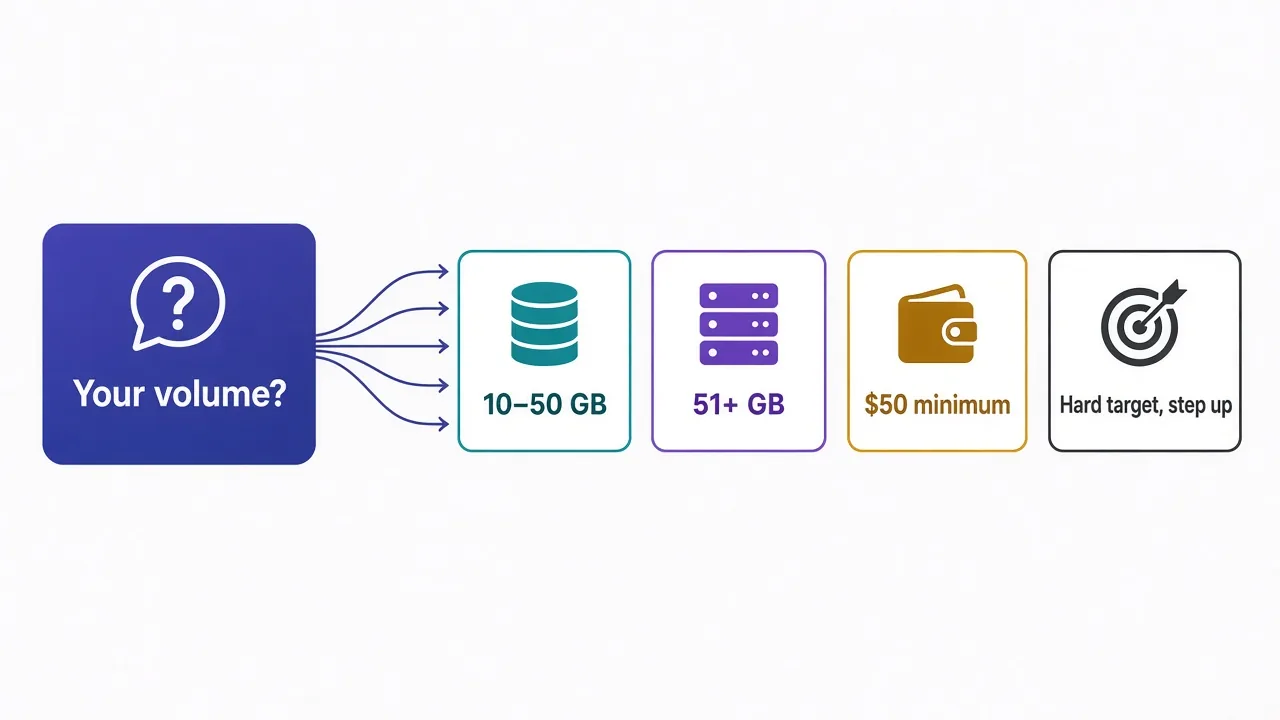
If you want the lowest published rate at 10 to 50 GB, start with Geonode.
The monthly 10 GB plan at $7.92 is hard to beat on paper. The $5 trial lets you check the pool first.
If you want a dead-simple $1 a GB with no expiry and no subscription, start with DataImpulse. The $5 Intro is the smallest gentle entry in this group.
Buying 51 GB or more and you like pay as you go? Proxy-Cheap's $0.78 band is worth a look. Can you start at $50 and use the traffic over time? PacketStream's flat $1 rate is straightforward.
PYPROXY and LunaProxy can get cheaper as volume rises, or when a bonus or unlimited plan fits. Just don't treat their lowest "from" rates as the price of a starter pack.
And if a roundup told you IPRoyal is $1.75 a GB, that's true from 10 TB. At 10 GB, you're closer to $5.25 a GB on the published subscription card.
Remember the second trap, too.
The cheapest gigabyte still loses if half your requests fail. Test on your target, then buy the plan that wins on cost per successful page.
Ready to compare listings side by side? Start with the residential proxy directory, then run that short test before you scale.
Frequently asked questions
As of 24 November 2026, Geonode and DataImpulse publish some of the lowest rates at 10 to 50 GB. Geonode's 10 GB monthly plan is $7.92. DataImpulse's public Intro and Basic rate is $1/GB, with a $5 or $50 starting top-up.
That $1.75/GB subscription rate starts at 10 TB, or 10,000 GB. At 10 GB, the published subscription card is $5.25/GB, or $52.50.
They can be, if your targets accept the pool and retries stay low. The number that matters is cost per successful page, so test a small pack first.
Only if you would use enough traffic to beat a metered bill. Geonode's unlimited plan starts at $1,800 a month, which is the wrong aisle for a 10 GB job.
Buy the smallest trial or pack, run a few hundred requests on your real target, then compare cost per successful page. Geonode's $5 trial and DataImpulse's $5 Intro are built for this.
Residential IPs come from household connections and usually cost more, but they blend in better. Cheap datacenter plans can be fine for lighter targets, and they're a different product from residential traffic.