







Two tabs open. Bright Data in one, Oxylabs in the other. Both say they're the biggest, the fastest and the most reliable.
So how are you supposed to pick? Both pricing pages look expensive, and both sales teams want a call.
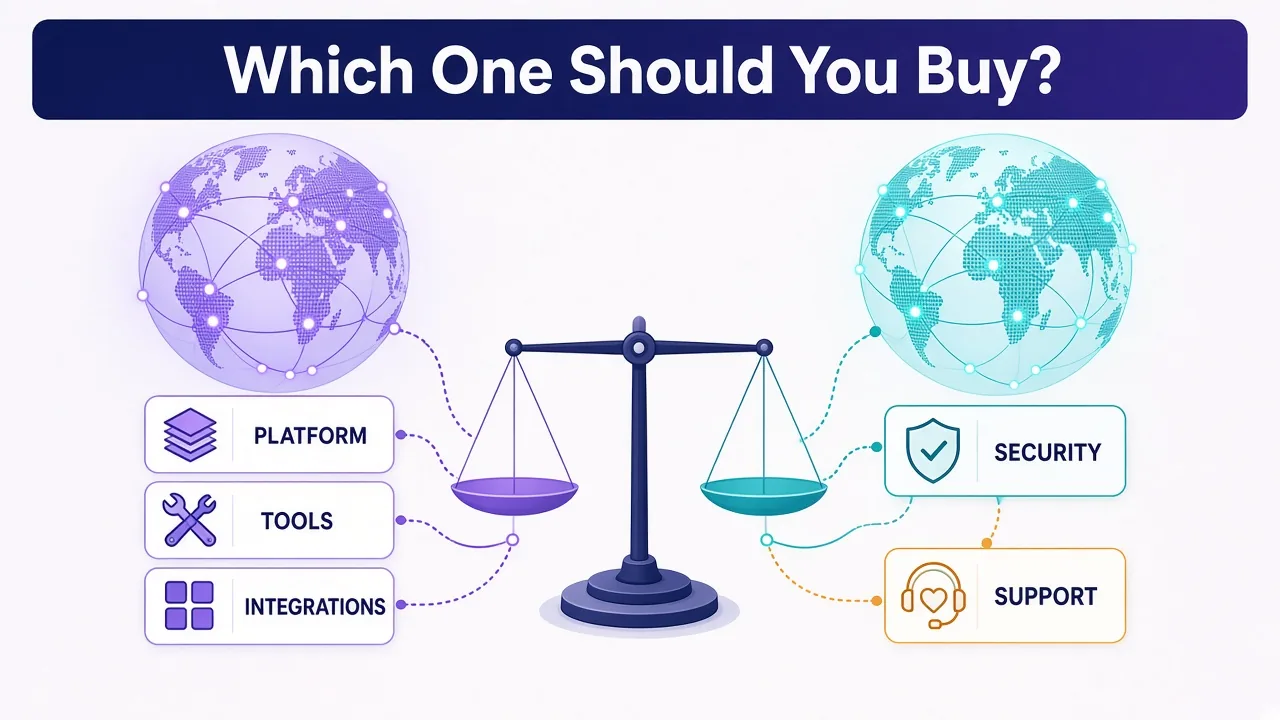
Here's the plain answer to Bright Data vs Oxylabs. Pick Bright Data if you want a full data platform. Pick Oxylabs if you want premium proxies, a scraper API and hands-on support.
That's the what. The why is more interesting, because the headline numbers point you the wrong way. There's one figure on each pricing page that decides the real cost, and almost nobody reads it first. We'll get to it.
Who are you, and what are you scraping?
Before any comparison, picture who usually lands on this question.
You've outgrown a budget provider. Maybe your scraper hits a retail site that started throwing CAPTCHAs. Maybe your boss wants a vendor with real compliance paperwork before the legal team signs off.
Either way, you're not shopping for the cheapest GB anymore. You're shopping for the vendor you won't have to replace in six months.
That changes the questions that matter. Pool size still counts. But so do billing models, onboarding friction, support and the tools that sit on top of the proxies.
Bright Data and Oxylabs both clear the "serious vendor" bar easily. They're the two names that set the price ceiling for the whole proxy market. The gap between them is in the details, so let's start with the big picture.
Bright Data vs Oxylabs at a glance
Here's how the two compare on the numbers from our own directory listings, as of November 2026. Providers change these often, so treat them as a snapshot, not a contract.
| Factor | Bright Data | Oxylabs |
|---|---|---|
| Founded | 2014 (formerly Luminati) | 2015 |
| Residential pool (advertised) | 72M+ IPs | 100M+ IPs |
| Datacenter pool (advertised) | About 770K IPs | 2M+ IPs |
| Mobile pool (advertised) | 7M+ IPs | Not in our listing |
| Countries | 195 | 195 |
| Quoted uptime | 99.99% | 99.9% |
| Average response (quoted) | About 0.7s | About 0.6s |
| Residential starting price | About $5.04/GB on a committed plan | About $8.00/GB |
| Datacenter starting price | About $0.60 per IP | About $0.65 per IP |
| Our editor rating | 4.3 / 5 | 4.4 / 5 |
Look at that table for ten seconds and you'd probably say Oxylabs wins on pool and Bright Data wins on price.
Both readings are a little misleading. Let's take them one at a time.
Does a bigger IP pool mean fewer blocks?
Oxylabs advertises 100M+ residential IPs. Bright Data advertises 72M+. On paper, that's a clear win for Oxylabs.
In practice, you never use the whole pool. You use the slice that sits in your target country, and often your target city.
Say you're checking prices on a German retail site. What matters is how many German residential IPs are online right now, and how clean they are. A global total tells you very little about that.
Both providers cover 195 countries. Both let you target by country, city and ASN (the network an IP belongs to, like a specific ISP). Neither publishes a live per-country count we could verify, so we won't pretend to know which has more IPs in Frankfurt.
Pool size, honestly
Once a provider is past tens of millions of residential IPs, the global number stops being the deciding factor. Ask for a trial and test your actual target country instead.
Where the pool difference does show up is in the other proxy types.
Bright Data lists a 7M+ mobile pool. Mobile IPs come from real carrier networks, which makes them the hardest to block on social platforms and app endpoints. Our Oxylabs listing doesn't cover mobile, so check their site if you need it.
Oxylabs, on the other hand, lists 2M+ datacenter IPs against Bright Data's roughly 770K. If you run high-volume, low-sensitivity jobs on datacenter IPs, that bigger pool gives you more room to spread requests.
Which one actually costs less?
This is where the headline numbers get slippery.
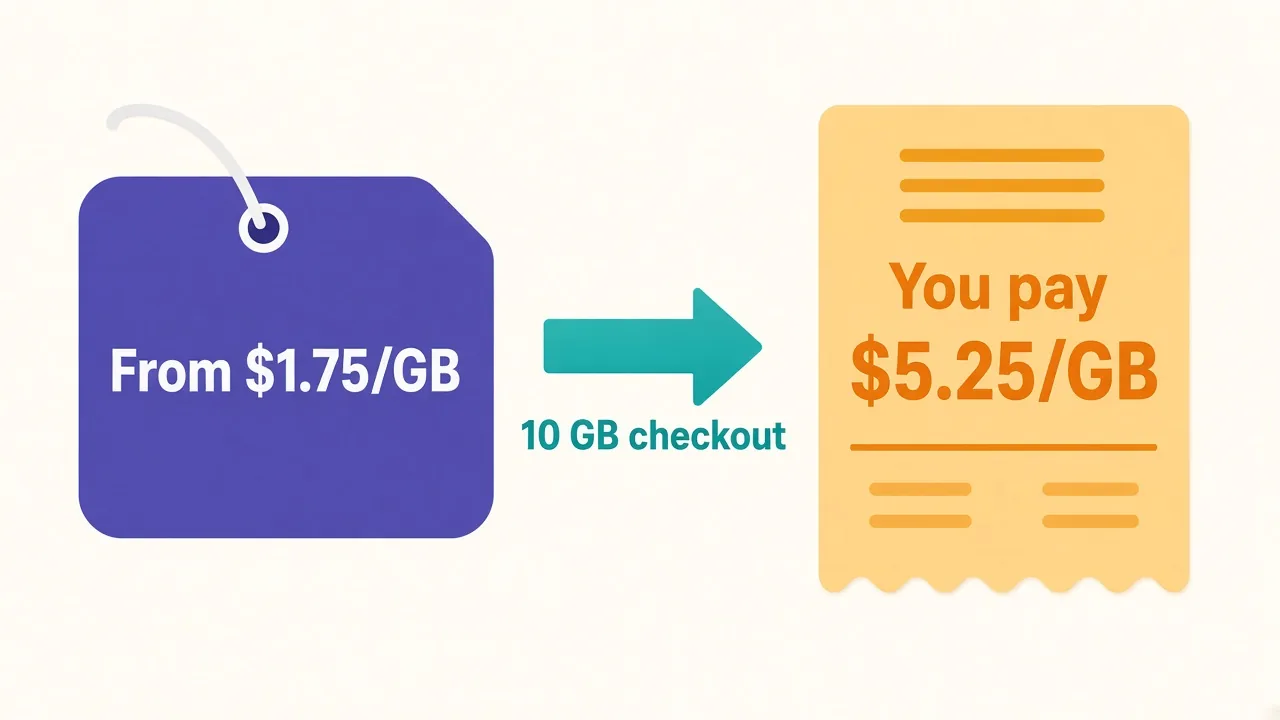
Bright Data's residential listing in our directory shows three tiers. Pay as you go sits at about $8.40/GB. A 38GB commitment drops that to about $5.04/GB. A 100GB commitment brings it to about $4.20/GB.
Oxylabs' residential pricing starts around $8.00/GB, with better rates on committed plans. Our listing doesn't break those tiers out, so check their pricing page for the exact steps.
So is Bright Data cheaper? Only if you commit.
Remember the figure we said almost nobody reads first? It's the commitment level behind the advertised rate. The "from" price on both sites belongs to a monthly plan, not to the first GB you buy.
Here's what that looks like in practice.
Using only 5GB this month? Then you're paying about the pay-as-you-go rate on Bright Data. That's slightly above Oxylabs' starting figure.
Using 100GB every month? Now Bright Data's committed tier looks very attractive.
| Your monthly usage | What to compare | Likely cheaper |
|---|---|---|
| Small and irregular | Pay-as-you-go rates | Roughly even, check both today |
| Steady 30 to 100GB | Entry committed plans | Often Bright Data on residential |
| Large and predictable | Custom enterprise quotes | Whoever negotiates harder |
There's a second catch. Both companies bill their scraping products separately from raw proxies.
Bright Data's Web Unlocker and SERP API charge per successful request. Oxylabs' Web Scraper API charges per successful result. If you mix proxies and APIs, your bill has two meters running, and forecasting gets harder on both.
For a deeper look at each bill, we've broken down Bright Data pricing and Oxylabs pricing separately. If the per-GB versus per-IP question is new to you, our guide to residential proxy pricing models covers it.
What do you get beyond the proxies?
This is the real split between the two, and it's bigger than any price difference.
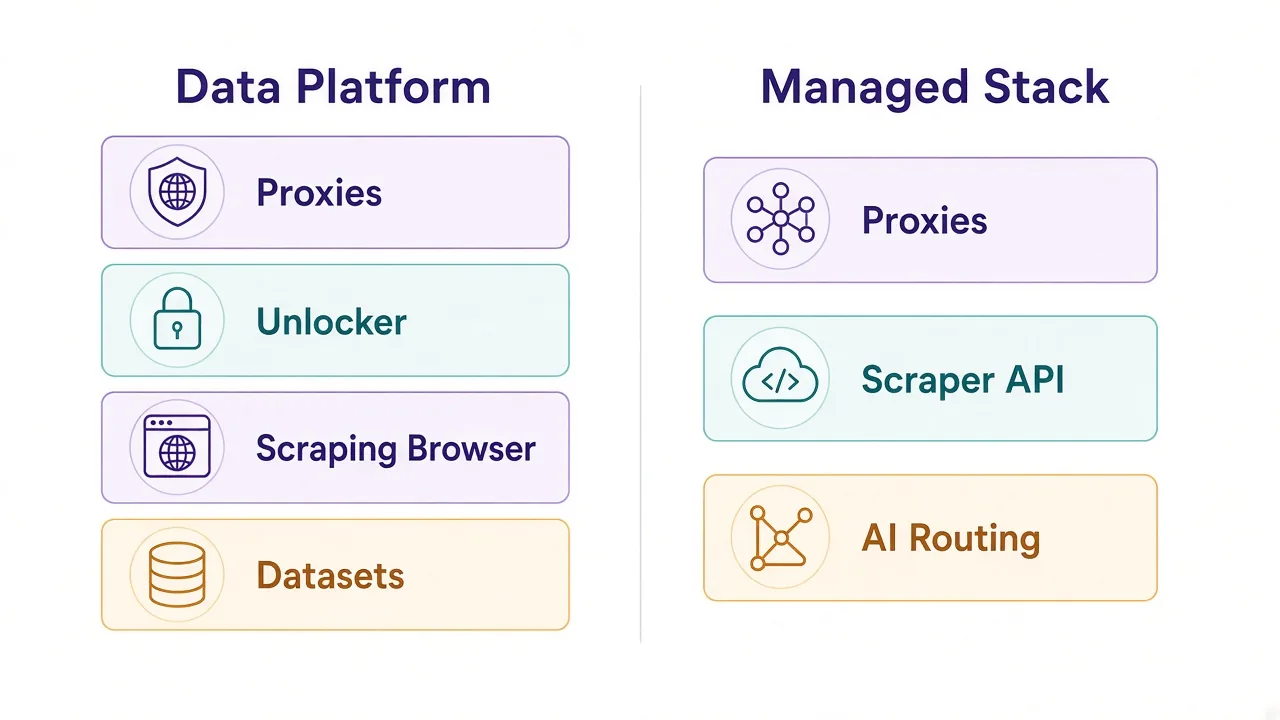
Bright Data has turned into a data platform. On top of the proxy network, it sells Web Unlocker, a SERP API, the Scraping Browser and ready-made dataset marketplaces. You can buy the data instead of collecting it.
Oxylabs is more focused. It sells premium proxies, a Web Scraper API and SERP scraping. It has also invested in AI-driven proxy management that routes requests and tunes rotation for you.
Why does that matter? Because it changes how much work lands on your team.
- Need the data but don't want to run scrapers at all? Bright Data's datasets are the shortcut neither rival matches here.
- Want to hand off unblocking but keep your own parsing? Both have an API for that.
- Want raw proxies with less manual tuning of IP rotation? Oxylabs' AI-assisted routing is built for exactly that.
- Running a headless browser against hostile sites? Bright Data's Scraping Browser is a ready-made option.
If you're not sure whether you want an API or raw proxies at all, read scraping APIs vs proxies first. It'll save you from paying for a layer you don't need.
How hard is it to get started?
Neither of these is a five-minute, card-and-go signup for every product. That surprises people.
Bright Data leans hard into know-your-customer checks. Business accounts usually go through a verification step before residential access opens up. Enterprises love that. A solo developer on a Friday night does not.
Oxylabs can also ask for verification on residential onboarding. So budget a little time for either one.
Both offer trial access, according to our directory. Use it. A trial against your own target tells you more than any comparison article, this one included.
Plan for the wait
If you need proxies running today, don't leave verification to the last minute. Start the signup a few days before the project goes live.
Then there's the dashboard.
Bright Data's control panel is powerful and dense. It exposes detailed usage logs, which helps when finance asks where the money went. It also has a real learning curve, because there are so many products in one place.
Oxylabs' setup is narrower, so there's less to learn. Its documentation is thorough, with clear API references and integration guides across languages. Bright Data's docs are extensive too, with code samples in several languages.
Who gives you better support when things break?
At this price, support isn't a nice extra. It's part of what you're paying for.
Oxylabs is the one we see praised most often for support. Business tiers get dedicated account managers and responsive technical help. That's a big reason it edges ahead on our editor rating.
Bright Data also gives paid tiers dedicated account managers and responsive technical support. Lower tiers lean more on docs and tickets.
So what's the practical difference? Small accounts. If you're spending modestly, Oxylabs tends to feel more hands-on. If you're a large account, you'll get a named contact at either company.
Compliance: which one will your legal team prefer?
Work at a company with a security review? This section might decide everything.
Oxylabs lists SOC 2 compliance. That's an independent audit of how a company handles security and data. It's often the first box a security questionnaire asks about.
Bright Data's strength here is its KYC process and its focus on ethical IP sourcing. It's the brand you'll hear most often in enterprise compliance conversations. The same KYC that slows down a hobbyist is what reassures a risk team.
Neither choice is wrong. But ask your security team which document they want before you sign. One of these vendors will make their job easier, and it depends on their checklist.
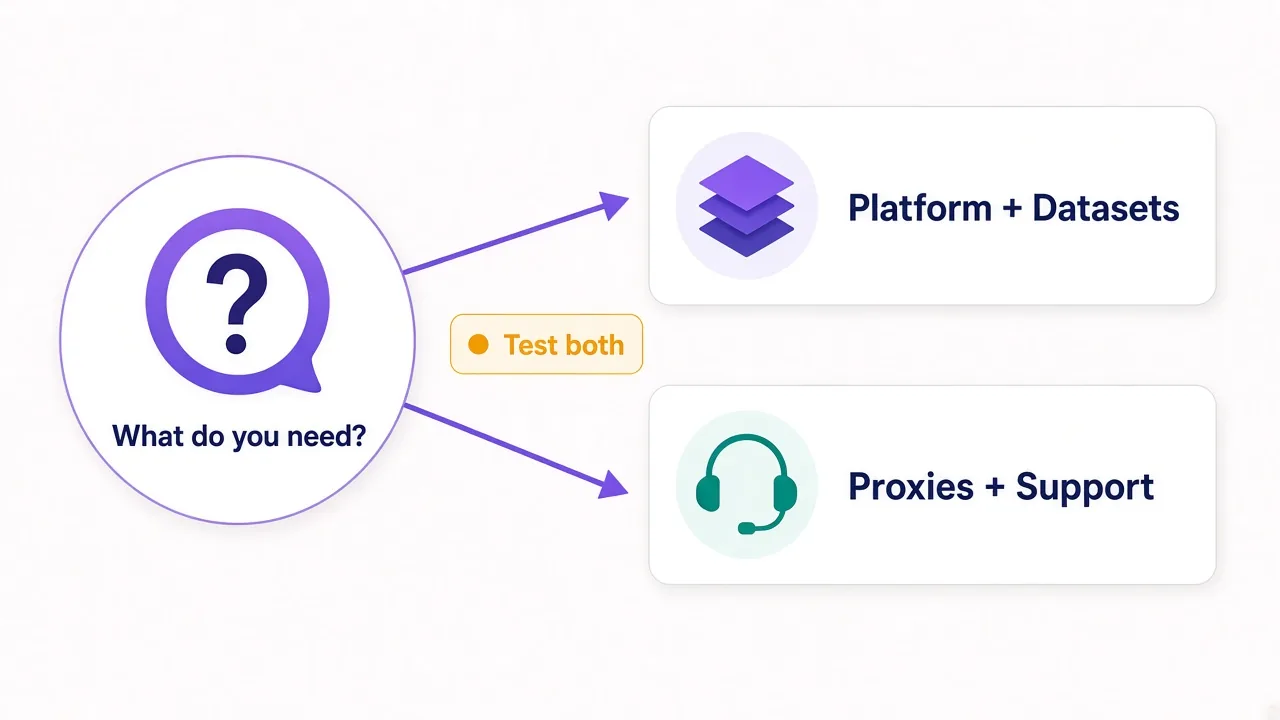
Which one wins for your use case?
Let's make this concrete. Here's where we'd lean for the jobs we see most.
| Use case | Our lean | Why |
|---|---|---|
| Price intelligence at scale | Either | Both are built for it, so compare committed rates |
| Social platforms and app endpoints | Bright Data | Its listed 7M+ mobile pool |
| SERP and SEO monitoring | Either | Both sell a dedicated SERP product |
| Buying data instead of scraping | Bright Data | Dataset marketplaces |
| High-volume datacenter jobs | Oxylabs | Larger listed datacenter pool |
| Security-reviewed procurement | Check your checklist | SOC 2 at Oxylabs, KYC focus at Bright Data |
| Small team, hands-on help | Oxylabs | Support is its standout |
Notice how often the answer is "either"? That's honest. At the top of the market, both vendors handle the core job well.
The tie-breakers are the extras: mobile, datasets, support style and the compliance paperwork.
Is either one overkill for you?
Here's the part comparison posts usually skip.
A lot of people asking "Bright Data or Oxylabs?" shouldn't buy either one yet.
If you're scraping a few thousand pages a month, both bills will sting. Both platforms assume you have real volume. Our own listings call each one overkill for casual or low-volume use.
Ask yourself three things:
- Will you use more than a few GB of residential traffic every month?
- Does your target fight back hard, with CAPTCHAs and fingerprinting?
- Does someone need a vendor with compliance documents?
If you answered no to all three, a value provider will likely do the job for far less. Our best residential proxy providers list covers cheaper options, and you can also browse Bright Data alternatives or Oxylabs alternatives.
If you answered yes to two or more, you're in the right aisle. Keep reading.
How do you test them before you commit?
Don't sign a monthly plan off a spec sheet. Run both trials against the same job.
- Pick one real target, in one real country, with your real scraper.
- Send the same number of requests through each provider.
- Track success rate, CAPTCHAs and response time, not just whether it "works".
- Test a sticky session if you log in, and rotating IPs if you crawl.
- Estimate your monthly GB, then price it on each committed tier.
That last step matters most. It's the commitment figure again. Once you know your real monthly usage, the price comparison usually settles itself.
Pro tip
Write down your target, request count and success rate for each trial. A one-page result sheet makes the sales call much shorter, whichever vendor you pick.
So, which one should you actually buy?
Start with what you need delivered, not with whose pool is bigger.
Want a full data platform, mobile IPs or ready-made datasets, and you'll commit to steady volume? Pick Bright Data.
Want premium proxies, a strong scraper API, less manual tuning and support that picks up the phone? Pick Oxylabs.
Still torn? Read the full Bright Data review and Oxylabs review, then run both trials on one real target.
The numbers will make the call for you.

Premium proxies built for enterprise scraping.
Frequently asked questions
Bright Data is better if you want a full data platform with mobile IPs and datasets; Oxylabs is better if you want premium proxies, a scraper API and hands-on support. At the core job of proxying hard targets, both are top tier.
Only on committed plans. In our directory, Bright Data residential runs about $8.40/GB pay as you go and about $5.04/GB on a 38GB plan, while Oxylabs starts around $8.00/GB. Prices change often, so check both pricing pages.
Oxylabs advertises the bigger pool, with 100M+ residential IPs against Bright Data's 72M+. For your project, the number of clean IPs in your target country matters more than the global total.
Often, yes. Bright Data runs know-your-customer checks before opening residential access for many accounts, and Oxylabs can ask for verification on residential onboarding too, so start signup a few days early.
Yes, both offer trial access according to our directory listings. Use it to test your real target and estimate your monthly GB before committing to a plan.
Usually not. Both are priced and built for teams with real volume, so a value residential provider is often a better fit for a few thousand pages a month.