









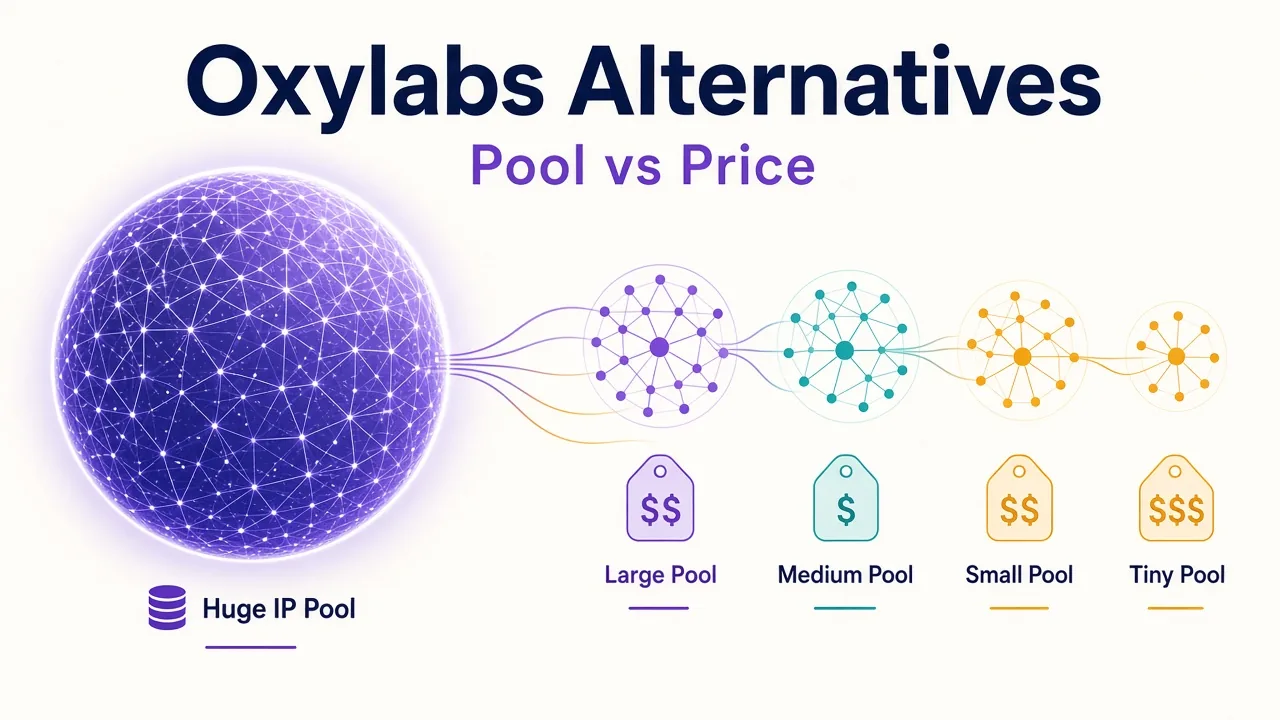
Oxylabs quoted you a price, and someone on your team went quiet.
The network is huge and the success rates are real. But about $8/GB to start is a lot of money if you're not running enterprise volume. So is a Scraper API bill that sits on a separate line.
Is there a provider with a pool that big for less? Mostly, no. The closest rival on both pool and price is Bright Data. If price matters more than raw pool size, Smartproxy (now Decodo) is where most teams land.
The rest of the Oxylabs alternatives win on one axis and give ground on the other. And a few listings claim pools far bigger than Oxylabs at a fraction of the price. We'll get to what that number really means.
First, why are you leaving?
Why are you shopping for an Oxylabs alternative?
Most people who search for this have one of four problems.
- The per-GB rate is too high for the volume you run.
- You're paying for enterprise features you never open.
- Residential onboarding asked for verification, and you wanted to start today.
- Scraper API usage is billed separately, so forecasting the bill is hard.
Our own listing backs this up. The proxy directory lists Oxylabs residential from about $8.00/GB, among the highest in the category. Our verdict calls it overkill for casual or low-volume users.
None of that makes Oxylabs bad. It's a top-tier network with a 100M+ residential pool, 195 countries, SOC 2 paperwork and support people actually praise.
The question is whether you need all of it. If you want the full plan math first, our Oxylabs pricing breakdown covers it.
So what are you really buying when you pay for that pool?
What does a 100M+ IP pool actually buy you?
A proxy pool is the set of IPs a provider can route your requests through. Bigger sounds better. Sometimes it is.
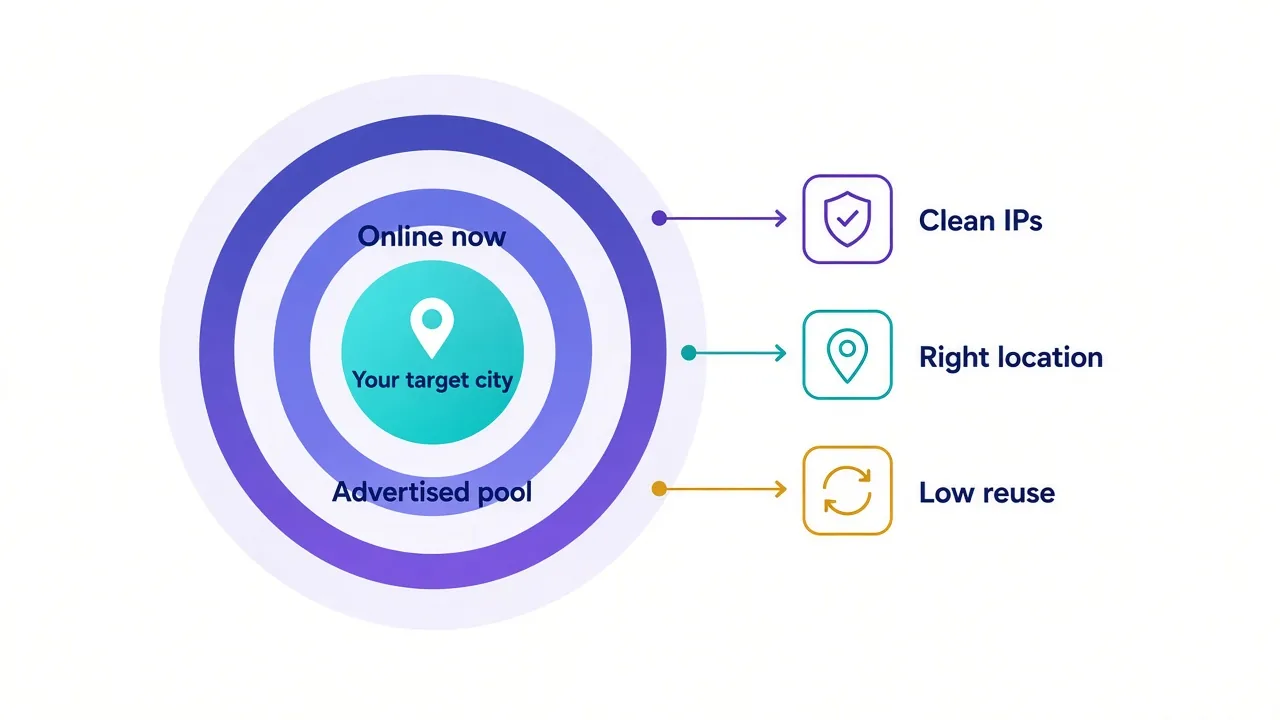
A big pool helps in two ways. You get more unique exits in hard-to-reach cities and ISPs. And each IP gets reused less often, so it's less likely to be burned when you get it.
Here's what the headline number doesn't tell you.
Providers count pool size their own way. Many count every unique IP seen over a period of time, not the IPs online right now. Very few publish how they count. So two "100M+" claims aren't always the same thing.
That matters.
As of October 2026, eight other providers in our directory of 44 advertise a residential pool of 90 million IPs or more. Two claim 200 million or more. Six of the eight list a lower starting price than Oxylabs, four of them under $2.
Country count tells a similar story. Oxylabs lists 195 countries, and so do plenty of mid-priced rivals. What differs is how many IPs each one has in a given city or ASN (the network an IP belongs to).
Does that mean you can get Oxylabs scale for a quarter of the price? Not quite. Hold that thought until the budget section.
What to compare instead
Pool size is a ceiling, not a promise. What you need is enough clean IPs in the countries and cities you target, at a cost you can sustain.
Bright Data: the only rival that matches on both
If you want an Oxylabs alternative that changes almost nothing, this is it.
Bright Data is the other enterprise giant. Our listing shows a 72M+ residential pool, a 7M+ mobile network and 195 countries. Its Web Unlocker, SERP API and Scraping Browser compete directly with Oxylabs' scraper tools.
On price it's close, and the tiers matter. Our pricing data has pay-as-you-go residential at $8.40/GB. The 38GB tier drops to $5.04/GB, and 100GB drops to $4.20/GB.
So at real volume, Bright Data's per-GB rate can land well under Oxylabs' $8 starting price. At low volume, it's no cheaper.
The catch? The dashboard is dense, KYC can slow down small accounts, and platform products are billed separately. Sound familiar? It's the same forecasting headache, with a different logo on the invoice.
Moving between the two is fairly painless, too. Both list city and ASN targeting, so your geo setup maps across without a rethink. Expect to change credentials and endpoints, not your whole approach.
Pick Bright Data when you want a second enterprise vendor for redundancy or contract leverage. Our Bright Data pricing guide walks through the tiers, and Bright Data alternatives covers the same question from the other side.

Nimble: the same pool claim, a different product
Nimble is the one listing in our directory that matches Oxylabs on both headline numbers. It advertises a 100M+ pool and starts at about $8.
But you're not buying the same thing. Nimble is a web data platform first. It sells AI-driven unblocking, structured output and managed Web, SERP, e-commerce and Maps APIs.
That's a fit if you use Oxylabs mostly through its Scraper API and spend real hours on parsing. Nimble's pitch is that it hands back cleaner data, so your team maintains less code.
The honest drawback is that it's more than you need if all you want is raw rotating IPs. Platform pricing is premium, and the full feature set takes time to learn.
Think of Nimble as an alternative to Oxylabs' data products, not its proxy pool.

AI-driven web data platform with residential proxies and managed data pipelines
Smartproxy (Decodo): most of the pool for about half the price
This is the switch we'd suggest most often.
Smartproxy, now rebranded as Decodo, lists a 55M+ residential pool across 195 countries, with city and ASN targeting. That's about half the size of Oxylabs' advertised pool.
The pricing is where it earns its place. Our data shows pay-as-you-go at $4.50/GB, the 100GB tier at $3.50/GB and 1TB at $2.60/GB. There's a free trial, and onboarding is self-serve.
For most mid-sized scraping and account work, 55M IPs is plenty. You run out of budget long before you run out of pool.
Where does it give ground? On the very hardest targets, success rates can trail the top providers. The compliance paperwork is also lighter than what Oxylabs hands an enterprise security team.
If you're on Oxylabs mainly for residential, run Smartproxy side by side first. Our Smartproxy pricing guide shows where each tier makes sense.

Powerful proxies without the enterprise price tag.
NetNut: a big pool built for steady sessions
Some teams don't leave Oxylabs over price. They leave because long sessions drop.
NetNut sits between the giants and the mid-market. Our listing shows about 85M+ residential IPs and a starting price of about $2.95. Its pitch is an ISP-direct backbone built for low latency and stable sessions.
That makes it a strong pick for sticky sessions, where you keep the same IP for a set time. A dropped connection there costs you a login or a checkout.
The catch is that the best value unlocks at larger commitments. Entry pricing is higher than budget rivals, and the dashboard is less polished than some.
Running long sessions, not quick rotating requests? Put NetNut in your bake-off. Our guide to sticky vs rotating proxies explains why that choice matters as much as the vendor.

ISP-backed residential proxies built for speed and stability at scale
GoProxy and the budget mega-pools: what's the catch?
Remember those big-pool, low-price listings from earlier? Here they are.
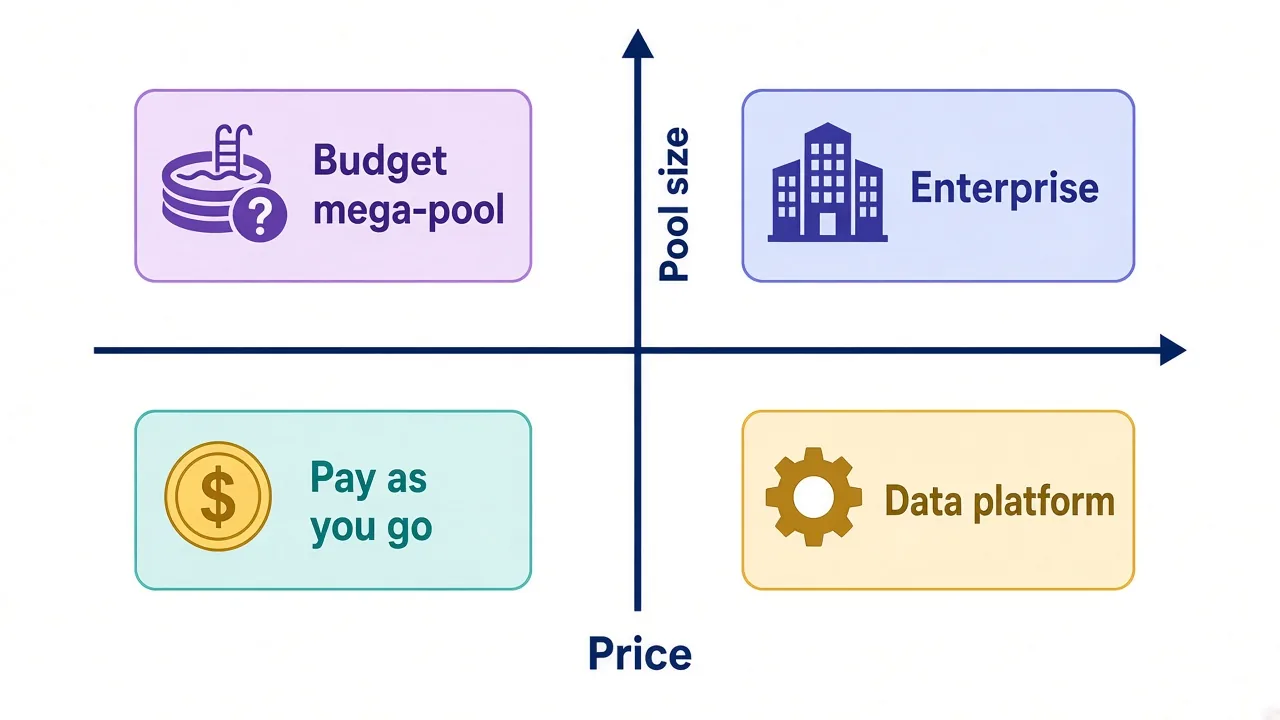
GoProxy advertises a 90M+ residential pool from about $1.80. LunaProxy claims 200M+ from about $0.85. On paper, both beat Oxylabs on pool and price at once.
Our own listings flag the same caution for both. The advertised pool size is hard to verify independently. Both are younger brands with a shorter public track record than the enterprise names.
That doesn't make them bad. GoProxy covers residential, ISP, datacenter and mobile on one platform, with city and ASN targeting. LunaProxy offers unlimited-traffic plans, SOCKS5 and strong Asia-Pacific coverage.
It means the pool number alone can't be your reason to buy. Test them on your real targets, in your real cities, before you move serious traffic.

Broad residential, ISP, datacenter and mobile proxies at competitive rates
Large residential pool with unlimited plans, SOCKS5 and budget per-GB rates
The pool-size trap
A bigger advertised pool at a lower price is a hypothesis, not a result. Test it on your targets before you migrate.
IPRoyal: when a smaller pool is the better deal
Here's a counterintuitive one. For a lot of teams, the right Oxylabs alternative has a third of the pool.
IPRoyal lists a 34M+ residential pool from about $1.75/GB. The traffic doesn't expire, and the model is true pay-as-you-go, so there's no monthly commitment to burn through.
Why does that matter? Bursty work wastes money on fixed plans. If you scrape heavily one week and barely at all the next, unused prepaid GB is the hidden cost.
The trade-offs are clear. There's no free trial, the automation tooling is leaner, and on heavily defended targets you'll see a small success gap. You also won't get dedicated account management or formal SLAs.
Pick IPRoyal when your traffic is uneven and your targets are moderate. It's also a fair fit for sneakers, ticketing and account tasks.

Flexible proxies with true pay-as-you-go.
Using Oxylabs for its Scraper API or datacenter IPs?
Not everyone on Oxylabs buys residential GB. Two other groups need different alternatives.
If you mostly use the Web Scraper API, compare managed scraping services, not proxy pools. Zyte, built by the team behind Scrapy, is the most credible name there. It bundles proxy management, rendering and AI-assisted extraction.
Zyte isn't a per-GB proxy seller, and per-request costs need careful modelling against your real workload. For ongoing Scrapy projects, that's usually a fair trade. For a quick one-off job, it's overkill.

Enterprise web scraping API and proxy management from the team behind Scrapy
If you mostly use Oxylabs' 2M+ datacenter network, the cheapest test is Webshare. Datacenter starts from $0.99 per IP, with a free tier of 10 proxies and self-serve signup.
Datacenter IPs are easier for tough sites to spot. On soft targets, that rarely matters. Our best datacenter proxy providers roundup has more options.

The most affordable way to start with proxies.
Oxylabs alternatives compared on pool and price
Here's the shortlist in one place. Pool sizes are what each provider advertises, and prices are our listed starting points as of October 2026.
| Provider | Advertised pool | Starting price in our listing | Wins on |
|---|---|---|---|
| Oxylabs | 100M+ | $8.00/GB | Scale, success rate, support |
| Bright Data | 72M+ | $8.40/GB PAYG, $4.20/GB at 100GB | Like-for-like enterprise rival |
| Nimble | 100M+ | About $8 | Managed data APIs |
| Smartproxy (Decodo) | 55M+ | $4.50/GB PAYG, $3.50/GB at 100GB | Price and ease of use |
| NetNut | 85M+ | About $2.95 | Stable long sessions |
| GoProxy | 90M+ | About $1.80 | Big pool claim, low entry price |
| IPRoyal | 34M+ | About $1.75/GB | Non-expiring pay-as-you-go |
Prices move often, so check the live cards above before you budget. The cards pull current data from our directory.
How do you run a fair bake-off?
This is the part most people skip, and it's the part that saves the money.
Remember the question from the start, about what to compare instead of pool size? It's cost per successful request on your own targets. A cheap GB that fails half the time isn't cheap.
Here's how we'd test it:
- Pick your two or three hardest real targets, not a demo site.
- Run the same script on Oxylabs and one or two challengers for a week.
- Log success rate, GB used and how often you hit blocks or CAPTCHAs.
- Divide total cost by successful requests for each provider.
Keep the test honest. Use the same concurrency, the same session type and the same retry logic on every provider. Change one thing at a time, or you'll be comparing your own settings instead of the networks.
Then add the time your team spent fixing things. Engineering hours are a real cost, and they rarely show up on the invoice.
One more check. If you target a specific city, test that city. A big global pool can still run thin in the one place your checkout flow needs.
Keep a fallback
You don't have to switch everything. Plenty of teams keep a small premium balance for the one target that refuses mid-tier pools.
So, which Oxylabs alternative should you pick?
Start with what's hurting, not with the biggest number on a pricing page.
Need an enterprise peer? Go with Bright Data. Paying too much for residential you could get cheaper? Try Smartproxy first. Losing long sessions? Test NetNut. Bursty traffic? IPRoyal won't waste your GB.
And if a mega-pool at a budget price looks too good, test it before you trust it.
Your next step is the proxy directory. Pull two of these cards, run a week of identical scripts, and let the cost per success decide.
The numbers will tell you more than the pool size ever did.
Frequently asked questions
Bright Data is the closest match on pool and price. Smartproxy (Decodo) is the best-value switch for most residential work. NetNut, IPRoyal and Nimble fit stable sessions, pay-as-you-go traffic and managed data APIs.
A few providers advertise 90M+ pools for under $2, but those counts are hard to verify independently. Test them on your own targets before moving serious traffic.
At volume it can be. Our listing has Bright Data residential at $8.40/GB pay-as-you-go, dropping to $4.20/GB on the 100GB tier, against Oxylabs from about $8.00/GB.
Not by itself. What matters is how many clean IPs are online in the countries and cities you target, and how often each IP gets reused.
Zyte is the most credible managed scraping alternative, and Nimble suits teams that want structured data APIs. Model their costs against your real workload, because API billing works differently from per-GB proxies.
Run the same scripts on your hardest real targets for a week and compare cost per successful request. Add the engineering time each provider costs you.