











IPRoyal says residential proxies start at $1.75 per GB.
Then you open the checkout, pick 1 GB to test, and the price reads $7.35. Same product. Four times the rate.
Did you misread the homepage? No. You just found the first thing to know about IPRoyal pricing.
The headline number is a 10 TB rate. Most people buy far less than that.
The good news is that IPRoyal is still one of the more flexible providers to buy from. Pay-as-you-go traffic usually doesn't expire, and the per-IP products are cheap.
There's one line of fine print about that "never expiring" traffic worth reading before you top up. We'll get to it. First, where that $1.75 comes from.
Where does the $1.75/GB number come from?
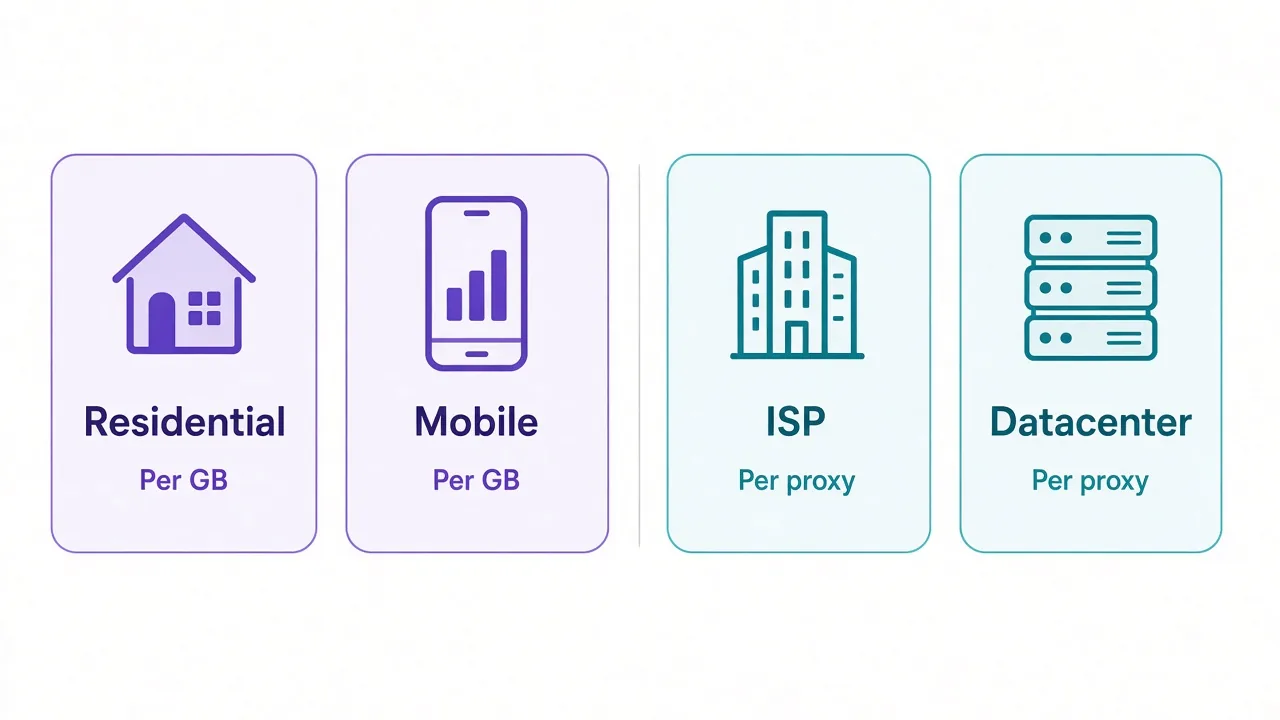
IPRoyal sells five main things: residential, ISP, datacenter and mobile proxies, plus a Web Unblocker for hard targets. Each one bills a different way.
The $1.75 figure belongs to residential proxies on a custom plan from 10 TB (10,000 GB). That's straight from IPRoyal's residential pricing page.
Ten terabytes is a lot of traffic. A scraper pulling lean 200 KB pages would need about 50 million page loads to burn through it.
So who actually pays $1.75? Large data teams with a sales contract. Everyone else lands somewhere between $5.25 and $7.35 per GB.
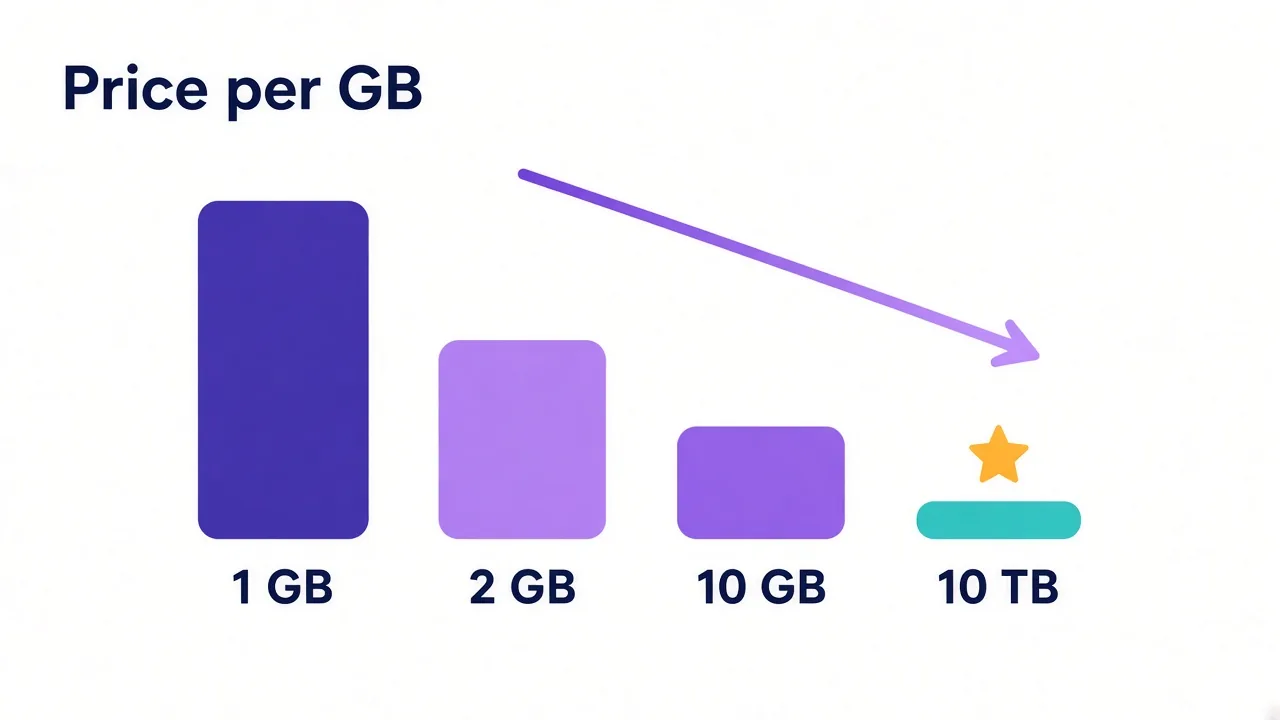
That gap isn't unusual. ProxyPicker, which tracks verified rate cards, notes that IPRoyal's curve runs from $7.00/GB down to $1.75/GB, a 4x spread. Small tests cost the most per GB, and big commitments get rewarded.
Prices change
We checked every rate below on IPRoyal's public pricing pages in October 2026, before tax. Confirm at checkout, because location and add-ons can move the final number.

Flexible proxies with true pay-as-you-go.
What do IPRoyal residential plans cost right now?
Residential is the product most people mean when they search for IPRoyal prices. You pay per GB of traffic that passes through the proxy, in both directions.
There are two ways to buy it: a monthly subscription or pay-as-you-go (PAYG). Here's the October 2026 rate card for both.
| Traffic | Subscription (per GB) | Pay-as-you-go (per GB) | PAYG total |
|---|---|---|---|
| 1 GB | $7.00 | $7.35 | $7.35 |
| 2 GB | $5.95 | $6.25 | $12.50 |
| 10 GB | $5.25 | $5.51 | $55.10 |
| 10 TB+ (custom) | $1.75 | $1.84 | Sales quote |
Notice the biggest drop. Going from 1 GB to 2 GB cuts the rate by about 15%. Going from 2 GB to 10 GB saves much less.
Every residential plan gets the same network. IPRoyal advertises 64M+ residential IPs across 195+ countries, with city-level targeting.
You also get sticky sessions of up to 7 days, auto-rotation every 1, 10 or 30 minutes, and unlimited concurrent sessions. IPRoyal doesn't lock any of it behind a bigger tier.
That's a nice change from providers that gate city targeting or long sessions behind enterprise plans. Not sure which session type you need? Our sticky vs rotating proxies guide covers it.
Subscription or pay-as-you-go: is 5% worth the auto-renew?
IPRoyal's help center says a subscription gets you an extra 5% off compared with PAYG. The table above matches that.
In real money, it's small. On 10 GB a month, you'd pay $52.50 instead of $55.10. That's $2.60 a month.
The trade is that a subscription renews on its own and adds the same traffic each period. If your usage drops one month, the GB still arrive and the card still gets charged.
There's also a one-way door. IPRoyal's subscription terms say you can't convert a PAYG purchase into a subscription. You can go the other way only after turning off auto-renewal.
So which one should you pick?
- Your monthly usage is steady and predictable: take the subscription and keep the 5%.
- Your usage comes in bursts or projects: stay on PAYG.
- You're still testing targets: PAYG, every time.
Honestly, for most small buyers the flexibility is worth more than $2.60. But that flexibility depends on the traffic sticking around, which brings us to the fine print.
Does IPRoyal traffic really never expire?
Mostly, yes. This is the line we promised at the start.
IPRoyal's FAQ says residential PAYG traffic does not expire under standard conditions. The same page adds a caveat: depending on your account plan, data activity requirements may apply to keep your balance active.
In plain words? Don't buy 500 GB, forget the account for a year, and assume it's all still waiting. Check your dashboard for the rules on your account before you stockpile.
Two more things trip people up.
First, you can't cancel a completed order. Once the GB are in your account, they're yours to use, not to refund.
Second, "never expiring" only describes residential PAYG. Fixed-term products like ISP, datacenter and dedicated mobile run for the period you bought, then stop.
Before you bulk-buy
Buy the volume you'll use in the next few months, not the next few years. The jump from 2 GB to 10 GB saves only about $0.70 per GB.
ISP and datacenter proxies: paying per IP instead of per GB
Need the same IP every day for an account or a store login? Then a per-GB plan is the wrong meter.
ISP proxies are static IPs registered to home internet providers but hosted in data centers. Datacenter proxies are plain server IPs. IPRoyal sells both per proxy, for a fixed term.
| Term | ISP (per proxy) | Datacenter (per proxy) |
|---|---|---|
| 24 hours | $1.80 | Not offered |
| 30 days | $2.70 | $1.57 |
| 60 days | $2.55 | $1.48 |
| 90 days | $2.40 | $1.39 |
Prices come from IPRoyal's ISP and datacenter product pages. Both list unlimited threads and HTTP(S) plus SOCKS5 support.
The catch is coverage. ISP proxies come from 31+ countries, and IPRoyal's datacenter pricing page lists more than 50. Residential covers 195+.
There's a soft cap too. Proxidize's breakdown of IPRoyal's pricing notes a 100 GB fair-use allowance per proxy, per 30-day cycle, on both products.
It also flags that IPRoyal's own support pages disagree on the minimum datacenter order, one proxy or five. That changes your smallest bill from $1.57 to $7.85, so check the dashboard first.
Still deciding between the two? Our explainer on what ISP proxies are walks through when the extra dollar per IP pays off.
Mobile proxies: the priciest meter, and when it's worth it
Mobile proxies route you through real carrier connections. Platforms are slow to block them, because blocking one mobile IP can lock out many ordinary phone users.
IPRoyal sells mobile two ways. Rotating mobile bills per GB. Dedicated mobile rents you a whole device's connection for a fixed term.
| Rotating mobile plan | Price per GB |
|---|---|
| 2 GB | $6.80 |
| 10 GB | $6.00 |
| 50 GB | $5.60 |
| 100 GB | $5.20 |
Dedicated mobile starts at $10.11 for 24 hours, and the 60-day card shows $123.50. Both figures are from IPRoyal's mobile pricing page, and the starting price depends on location.
Here's the honest downside. Proxidize reports that rotating mobile traffic renews every 30 days and unused GB don't carry into the next cycle. That's the opposite of residential PAYG.
So when is mobile worth it? When a target is mobile-first, like some social apps, and residential IPs keep getting challenged. For desktop scraping, it's usually overkill. Our mobile vs residential comparison goes deeper.
What does a real IPRoyal bill look like?
Rate cards are hard to reason about. So here are three hypothetical jobs, priced with the October 2026 list rates.
Job one: a small price tracker. Say you check 2,000 product pages a day, and each page costs about 300 KB with images blocked. That's roughly 18 GB a month.
At the 10 GB tier rate, 18 GB costs about $99 on PAYG or $95 on a subscription. Pack sizes at checkout can round that up a little.
Job two: five social accounts on fixed IPs. You want one stable IP per account. Five ISP proxies for 30 days cost $13.50.
The same five identities on residential sticky sessions would bill per GB instead. For light account work, the flat per-IP price is usually cheaper and simpler.
Job three: bulk crawling an easy site. If the target barely fights back, datacenter IPs do the job.
At the 90-day card rate of $1.39 per proxy, 10 proxies come to $13.90. You get unlimited threads, within the 100 GB fair-use cap.
See the pattern? The meter you choose moves the bill far more than the tier you choose.
Cut the GB, cut the bill
Residential bills count every byte. Blocking images, fonts and ad scripts in your scraper can shrink each page load a lot, and the invoice shrinks with it.
Which mistakes make IPRoyal cost more than it should?
Most overspending on IPRoyal has nothing to do with the rate card. It comes from buying the wrong thing.
The first mistake is buying mobile for a desktop job. Mobile GB cost about as much as residential, and with rotating plans, unused traffic resets every cycle. If residential IPs already get through, you're paying for trust you don't need.
The second is buying 10 GB for a test. The 10 GB tier looks like better value, but a failed test leaves you holding traffic for a target that doesn't work.
Ignoring retries is the third. If a quarter of your requests fail and get retried, you pay for that traffic twice. A cleaner setup often saves more than a bigger tier.
The fourth is targeting a city you don't need. Narrow locations have fewer IPs, so you hit more blocks and burn more retries. Use country-level targeting unless the data truly changes by city.
No free trial: how do you test IPRoyal cheaply?
IPRoyal doesn't offer a free trial. As of October 2026, 33 of the 44 proxy providers in our proxy directory do, so this stands out.
Is that a dealbreaker? Not really, because the PAYG floor is low.
A single 1 GB residential purchase costs $7.35. That's enough to test authentication, geo-targeting and a few hundred requests against your real target.
For static IPs, one ISP proxy for 24 hours costs $1.80. That's cheaper than most trials are worth.
Here's how we'd run the test:
- Buy 1 GB of residential PAYG.
- Run your scraper or account flow against the target you care about.
- Log the success rate and the GB used per 1,000 requests.
- Multiply out to your monthly volume before you buy more.
Step three is the one people skip. Without it, you're guessing at the bill.
How does IPRoyal pricing compare with other providers?
On small residential purchases, IPRoyal isn't the cheapest.
ProxyPicker ranks IPRoyal's $7.00 entry rate last among the 12 providers it has verified. The median entry rate in that set is $3.50 per GB, and DataImpulse charges a flat $1.00.
Smartproxy, now called Decodo, charges $4.00 per GB on pay-as-you-go. We broke that down in our Smartproxy pricing guide.
So why does anyone pick IPRoyal? Because the price per GB isn't the whole story.
IPRoyal gives every buyer week-long sticky sessions, city targeting and traffic that usually doesn't expire. It also sources residential IPs through its Pawns.app bandwidth-sharing app, which we covered in our post on ethically sourced proxy IPs.
If raw cost per GB is all you care about, look here first:

Transparent pay-as-you-go residential proxies with no minimums
If you want a polished dashboard and a free trial at a lower entry rate, Smartproxy is the common cross-shop:

Powerful proxies without the enterprise price tag.
Running at enterprise scale? Our Bright Data pricing and Oxylabs pricing posts cover the other end of the market.
Who should pick IPRoyal, and who should skip it?
IPRoyal fits buyers whose usage comes in bursts. Think freelancers, small scraping projects, sneaker and ticket tasks, and teams that need a handful of static IPs.
It also suits anyone who hates use-it-or-lose-it monthly plans. That's the real selling point, more than the headline rate.
Skip it if you burn hundreds of GB of residential traffic every month but aren't near the 10 TB tier. At that volume, cheaper flat rates elsewhere will add up fast.
Skip it too if you need a formal enterprise contract, a dedicated account manager, or a free trial before any spend.
So, which IPRoyal plan should you actually buy?
Start with the job, not the price per GB.
Rotating through lots of IPs on protected sites? Residential PAYG, starting with 1 GB. Holding accounts on fixed IPs? ISP proxies by the month. Crawling easy sites fast? Datacenter for 90 days.
Only move to a subscription once your usage is steady enough that the 5% beats the freedom to stop.
Want to see how IPRoyal stacks up on more than price? Compare it with our best residential proxy providers list.
Ten minutes there can save you a month of the wrong plan.
Frequently asked questions
IPRoyal residential proxies cost $7.35 per GB for 1 GB on pay-as-you-go, or $7.00 on a subscription, as of October 2026. The rate drops to $5.51 (PAYG) or $5.25 (subscription) at 10 GB.
Only on custom residential plans from 10 TB (10,000 GB), and that's the subscription rate. Pay-as-you-go at that volume is $1.84 per GB, and most small buyers pay $5.25 to $7.35.
Residential pay-as-you-go traffic does not expire under standard conditions. IPRoyal notes that data activity requirements may apply on some account plans, so check your dashboard before buying a large balance.
Yes, a residential subscription is 5% cheaper than pay-as-you-go. It auto-renews and adds the same traffic each period, so it only makes sense when your monthly usage is steady.
No, IPRoyal doesn't offer a free trial. The cheapest way to test is 1 GB of residential pay-as-you-go for $7.35, or one ISP proxy for 24 hours at $1.80.
ISP proxies start at $1.80 per proxy for 24 hours and $2.70 for 30 days, while datacenter proxies start at $1.57 per proxy for 30 days. Longer terms lower the per-proxy rate, down to $2.40 (ISP) and $1.39 (datacenter) on 90-day plans.