











You bought ten residential proxies for ten accounts. By Friday, half of them had rotated to new IPs mid-session, and two accounts were asking for phone verification.
Sound familiar? That's the exact problem ISP proxies exist to fix.
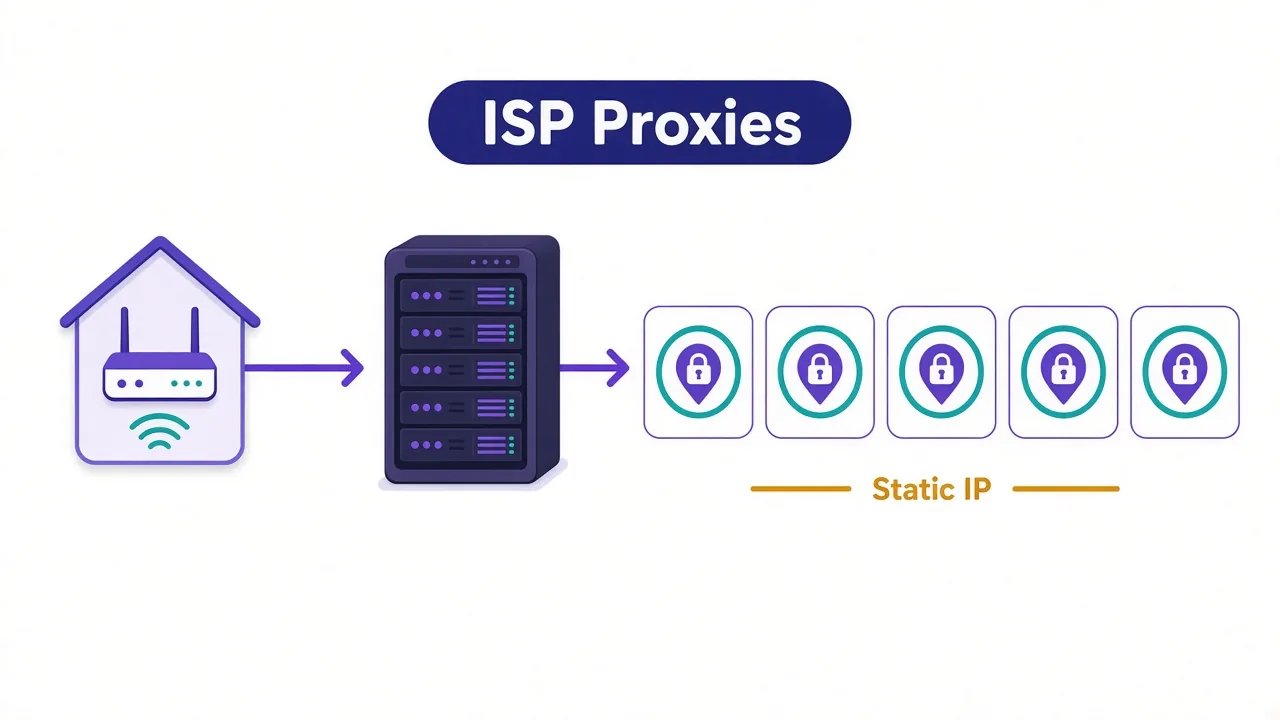
The best ISP proxy providers sell you a static IP that looks like a home connection. It stays yours for as long as you pay.
For most account work, our top pick is Live Proxies. For speed-critical checkouts, it's Mars Proxies.
But the cheapest per-IP price is rarely the cheapest proxy. There's one detail that decides whether an ISP IP lasts months or dies in a week. We'll get to it after the picks.
Our ISP proxy picks at a glance
Here's the short list. Prices live on the provider cards further down, because they change more often than this article does.
| Provider | Best for |
|---|---|
| Live Proxies | Clean IPs for social and multi-account work |
| Mars Proxies | Low-latency sneaker and retail checkouts |
| GoProxy | One account for ISP plus other proxy types |
| LunaProxy | The lowest per-IP entry price |
| IPIDEA | Asia-Pacific targets |
| 922 S5 Proxy | Hand-picking static SOCKS5 IPs by city |
| ABCProxy | Budget buyers who also need an unlocker |
Two more, PYPROXY and MangoProxy, get a shorter look near the end. They fit narrower jobs.
What makes an ISP proxy different from residential?
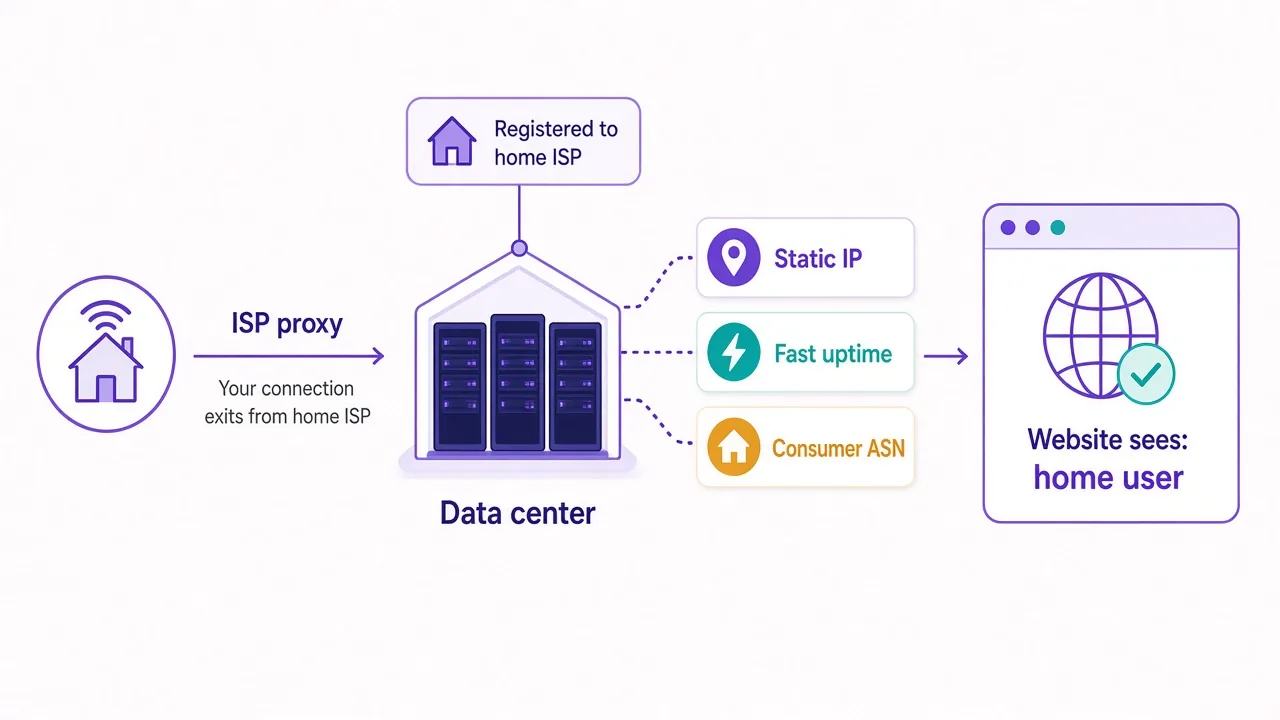
An ISP proxy is an IP address registered to a consumer internet provider, but hosted on a server in a data center.
That mix is the whole point. Websites look up who owns the IP and see a home broadband company. Your traffic, though, runs on fast server hardware.
A normal residential proxy works differently. It routes you through a real household device, which can go offline or change IP at any moment.
So you get three things from ISP proxies that residential pools struggle to give you:
- The same IP every day, for as long as you rent it.
- Datacenter-like speed and uptime.
- An ASN (the network owner a site looks up) that reads as consumer, not cloud.
The trade-off? Fewer locations, higher prices per IP, and a fingerprint that a careful site can still question. Our explainer on what ISP proxies are goes deeper on the mechanics.
How we picked the best ISP proxy providers
We started from our own directory, not a press release. As of October 2026, 9 providers in it list a dedicated ISP or static residential product.
Eight of those nine sell ISP proxies per IP. Their starting prices run from $1.30 to $7 per IP, with a median of $2.50. Six of the nine offer a free trial.
Each pick here had to clear three bars:
- A real ISP or static residential product type in the directory.
- A clear reason to choose it over the others on this list.
- An honest catch we'd tell a friend about before they paid.
We didn't run lab tests for this post, so you won't see invented success rates. The ratings and notes come from our editor reviews. The prices come from the directory listings.
One more thing before the picks. Big all-purpose networks sell ISP plans too, but our directory doesn't list an ISP product for them yet. We'd rather leave them out than guess.
Live Proxies: the cleanest pick for account work
If your accounts are the asset, start here.
Live Proxies runs private, curated pools instead of chasing giant IP counts. Our editors rate it 4.3 out of 5, the highest of any ISP provider in the directory.
Less crowded pools mean fewer strangers burning the reputation of IPs near yours. That matters more for logins than for scraping.
Coverage leans hard on the US, UK and EU. It also lists integrations with antidetect browsers like Multilogin and AdsPower, so each profile can keep its own static IP.
The catch is scale and price. The pool is smaller than the mega-networks, long-tail countries are thin, and per-unit pricing sits above the budget brands.
Running a handful of high-value social or marketplace accounts in Western markets? This is the one we'd buy first.

Curated, private residential pools for US, UK and EU targets
Mars Proxies: built for checkout speed
Sneaker drops punish slow proxies. A half-second delay can mean an empty cart.
Mars Proxies knows that and builds for it. It tunes its ISP lines for low latency, and its ISP plans come with no cap on concurrent connections.
It has a strong name in the cook community, which is where it puts most of its effort.
That focus is also the drawback. It lists about 20 countries and no free trial. Its $7 starting price per IP is also the highest ISP price in our directory.
For general scraping, you're paying for speed you won't use.
Copping limited releases or racing a retail queue? Then the premium buys exactly the thing you need.

Low-latency ISP and residential proxies built for sneaker copping
GoProxy: one dashboard when your jobs keep changing
Not every week is an ISP week.
Some days you need static IPs for logins. Other days you're crawling public pages, or checking an app over mobile.
GoProxy covers residential, ISP, datacenter and mobile in one account. Its ISP proxies start at $1.50 per IP in our listing, and city plus ASN targeting run across the platform.
ASN targeting is handy here. It lets you pick which consumer network your IP appears to come from.
The honest drawback: it's a newer brand with a shorter public track record, and it isn't the cheapest on any single type. You're paying for having everything in one place.

Broad residential, ISP, datacenter and mobile proxies at competitive rates
LunaProxy: the lowest entry price per IP
On a tight budget? LunaProxy has the lowest per-IP ISP starting price in our directory, at $1.30.
It also supports SOCKS5 alongside HTTP and HTTPS, which helps if your tools prefer one protocol. Our HTTP vs SOCKS5 guide explains when that choice matters.
Its coverage is strongest in Asia-Pacific, and there's a free trial to test before you commit.
Now the catch. LunaProxy is a younger brand than the established leaders, and support depth can vary on complex setups.
A cheap static IP is great until it's already flagged. Test a few on your real target before you buy fifty.
Large residential pool with unlimited plans, SOCKS5 and budget per-GB rates
IPIDEA: the pick for Asia-Pacific targets
Most ISP providers think in US and UK first. IPIDEA doesn't.
Its standout strength is Asia-Pacific coverage. It's also the broadest provider here, listing 220 countries across its products.
ISP proxies start at $1.50 per IP. You can authenticate with an IP allowlist or a username and password, which makes it easy to plug into most tools.
The drawback is the flip side of that focus. For North America and Europe, it doesn't offer much you can't get elsewhere.
Running e-commerce or ad checks across Asian markets? Put it on the shortlist. Selling into Ohio? Look higher up this list.
Residential proxies with exceptional Asia-Pacific coverage and per-GB pricing
922 S5 Proxy: hand-pick your static IPs
Some people don't want an IP assigned to them. They want to choose it.
922 S5 Proxy sells static residential IPs per IP, starting at $3. Its desktop client lets you pick IPs by city or country and bind them to accounts.
It's built around SOCKS5 and lists integrations with Multilogin, AdsPower and BitBrowser. That makes it a common choice for multi-account setups.
Per-IP billing is also a relief if per-GB pricing has burned you before. You know your bill on day one.
The catch? The desktop-client workflow feels clunkier than a clean API. Support and docs are basic, and we'd treat the advertised pool size with caution.

Huge SOCKS5 residential pool with pay-per-IP pricing
ABCProxy: budget ISP with an unlocker on the side
Need static IPs for some jobs and help with tougher sites for others?
ABCProxy sells ISP proxies from $2 per IP, plus residential, datacenter and mobile. It also bundles a Web Unlocker, a managed service that handles blocks on heavily protected sites.
That combination is rare at this price, and there's a free trial.
The honest drawback: it's a newer brand, and quality can be less consistent than premium networks. The advertised pool numbers deserve the usual skepticism too.
Good for cost-sensitive projects where you'll check results yourself. Less good when one bad IP costs you a client.

Fast-growing budget proxies plus a Web Unlocker
What about PYPROXY and MangoProxy?
Both made our directory list. Both fit narrower needs.
PYPROXY sells ISP proxies from $5 per IP. Its appeal is breadth and unlimited-traffic plans across proxy types. Its editor notes warn that IP quality can vary on the cheapest tiers, and there's no free trial.

Budget residential, ISP and datacenter proxies with a huge pool
MangoProxy is the odd one out. It's the only provider here that bills a dynamic ISP option per GB, from $0.80, alongside static ISP sold per IP.
Its Brazil coverage is a real standout, at roughly 36 million advertised IPs. You get targeting by country, state, city, ZIP and ASN at no extra cost. The catch is no free trial and little public information about the company.

Residential, ISP, datacenter and mobile proxies with a Brazil-heavy 90M+ pool
Per IP or per GB: which ISP plan costs you less?
This is where most people overpay.
Per-IP pricing charges you for each address, usually monthly. Per-GB pricing charges for the traffic you push through.
Which one wins depends on what you're doing with the IP.
| Your job | Better plan | Why |
|---|---|---|
| A few accounts, light browsing | Per IP | Low traffic, and each account keeps its own address |
| Many accounts on one IP each | Per IP | The bill scales with accounts, not with page loads |
| Heavy data pulls from one location | Per IP | If bandwidth is included, big pulls don't raise the bill |
| Short bursts across many cities | Per GB | You pay for usage instead of IPs you barely touch |
Say you run 15 shop accounts. Each needs one stable IP and maybe a few hundred page loads a day.
Per IP, you buy 15 addresses and know the bill upfront. Per GB, the bill moves with every page load, and you still have to keep each IP pinned to one account.
Quick check before you buy
Count the accounts or sessions that need their own IP. If that number drives your needs, buy per IP. If total traffic drives them, compare per-GB plans.
The catch no pricing page mentions: who shares your subnet
Remember that detail from the start, the one that decides how long an ISP IP lasts?
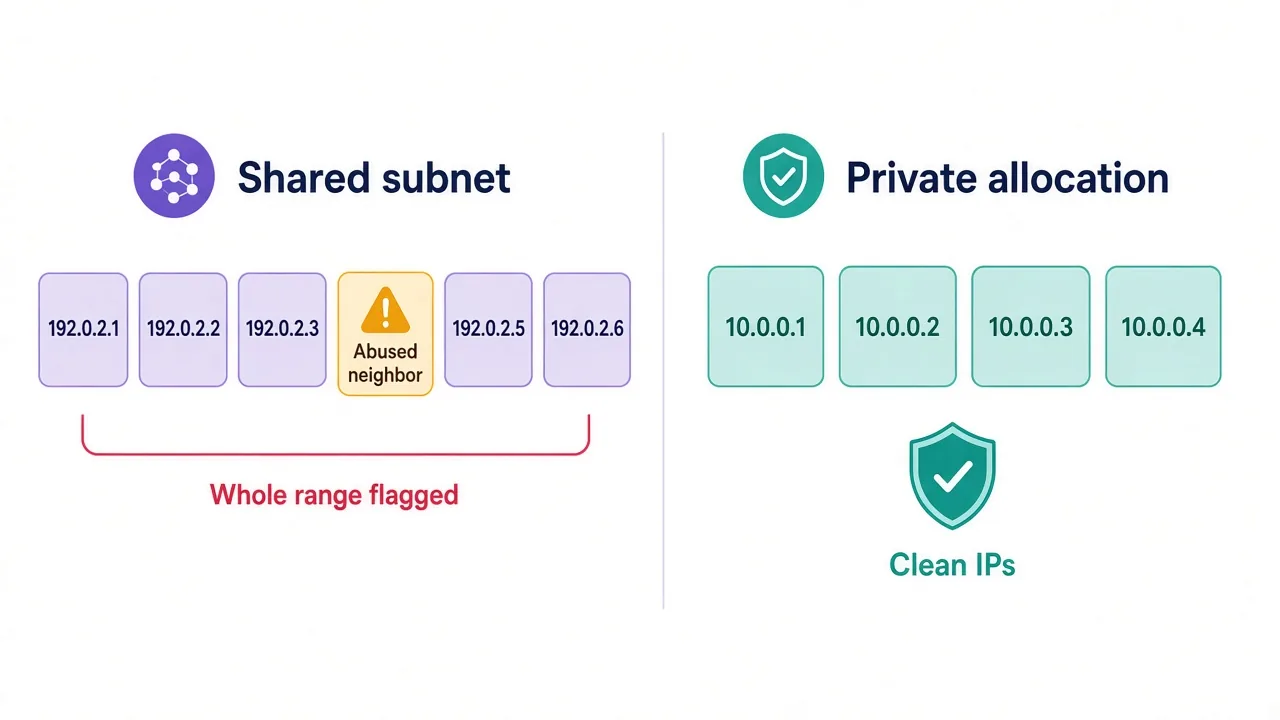
It's the subnet, the block of neighboring addresses your IP sits in.
ISP proxies often come from contiguous ranges a provider leases from an ISP. If another customer abuses addresses next to yours, sites can flag the whole range. Your clean account inherits the damage.
There's a second risk. A strict site can notice that a "home" IP answers with server-grade speed and never goes offline. That's rare on most targets, but it happens on the toughest ones.
So what do you do about it?
- Ask whether IPs are private to you or shared with other customers.
- Spread important accounts across different subnets, not one block.
- Check new IPs before you assign them. Our guide on how to check if your proxy is working walks through it.
- Ask for a replacement when an IP gets flagged, instead of fighting it.
Don't rotate ISP proxies by accident
A static IP only helps if you keep it. Pin each account to one address and leave it there. Our sticky vs rotating guide covers when rotation makes sense instead.
This is why Live Proxies tops our list. Curated, less crowded pools cut the noisy-neighbor risk that cheap shared ranges carry.
Do you even need an ISP proxy?
Honestly, not always.
If you're crawling public pages and don't log in, rotating residential or plain datacenter IPs are usually cheaper. Our datacenter roundup and residential roundup cover those.
If the target is a mobile-first app that trusts carrier IPs most, look at mobile proxies instead.
ISP proxies earn their price when one identity has to stay put for weeks. That means social accounts, marketplace shops, ad accounts and checkout bots.
So, which ISP proxy provider should you buy?
Start with what has to stay the same: the account, not the price tag.
Running valuable accounts in the US, UK or EU? Go with Live Proxies. Racing checkouts? Mars Proxies. Watching every dollar? Test LunaProxy first, then scale.
Whichever you pick, buy a few IPs before you buy fifty, and check each one on your real target.
Ready to compare? Open the proxy directory, filter for ISP, and put two cards side by side.
You'll know in five minutes.
Frequently asked questions
An ISP proxy is a static IP registered to a consumer internet provider but hosted on a data center server. Sites see a home broadband network, while you get server speed and an IP that doesn't change.
ISP proxies are better when one account needs the same IP for weeks. Rotating residential proxies are usually better and cheaper for large public scraping jobs that need many different IPs.
Live Proxies is our top pick for social media and multi-account work. Its curated, less crowded pools focus on the US, UK and EU, though it costs more than budget brands.
Most ISP proxies are sold per IP, and starting prices in our directory run from $1.30 to $7 per IP as of October 2026. Check each provider card for current pricing before you buy.
ISP proxies usually get blocked because of their subnet, not the single IP. If neighbors in the same range abuse a site, it can flag the whole block, so ask for private or less crowded allocations.