







You opened GoLogin's pricing page to add ten more profiles, and the number made you wince.
Or maybe it's not the price. Maybe a teammate wants an automation feature it doesn't have. Or a profile got flagged, and you want a second opinion on the fingerprint.
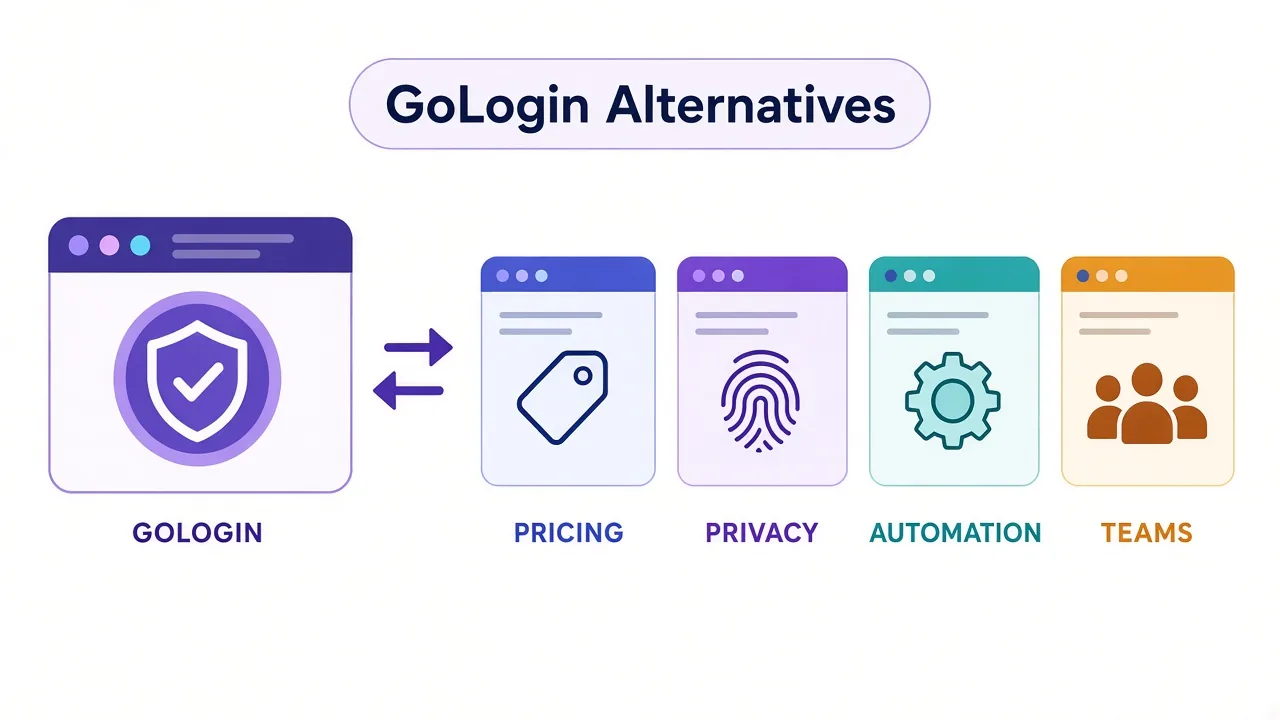
Whatever sent you looking, there are good GoLogin alternatives. For most people switching on price, AdsPower is the first one to test. If you run paid-social accounts on a tight budget, Dolphin Anty is the usual starting point.
But GoLogin does one thing that almost nothing else in our directory copies. Lose it by accident and you'll feel it within a week. So before you compare anything, ask yourself one question: what exactly are you replacing?
Why are you shopping for a GoLogin alternative?
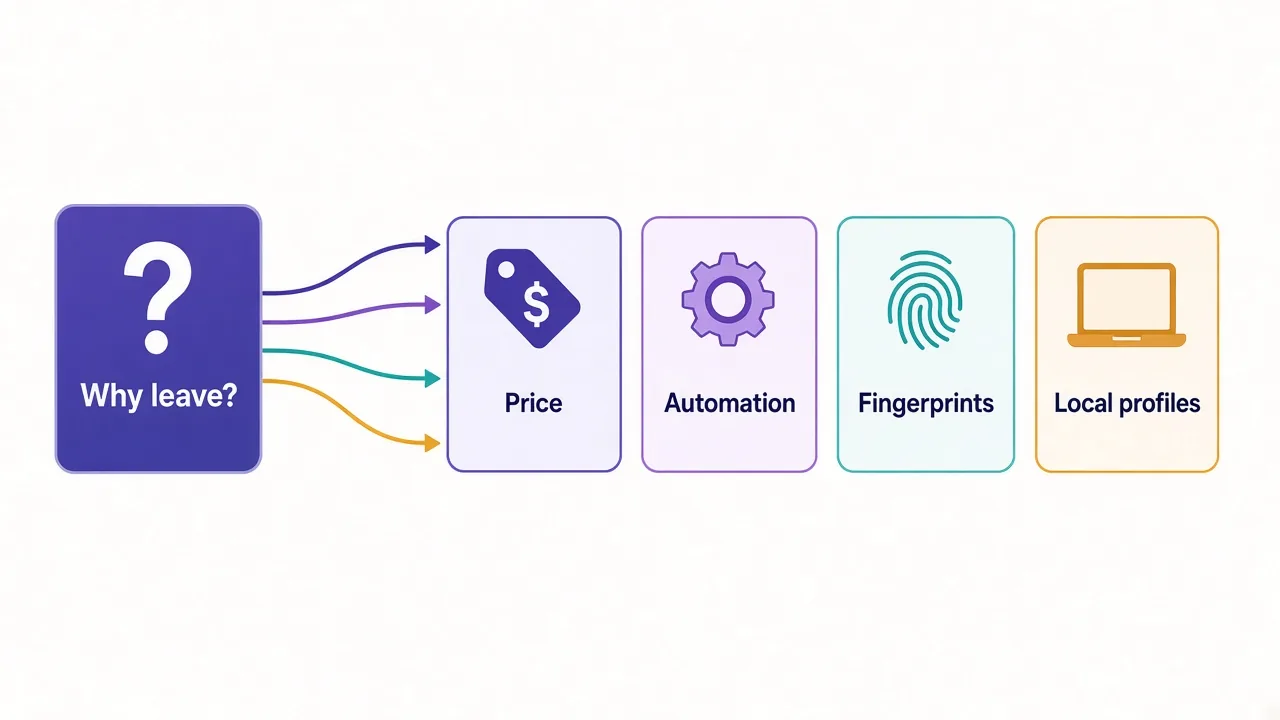
Most people who search for this fall into one of four camps.
- The plan you need costs more than you want to pay.
- You want deeper automation than the API gives you.
- A strict platform keeps flagging your profiles.
- You'd rather keep profiles on your own machine than on someone else's servers.
Each camp needs a different answer. That's why "best GoLogin alternative" lists that rank one winner for everyone tend to mislead.
Our antidetect browser directory lists GoLogin from $24/mo. Our own verdict is that the price is higher than budget rivals like AdsPower and Dolphin Anty. It also notes that free access works more like a trial than a permanent free tier.
None of that makes GoLogin a bad tool. An antidetect browser is something you live in all day, though. A small mismatch between the tool and your work adds up fast.
So which camp are you in? Keep it in mind. Every section below says which camp each tool suits.
What does GoLogin do well that you might lose?
This is the part most switching guides skip. Here's what GoLogin brings that you should check for in any replacement.
GoLogin stores profiles in the cloud. Anyone on your team can open the same account from any device without passing profile files around. Roles and permissions sit on top of that.
It also runs on more systems than almost anything else. Our listing shows Windows, macOS, Linux and Android.
That last one is the thing we hinted at earlier. As of October 2026, GoLogin is the only one of 17 browsers in our directory with a native Android app. If you check accounts from your phone, no alternative here gives you the same experience.
Linux narrows the field too. Only six of the 17 list a Linux client, and GoLogin is one of them.
Check this before you switch
If your team relies on the Android app or a Linux desktop, cross off any alternative that doesn't support it first. Price comes second.
The rest of GoLogin's feature list is easier to replace. It uses its own Chromium-based browser, called Orbita. It has an API with Selenium and Puppeteer support, and you can buy proxies inside the app or bring your own.
AdsPower: the cheaper switch with real automation
If price is the main reason you're leaving, start here.
Our directory lists AdsPower from $5.40/mo, one of the lowest per-profile prices in the category. There's a free plan with five profiles, so you can test it on real accounts before paying anything.
Automation is where it pulls ahead of GoLogin. AdsPower ships a no-code RPA robot, which records and replays repetitive tasks for you.
It also has a Synchronizer that mirrors your clicks across many windows at once. Its local API covers Selenium, Puppeteer and Playwright.
What do you give up? The cloud model, mostly. AdsPower is local-first, so profiles live on your machine. There's no Linux client in our listing, and no Android app.
The interface is dense, and first-time users can feel lost for a day or two. Some compliance-sensitive teams also weigh the fact that it's a China-origin vendor.
For e-commerce stores, dropshipping and ad accounts, it's the value pick we'd test first. Our AdsPower pricing breakdown shows where each plan starts to make sense.

Profiles at scale with strong automation.
Dolphin Anty: the free tier media buyers start on
Running Facebook or TikTok ad accounts? You've probably heard of this one already.
Dolphin Anty gives you 10 fully usable profiles at $0. That's one of the most generous free tiers in our directory, and it's why the tool spread so quickly through paid-traffic teams.
It's built around paid social. Its automation handles chores like account warming, and its fingerprints aim to look consistent rather than randomly shuffled. It runs on Windows, macOS and Linux, so Linux teams keep their desktop.
The honest drawback is focus. Dolphin Anty leans hard toward ad-buying work. If your accounts are marketplaces or scraping jobs, the extras matter less. Its automation also isn't as deep as AdsPower's RPA robot.
It's a younger vendor too, founded in 2021. That's a shorter track record than GoLogin's 2019 start.
For a solo media buyer or a small agency, it's the cheapest way to replace GoLogin without losing team features. You can invite members, set roles and share profiles.

Multilogin: is the premium pick really cheaper?
Here's a result that surprised us. In our directory, Multilogin lists a starting price of $19/mo, below GoLogin's $24.
Don't read too much into that. Our verdict still calls Multilogin one of the most expensive antidetect browsers available. Entry-level profile and seat limits push serious users onto pricier tiers fast.
So why look at it at all? Because it's the most mature tool in the category, in development since 2015. If one flagged account costs you more than a year of subscription, that track record is what you're paying for.
Multilogin has two separate browser engines. Mimic runs on Chromium and Stealthfox on Firefox. Profiles live in the cloud, and your team can share them, like GoLogin's.
The catch is weight. Running many profiles at once uses more RAM and CPU, and the learning curve is steeper. There's no mobile app either.
Choosing between the two directly? Our GoLogin vs Multilogin comparison goes deeper. Multilogin pricing covers the plan limits.

The original enterprise antidetect browser.
Octo Browser: fingerprints first, cloud profiles included
Are your profiles getting flagged on strict platforms? Then price is probably the wrong thing to optimise.
Octo Browser's whole pitch is profiles that survive. Its fingerprints come from real devices and stay stable across sessions. That stability is what keeps a long-lived account from looking like a new device every time you log in.
It also keeps the parts of GoLogin that teams like. Profiles are stored in the cloud, roles and permissions are built for agencies, and there are clients for Windows, macOS and Linux.
There's no free plan, so testing it costs money. Pricing is in euros and climbs steeply with profile count. Automation is code-only through a local API, with no no-code builder.
Pick Octo if a lost account hurts more than a higher bill. To see what a platform actually reads from your browser, our guide to how browser fingerprinting works is a good primer.

Fingerprint quality above everything else.
Kameleo: for teams who drive profiles from code
Some people barely look at their profiles. A script opens them, does the work and closes them again.
If that's you, Kameleo is the most automation-friendly tool in our directory. It has a local REST API and official SDKs for C#, Python, Java and Node. Selenium, Puppeteer and Playwright work out of the box.
It also offers real mobile profiles through an emulated Android environment, not just a swapped user agent. That's useful when a platform treats mobile traffic more gently.
The big limit is the desktop client. It's Windows-only, which rules it out for Mac and Linux teams. There's no free plan, and euro pricing starts at around €59/mo in our listing.
Profiles are local by default, so team sharing is thinner than GoLogin's cloud setup. For a pipeline, that rarely matters. For a sales team sharing logins, it does.
Already scripting browsers? Our Playwright proxy guide shows the proxy side of that setup.

API-first antidetect with real mobile profiles.
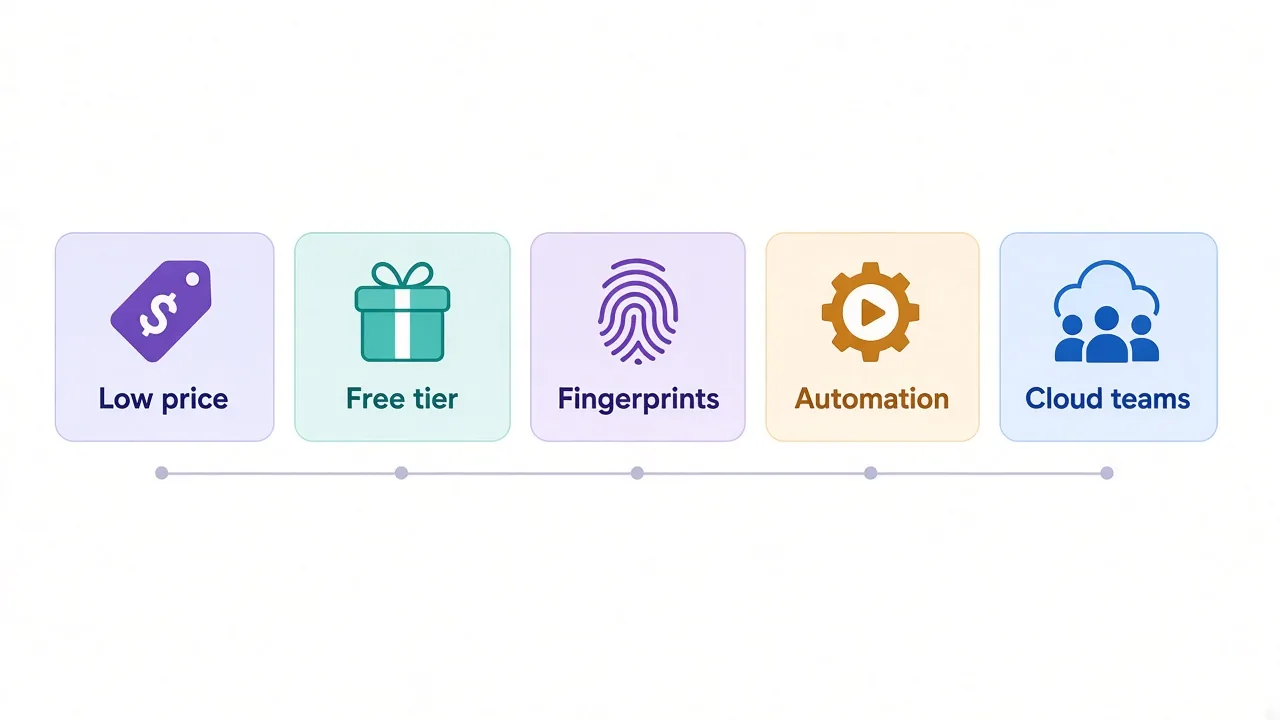
MoreLogin and BitBrowser: how cheap can you go?
Running lots of ordinary accounts and doing the same thing in each? Then the budget end of the market is worth a look.
MoreLogin lists plans from about $9/mo. Its main feature is a window synchroniser that copies actions from one leader window into many others. Bulk import, grouping and team roles are all there.
BitBrowser goes further on the free side. Our listing shows a free tier of around ten profiles and paid plans from about $10/mo. It includes a synchroniser, RPA-style automation and team roles, features that mid-market tools charge several times more for.
The catch is the same for both. Stealth is adequate rather than exceptional on the strictest platforms, and neither lists a Linux client.
Each has its own wrinkle too. MoreLogin was founded in 2022, so its track record is short. BitBrowser's documentation is thinner, and some buyers exclude it as a China-origin product.
We'd use them for volume work on mainstream sites. For accounts you can't afford to lose, go back up to Octo or Multilogin.

Cheap profiles with synchronised windows.

Ten free profiles, then cheap scaling.
Incogniton: a simple pick for solo operators
Not everyone needs team seats. If it's just you and a handful of accounts, Incogniton is worth a look.
It offers 10 free profiles, and paid plans start at $29.99/mo in our listing. The interface is calm and easy to learn. Manual fingerprint controls let you see and tune exactly what each profile shows, from Canvas and WebGL to fonts and audio.
Each profile can carry its own HTTP, HTTPS or SOCKS5 proxy, with a built-in test. The Selenium and Puppeteer API covers basic automation.
Here's the big gap. Incogniton is one of only two browsers in our directory without real team collaboration. No shared profiles, no roles, no permissions. There's no Linux client either.
That's fine for a solo seller or freelancer. For an agency, it's a dealbreaker.
Simple, reliable multi-account browsing.
Not every multi-login tool is antidetect
Ghost Browser gives every tab its own cookies, but it doesn't change your device fingerprint. If platforms link accounts by fingerprint, it won't replace GoLogin.
GoLogin alternatives compared side by side
Here's the shortlist in one table. Starting prices and features are from our directory as of October 2026, so check the live cards before you budget.
| Browser | Listed starting price | Free plan | Linux client | Best for |
|---|---|---|---|---|
| GoLogin | $24/mo | Trial | Yes, plus Android | Cloud teams on any device |
| AdsPower | $5.40/mo | 5 profiles | No | Cheap profiles, no-code automation |
| Dolphin Anty | $0 | 10 profiles | Yes | Paid-social media buyers |
| Multilogin | $19/mo | No | Yes | High-value accounts |
| Octo Browser | $29/mo | No | Yes | Fingerprint quality |
| Kameleo | About €59/mo | No | No (Windows only) | Code-driven pipelines |
| MoreLogin | About $9/mo | Small free tier | No | Synchronised volume work |
| Incogniton | $29.99/mo | 10 profiles | No | Solo operators |
Notice something? Nine of the 16 other browsers in our directory list a lower starting price than GoLogin. But among true antidetect tools, only Dolphin Anty, Multilogin and Nstbrowser pair that lower entry price with Linux and team features.
Entry prices also hide limits. A cheap starting plan with few profiles can cost more than GoLogin once you scale, so price your real profile count.
How do you switch without getting accounts flagged?
This is the second thing we promised to come back to, and it's where most migrations go wrong.
When you move an account to a new browser, its fingerprint changes. Different engine, different Canvas output, different fonts. To the platform, a familiar account just logged in from what looks like a new device.
One new device is normal. Fifty accounts all switching devices on the same afternoon is not.
Here's how we'd move without drama:
- Move a few low-value accounts first and watch them for a week.
- Keep each account on the same proxy IP and location it used in GoLogin.
- Import cookies where the new tool supports it, so sessions carry over.
- Spread the rest of the move over days, not one sitting.
- Check each new profile with our fingerprint checker before logging in.
The proxy step matters most. If the device and the IP both change at once, the platform has nothing familiar left to trust. Our guide to proxies for antidetect browsers covers which types hold up.
Long-lived logins also want sticky sessions rather than rotating IPs. An IP that changes mid-session undoes all the careful work above.
Keep GoLogin for a month
Don't cancel on day one. Keep your old plan running until the moved accounts have survived a few weeks of normal use.
So, which GoLogin alternative should you pick?
Start with why you're leaving, not with the cheapest number on a pricing page.
Leaving on price? Test AdsPower. Running ad accounts on a budget? Start on Dolphin Anty's free tier. Losing accounts to flags? Try Octo or Multilogin. Scripting everything? Look at Kameleo.
And if your team lives on Android, think twice. Nothing else in our directory replaces that app.
Your next step is the antidetect browser directory. Pick two from your camp, move five test accounts, and see which one you'd keep.
A week of real use beats any feature list.
Frequently asked questions
For most people switching on price, AdsPower is the first to test. Dolphin Anty suits budget paid-social work, while Octo Browser and Multilogin suit accounts you can't afford to lose.
Yes. Dolphin Anty offers 10 free profiles, Incogniton offers 10, and AdsPower offers 5. Free tiers carry limits, so check profile and team caps before you scale.
Yes, at entry level. Our directory lists AdsPower from $5.40/mo against GoLogin from $24/mo, though AdsPower is local-first and has no Linux client or Android app.
None in our directory. As of October 2026, GoLogin is the only one of 17 antidetect browsers we list with a native Android app, so phone-based teams should weigh that before switching.
They can, because moving changes each account's fingerprint. Keep the same proxy IP per account, import cookies, and migrate a few accounts at a time over several days.
Multilogin is the more mature, stealth-focused option, while GoLogin is easier and adds an Android app. Our listing shows Multilogin from $19/mo, but its higher tiers cost more.