








Webshare got you started for almost nothing. Ten free datacenter proxies, a self-serve signup, no sales call.
Then the project grew. Maybe your residential requests started failing on a tougher site. Maybe you need city-level targeting, or bandwidth that doesn't burn out mid-month. Sound familiar?
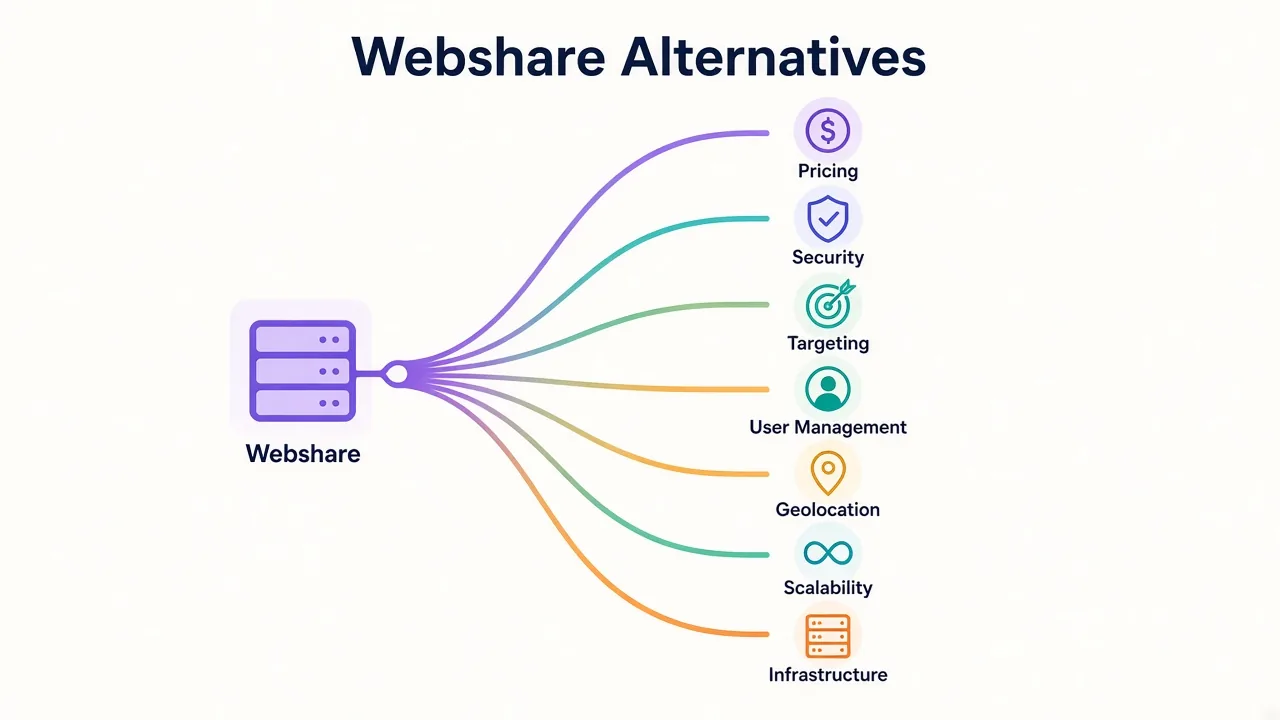
Here's the short version of these Webshare alternatives: for cheap residential traffic, look at IPRoyal. For a polished all-rounder, Smartproxy (now Decodo). The other five picks each win one specific job.
Which job is yours decides everything. And there's one question most people skip before switching, which we'll get to before the list.
Why do people outgrow Webshare in the first place?
Webshare is good at one thing: making proxies cheap and easy to try. Our directory lists its datacenter proxies from $0.99 per IP and residential from $4.50 per GB, as of October 2026.
That free tier is a real gift. You can test a script, learn how proxy auth works and break nothing.
The catch shows up on harder targets. In our listing, the main drawback is that its residential success rates trail premium providers on hard targets. It also has no built-in unblocking or CAPTCHA tools.
So the usual triggers for leaving look like this:
- Requests to a well-defended site keep coming back as blocks or CAPTCHAs.
- You need city, ISP or carrier targeting for local results.
- Your traffic is bursty, and you hate paying for bandwidth you didn't use.
- You're running real accounts, not just crawling pages.
Hit one of those? You're in good company.
None of those mean Webshare is bad. They mean you've hit the edge of what a budget-first provider is built for.
The question to answer before you switch
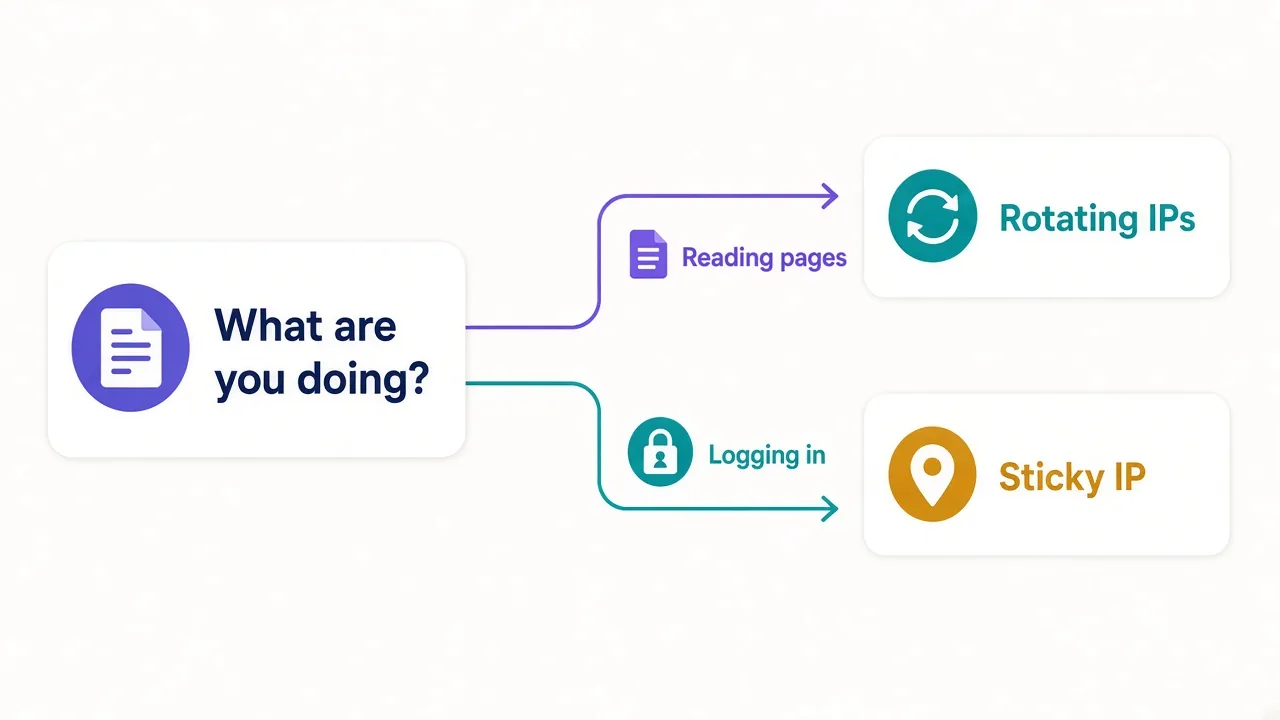
Remember that question from the start? Here it is: are you logging in, or just reading pages?
Reading pages means scraping prices, checking search results or monitoring stock. You want lots of IPs that rotate often, and you care about cost per successful request.
Logging in means managing accounts on social platforms or marketplaces. You want one clean IP that stays put for the whole session. Rotation there gets accounts flagged.
That split changes which provider wins. A cheap rotating pool is perfect for crawling and risky for accounts. If the difference is new to you, our guide to sticky vs rotating proxies covers it in five minutes.
Quick rule
Crawling public pages? Optimize for price per GB and pool size. Running accounts? Optimize for IP cleanliness and sticky session length.
Our 7 Webshare alternatives at a glance
We picked these from the providers we list in the DriftProxy proxy directory. Each one beats Webshare at something specific. We left prices out of the table because they move, and the cards below each pick show live figures.
| Provider | Best for | Main trade-off |
|---|---|---|
| IPRoyal | Cheap residential, bursty projects | No free trial |
| Smartproxy (Decodo) | Best all-rounder for most people | Mid-sized pool |
| Oxylabs | Hard targets at high volume | Premium pricing |
| Live Proxies | Social media and account work | Fewer countries |
| SOAX | City, ISP and carrier targeting | Smaller residential pool |
| Geonode | Heavy scraping without per-GB bills | Limited fine targeting |
| Rayobyte | Datacenter and ISP proxies at scale | Pricier residential |
1. IPRoyal: the cheapest jump up to real residential
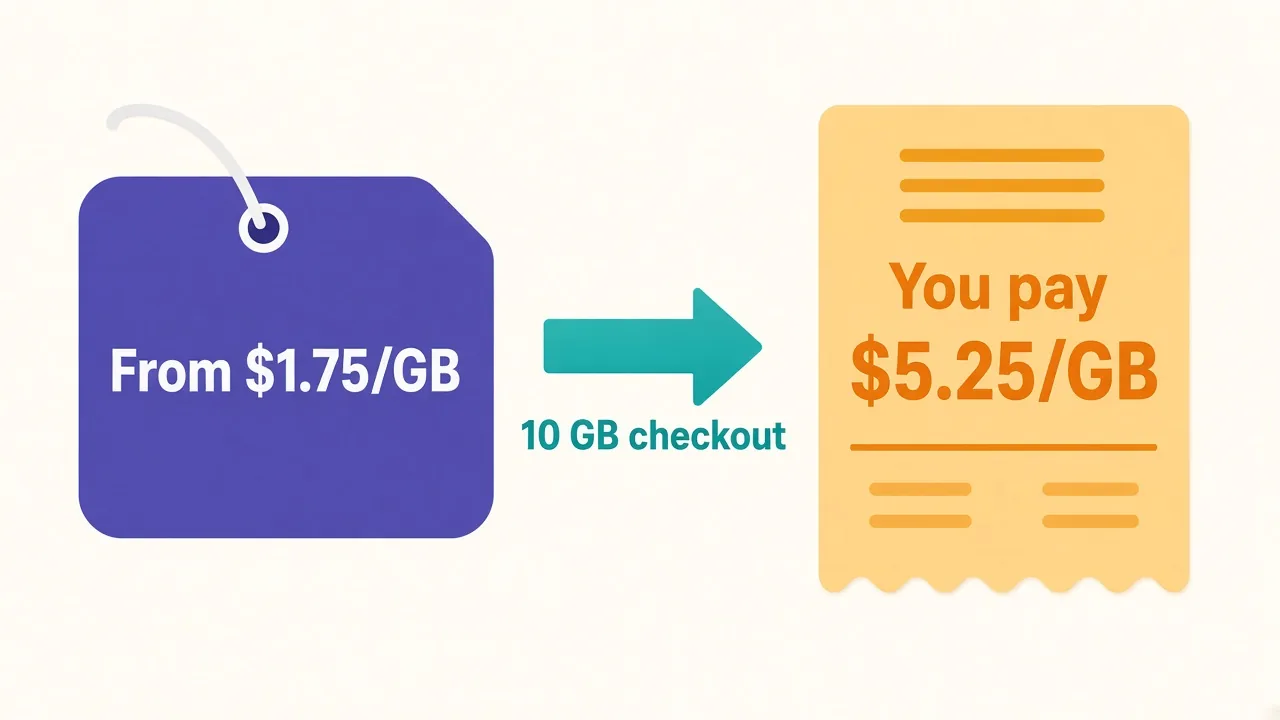
If Webshare's residential traffic feels pricey for what you get, IPRoyal is the natural next step. Our directory lists its residential proxies from about $1.75 per GB, among the most affordable we track.
The part we like most is that residential traffic doesn't expire. Buy 10 GB for a side project, use 3 GB, and the rest is still there next month. That's ideal for work that comes in bursts.
It's true pay-as-you-go, with no forced monthly plan. It also covers 195 countries with a 34M+ pool.
The honest downside? There's no free trial. Your first small top-up is your test, so start with the smallest package and check it against your real target. Our IPRoyal pricing breakdown shows where the per-GB rate drops.

Flexible proxies with true pay-as-you-go.
2. Smartproxy (Decodo): the safe pick for most people
Smartproxy rebranded as Decodo, so you'll see both names around. Either way, it's the provider we'd point a Webshare user to when they want "the same ease, but better results."
The dashboard is one of the friendliest we've listed, and onboarding feels close to Webshare's. Our directory shows a fast average response of around 0.55 seconds and residential from about $3.50 per GB.
Where does it fall short? The pool is mid-sized, at 55M+ IPs, versus the 100M+ of the biggest enterprise networks. For most projects, that never matters.
If you want to compare it with its own rivals, we wrote up Smartproxy alternatives too.

Powerful proxies without the enterprise price tag.
3. Oxylabs: when the target fights back hard
Some sites barely notice proxies. Others throw a CAPTCHA at the third request. If you're stuck on the second kind, Oxylabs is built for you.
It runs one of the largest residential pools around, at 100M+ IPs across 195 countries. In our listing, it stands out for very high success rates against demanding anti-bot targets. AI-driven management also cuts manual rotation tuning.
The trade-off is cost. Residential starts around $8 per GB in our directory, which is among the highest in the category.
Is it worth it? Only for the right job.
That's overkill for a hobby scraper. It makes sense when failed requests cost you more than bandwidth does. See the tiers in our Oxylabs pricing guide.

Premium proxies built for enterprise scraping.
4. Live Proxies: built for accounts, not crawling
This is the pick for the "logging in" crowd from earlier. Live Proxies runs private, curated residential pools, so the IPs you get haven't been hammered by thousands of other scrapers.
That cleanliness is what keeps social and marketplace accounts alive. Its coverage is strongest in the US, UK and EU, and it also sells static ISP proxies for long sessions.
What's the catch? Scale. The pool is around 500K+ IPs across roughly 40 countries. That makes it the wrong tool for crawling millions of pages or hitting long-tail locations.
Pair it with an antidetect browser if you run several profiles. Our list of the best proxies for antidetect browsers explains why the two belong together.

Curated, private residential pools for US, UK and EU targets
5. SOAX: precise targeting for local results
Say you're checking how a product ranks for searchers in Austin, not just "the US." That kind of local check needs fine-grained targeting. SOAX makes precise location work easy.
Our directory rates its geo-targeting as best in class, down to city, ISP and mobile carrier. Its pool is ethically sourced and regularly refreshed, and the mobile network handles some of the toughest targets.
The downside is size. At 8.5M+ residential IPs, the pool is small next to rivals in the tens of millions. Pricing starts around $4 per GB, so it isn't the cheapest either.
If sourcing matters to your compliance team, our piece on ethically sourced proxy IPs shows what to ask any provider.

Clean, ethically-sourced residential & mobile IPs.
6. Geonode: heavy scraping without the per-GB meter
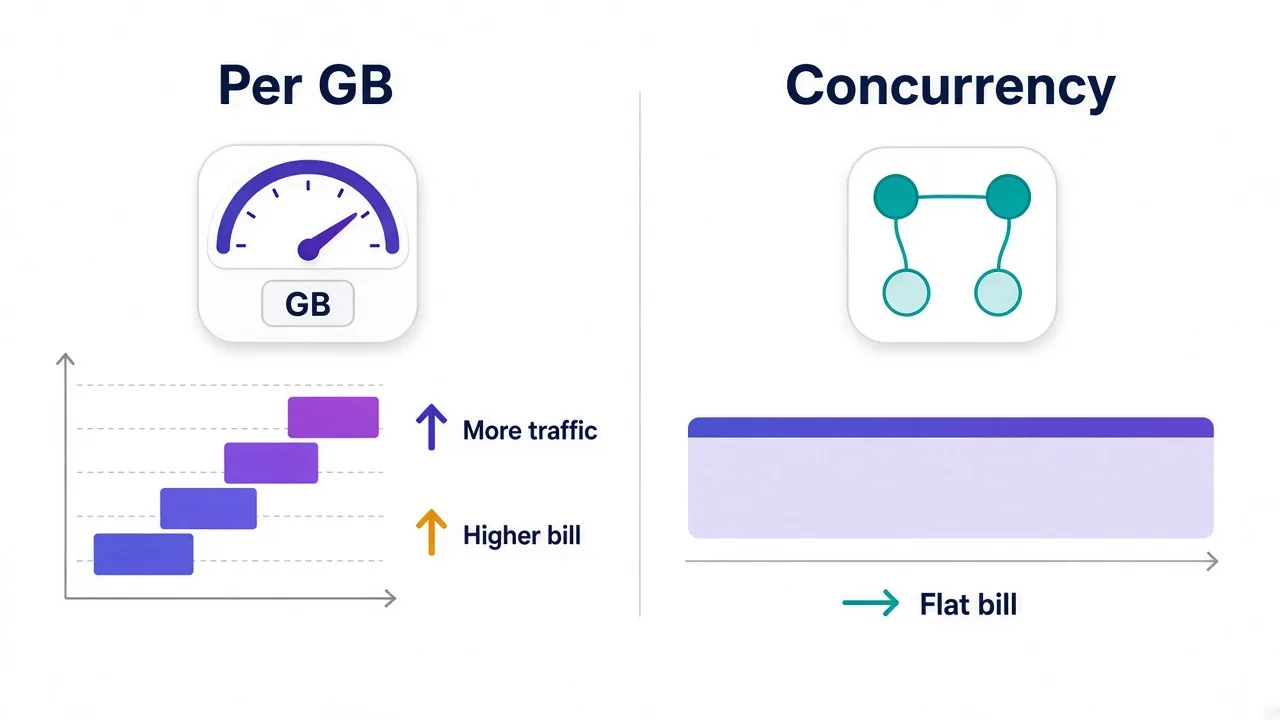
Here's a pricing model most Webshare users haven't tried. Geonode sells unlimited-bandwidth residential plans priced by concurrency, meaning how many connections you run at once.
Why does that matter? If your scraper pulls heavy pages all day, per-GB billing punishes you for every image and script. With concurrency pricing, the bill stays flat as traffic climbs.
For steady, high-volume crawling, that's a big deal.
It's developer-friendly, with clear docs and a quick API setup. The trade-offs are a smaller residential pool of about 2M+ IPs and limited city or ASN targeting.
Not sure how much traffic you burn? Our guide to proxy bandwidth helps you estimate it before you pick a plan type.

Unlimited-bandwidth residential proxies priced by concurrency
7. Rayobyte: a bigger home for datacenter and ISP proxies
Plenty of people use Webshare purely for datacenter proxies, and that's fine. When you need more of them, or more reliable static IPs, Rayobyte is the step up.
It's a US-based provider with a very large dedicated datacenter footprint and a strong ISP (static residential) offering. ISP proxies give you a home-looking IP that doesn't change, which suits long sessions.
Its residential side is the weaker half. The pool isn't as deep as the specialists above, and residential pricing sits on the higher side.
Weighing datacenter options in general? Our roundup of the best datacenter proxy providers goes wider.

US-based proxy and scraping platform with a big datacenter footprint.
Is the free tier the thing you'll actually miss?
For a lot of people, yes. Webshare's ten free datacenter proxies are rare, and none of the seven picks above copy that exactly.
Most of them do offer a free trial in our directory, though. IPRoyal is the exception, so test it with its smallest paid package.
Whatever you do, don't fall back on public free proxy lists for real work. They're slow, shared with strangers and often logged. Our comparison of free vs paid proxies lays out the risks.
Before you migrate
Run the same 100 requests against your real target with your old and new provider. Compare success rate, not just speed.
Three mistakes people make when leaving Webshare
Switching providers feels like progress. Done carelessly, it just moves the same problem to a bigger bill.
Mistake one: buying the biggest pool. A 100M+ pool sounds safer than a 2M one. But if you only target one country, most of those IPs never touch your traffic.
What matters is how many clean IPs sit in the locations you actually use.
Mistake two: judging by speed tests alone. A fast proxy that gets blocked is still a failed request. Measure success rate on your real target first, then look at response time.
Mistake three: using rotating IPs for accounts. This one hurts the most. Picture a shop account that logs in from Ohio, then Poland, then Brazil within ten minutes.
No real person does that. Platforms notice, and the account gets a verification wall or worse.
So what's the fix? Match the session type to the job, keep one IP per account, and change one variable at a time when you test.
Proxies keep getting flagged and you're not sure why? Read why proxies get banned before you spend money on a new provider. Sometimes the fix is a setting, not a switch.
How do you switch without breaking your setup?
Relax. This part is easier than it sounds.
The good news: moving providers is mostly a config change. Your code doesn't care whose IPs it uses.
- Pick one target URL that matters and save a baseline result from Webshare.
- Create a trial or small plan with the new provider and grab its gateway host, port and credentials.
- Swap the proxy string in one script or browser profile, not all of them.
- Check that the new IP and location are what you expect.
- Run a small batch, compare block rates, then roll it out.
Step four trips people up more than you'd think. A wrong country or a leaked real IP ruins the test. Our guide on how to check a proxy is working covers the quick checks.
One more thing. Keep your Webshare account for a week while you compare. If the new provider disappoints, you've lost nothing.
Could a scraping API beat any proxy here?
Sometimes, yes. If you're spending hours fighting CAPTCHAs and fingerprint checks, a scraping API handles rotation, retries and rendering for you.
You trade control for convenience, and pricing moves to credits instead of gigabytes. For page-reading jobs on heavily protected sites, that trade often pays off.
Think of it as renting the whole unblocking stack along with the IPs.
For account work, it doesn't fit at all. Our breakdown of scraping APIs vs proxies shows where the line sits.
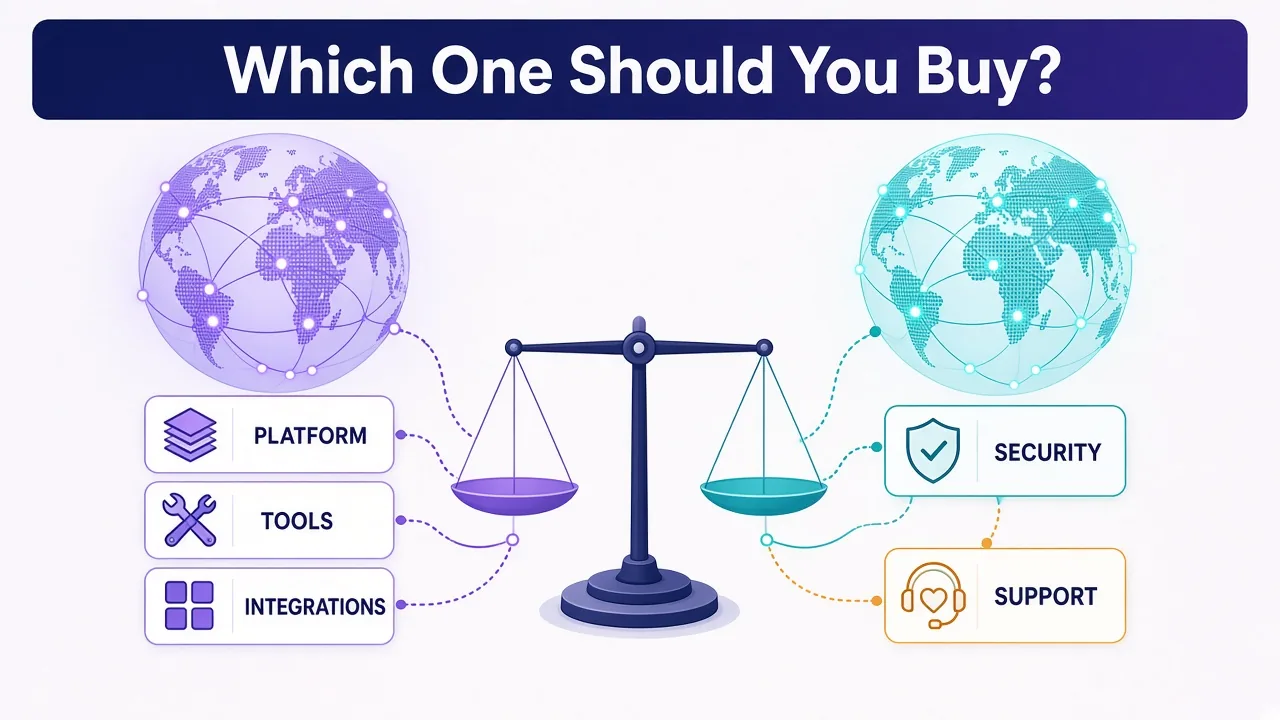
So, which Webshare alternative should you pick?
Go back to the one question: logging in, or reading pages?
Running accounts? Start with Live Proxies. Crawling on a budget? IPRoyal, or Geonode if your traffic is heavy and steady. Stuck on a site that blocks everything? Oxylabs. Need a specific city? SOAX.
And if you just want something that works without thinking about it, Smartproxy is the easy call.
Still undecided? Compare every provider we've reviewed side by side, then test your top pick on your real target.
That's the whole decision.
Frequently asked questions
For most people, Smartproxy (now Decodo) is the best all-round Webshare alternative. It keeps the easy setup but adds a larger residential pool and better results on tougher sites.
IPRoyal is the cheapest step up, with residential traffic from about $1.75 per GB in our directory as of October 2026. Its traffic doesn't expire, which suits bursty projects.
None of our seven picks copies Webshare's free plan of 10 datacenter proxies. Most offer a free trial instead, so you can test on your real target before paying.
Live Proxies is our pick for account work because it uses private, curated residential pools. Pair its sticky IPs with one IP per account and an antidetect browser for multiple profiles.
Webshare works well for light scraping and easy targets, especially on its cheap datacenter proxies. On heavily protected sites, its residential success rates trail premium providers like Oxylabs.
Swap the gateway host, port and credentials in one script first, then compare success rates on your real target. Keep your Webshare account for about a week until the new provider proves itself.