









You hired a virtual assistant to answer buyer messages on your eBay store. They log in from another country on day one.
By the next morning, the account wants extra verification. Your Etsy shop, which they also help with, does the same thing a week later.
Sound familiar? Nothing shady happened. The marketplaces saw a login from somewhere new and got nervous.
For most sellers, the best proxies for eBay and Etsy are static residential (ISP) IPs, one per store. Put each IP in the country where the store lives. Rotating residential IPs belong to research work like price tracking, not to logins.
Why that split, and which providers fit each job? We'll cover both. We'll also bust the biggest myth about "hiding" extra shops. Then we'll get to the habit that triggers more security checks than any IP.
Why would an eBay or Etsy seller need a proxy at all?
Most solo sellers working from one home connection don't. Your home IP is already the most believable network a store can have.
Proxies start to matter once your setup gets more complicated. Here are the situations where we'd reach for one:
- A team member or assistant logs in from a different city or country
- You travel a lot but want your store to keep one steady home base
- You run several stores and want each one to have its own consistent network
- You track competitor prices or sold listings across hundreds of pages
- You want to see how your listings look to buyers in another country
Notice the pattern? Every one of those is about consistency or visibility. None of them is about tricking the marketplace.
That distinction shapes everything else in this guide, so it's worth getting straight before you spend a cent.
Can a proxy hide your Etsy shops from each other?
No. And on Etsy, you're not supposed to try.
Etsy's own help page on opening a second shop says you're welcome to run several. Each shop needs its own account and email address.
Here's the part most proxy guides skip. Etsy also says you must list every shop you run in the Public Profile of each account. It asks you to use the same taxpayer ID and address where they apply.
So the shops are linked on paper whether you like it or not.
eBay works in a similar way. Its multiple accounts policy allows separate accounts for buying, selling or different product lines. It also says restrictions on one account can be applied to your other linked accounts.
What both platforms ban is using a new account to dodge fees, limits or a suspension. Etsy's Seller Policy also rules out duplicate shops built to game search.
What a proxy won't fix
If a store was suspended, a fresh IP won't make a new one legitimate. Both marketplaces treat ban evasion as a policy breach, and they look at far more than your IP.
So why bother with proxies? Because legitimate multi-store sellers still get tripped up by messy network signals. That's the problem a good proxy solves.
What do eBay and Etsy notice when you log in?
Every login leaves a trail. The IP is only one part of it.
The IP tells the site roughly where you are and what kind of network you're on. A home broadband line looks normal. A cloud server or a busy VPN exit looks less normal.
Your browser adds more. Cookies, saved sessions and your browser fingerprint can show that two accounts live on the same machine. A fingerprint is the mix of screen size, fonts, graphics card and settings your browser reveals.
Then there's history. Say a store logs in from Ohio every day for a year. If it suddenly appears in Manila, that looks odd, even if nothing is wrong.
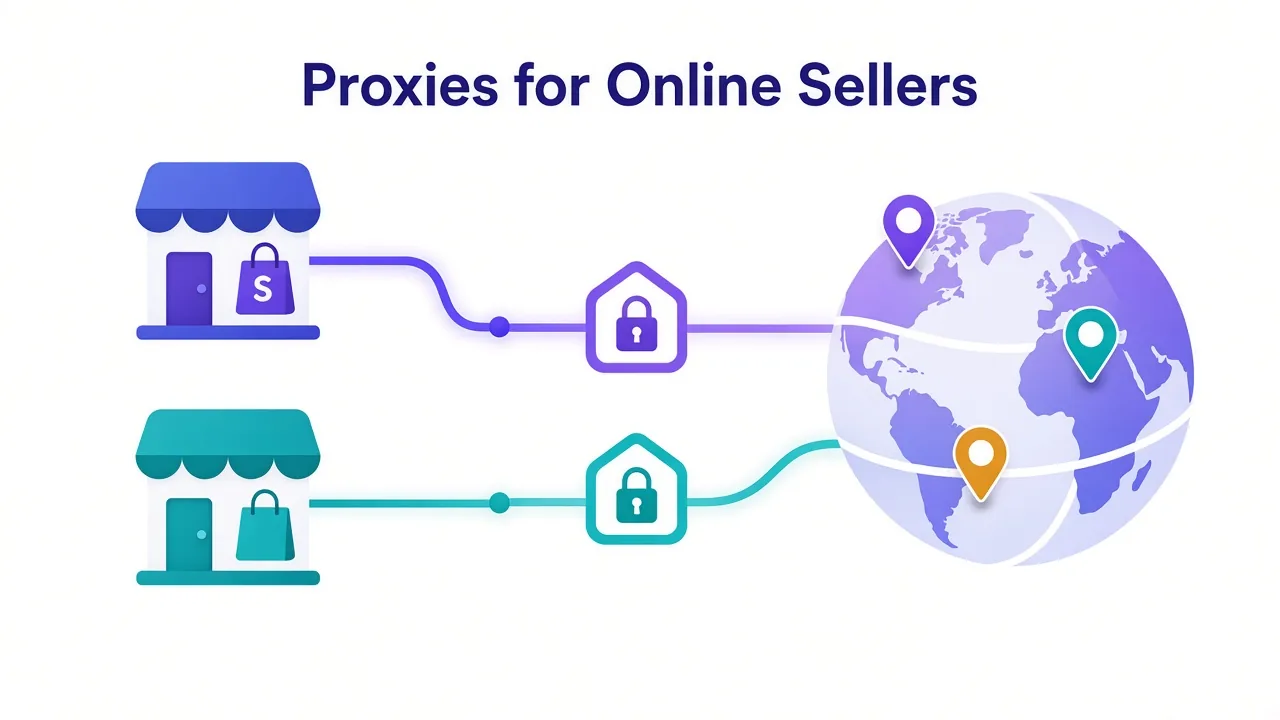
That's the real job of a seller proxy. It gives each store one believable, stable home on the network, no matter who is sitting at the keyboard.
Which proxy type fits each eBay and Etsy job?
Pick the type for the job first. The provider comes second.
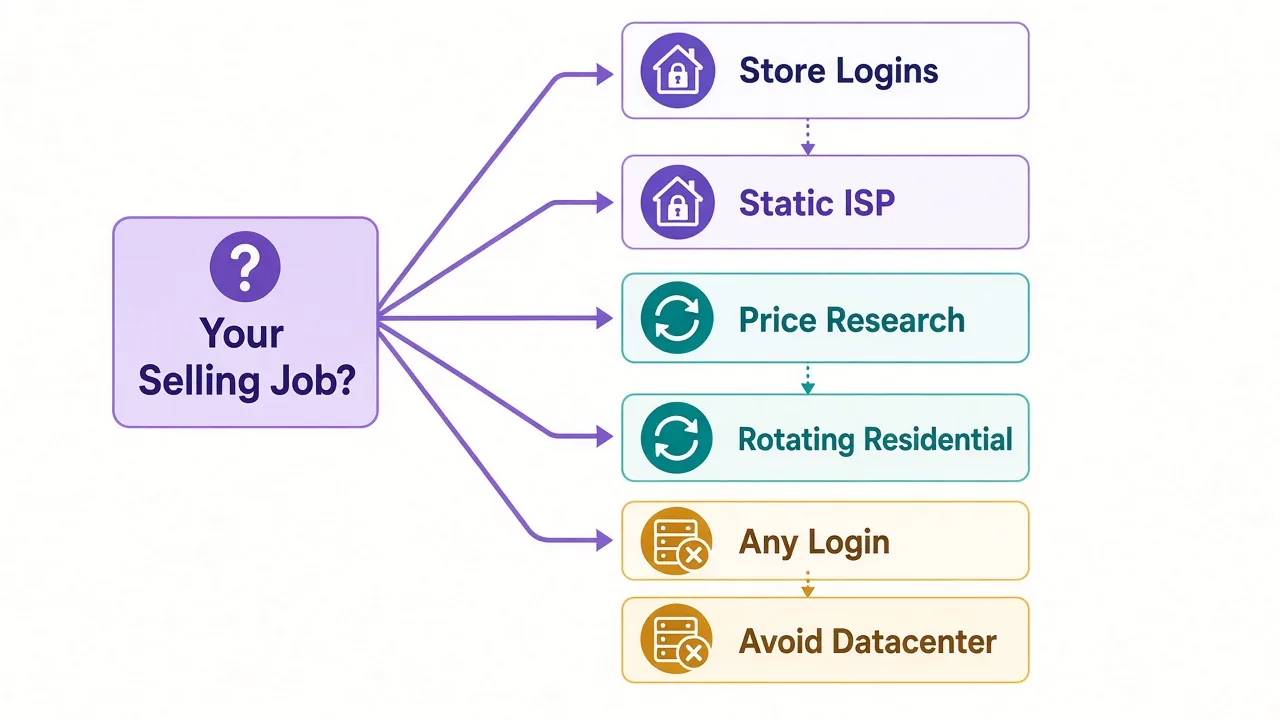
| Your selling job | Proxy type | Why it fits |
|---|---|---|
| Running a store you'll keep for years | ISP (static residential) | One home-style IP that never changes |
| Giving a remote assistant access | ISP in the store's home country | Their logins look like they come from your usual location |
| Short-term logins on a tight budget | Residential with sticky sessions | Holds one home IP for a set time per session |
| Price tracking and sold-listing research | Rotating residential | Spreads requests so no single IP hits a limit |
| Checking listings as a foreign buyer | Residential with country targeting | Shows you the local search page and prices |
| Any store login | Datacenter | Avoid it: cloud ranges are easy to spot |
ISP proxies are the star here because they combine two things. They're registered to real internet providers, and they stay the same for as long as you rent them.
New to the terms? Our ISP proxy explainer and static vs dynamic IP guide cover the basics in a few minutes.
Why do datacenter proxies and VPNs cause trouble on marketplaces?
Datacenter proxies are fast and cheap. In our proxy directory, several start at well under a dollar per IP.
The catch is where they live. Their ranges belong to hosting companies, and any site can check the ASN, the network that owns an IP.
Real shoppers and sellers don't browse from server racks. So a store login from a cloud range starts with less trust.
VPNs have a different problem. Thousands of people share the same exit IPs, and some of them are up to no good.
That shared reputation follows you into Seller Hub. A VPN is great for privacy on café Wi-Fi, but it's a poor fit for a business account. Our proxy vs VPN guide explains the difference in more depth.
Free proxy lists are worse still. You don't know who runs them, and a free proxy can read or change unencrypted traffic. Our free vs paid proxies breakdown walks through the risks.
The best proxies for eBay and Etsy store accounts
These four suit account work: listing, messaging buyers, handling orders and managing several stores you plan to keep. Prices below come from our directory as of October 2026, and the cards show the live figures.
Live Proxies: best for long-lived stores in the US, UK and EU
Live Proxies sells static residential (ISP) IPs, starting around $3 per IP in our directory. That's a fair price for an address a store can keep for months.
Its private pools focus on the regions where most eBay and Etsy sellers are based. You get one steady IP per store, which is exactly the pattern a normal seller leaves.
The drawback is reach. It covers about 40 countries, so a store registered somewhere less common may not find a local match.

Curated, private residential pools for US, UK and EU targets
Mars Proxies: best for a small number of premium ISP IPs
Mars Proxies lists ISP IPs from about $7 per IP in our directory. That's more than Live Proxies, but you're paying for dedicated, static addresses.
It suits a seller who runs two or three valuable stores and wants each one locked to its own IP for good.
The honest catch: coverage is narrow at around 20 countries, and there's no free trial. Check that your store's country is on the list before you buy.

Low-latency ISP and residential proxies built for sneaker copping
IPRoyal: best for sellers on a tight budget
IPRoyal's residential traffic starts around $1.75 per GB in our directory, on pay-as-you-go. Unused traffic doesn't vanish at the end of the month.
That matters because store work barely uses any data. Checking orders and replying to messages a few times a day won't get anywhere near a gigabyte.
Use its sticky sessions to hold one IP per login. The drawback is that a sticky residential IP still changes eventually, so it's a step below a true ISP address. There's also no free trial.

Flexible proxies with true pay-as-you-go.
SOAX: best for precise country and city targeting
SOAX offers residential from about $4 per GB and mobile from about $6.50 per GB in our directory. Its strength is fine-grained location targeting.
That helps when a store needs to look local to one region. It also lets you see a listing exactly as a buyer in one city would.
The catch? Per-GB pricing makes it pricier than a flat ISP IP for daily logins. We'd use it for targeted checks and keep stores on static IPs.

Clean, ethically-sourced residential & mobile IPs.
The best proxies for marketplace research and price tracking
Research is a different job. Nobody is logged in, and you don't need one IP to stay put.
You need many IPs sharing the load while you pull sold prices or competitor listings. That way no single address hits a rate limit.
Decodo (Smartproxy): best all-rounder for small teams
Decodo, still listed as Smartproxy in our directory, starts residential plans around $3.50 per GB. Rotating and sticky sessions live in the same dashboard.
That's handy if one team both runs stores and tracks competitor pricing.
The drawback is that it's a generalist. For pure store logins, a dedicated ISP IP gives you more stability for the money. Our Smartproxy pricing guide breaks down the plans.

Powerful proxies without the enterprise price tag.
DataImpulse: best for cheap, steady research
DataImpulse lists residential traffic from about $1 per GB in our directory. That's the lowest entry price in this guide.
For a side project that checks a few hundred listings a day, that keeps costs small.
The trade-off is fewer premium features and no free trial. Keep it for research and put your stores on something static.

Transparent pay-as-you-go residential proxies with no minimums
Bright Data: best for large research projects
Bright Data runs one of the largest pools we list, with residential starting around $5.04 per GB. It also has a free trial.
If you're tracking whole categories across many countries, scale and geo-targeting are the point.
For a solo seller, it's overkill. Onboarding includes compliance checks, and costs climb fast at volume. Our Bright Data pricing breakdown shows where the money goes.

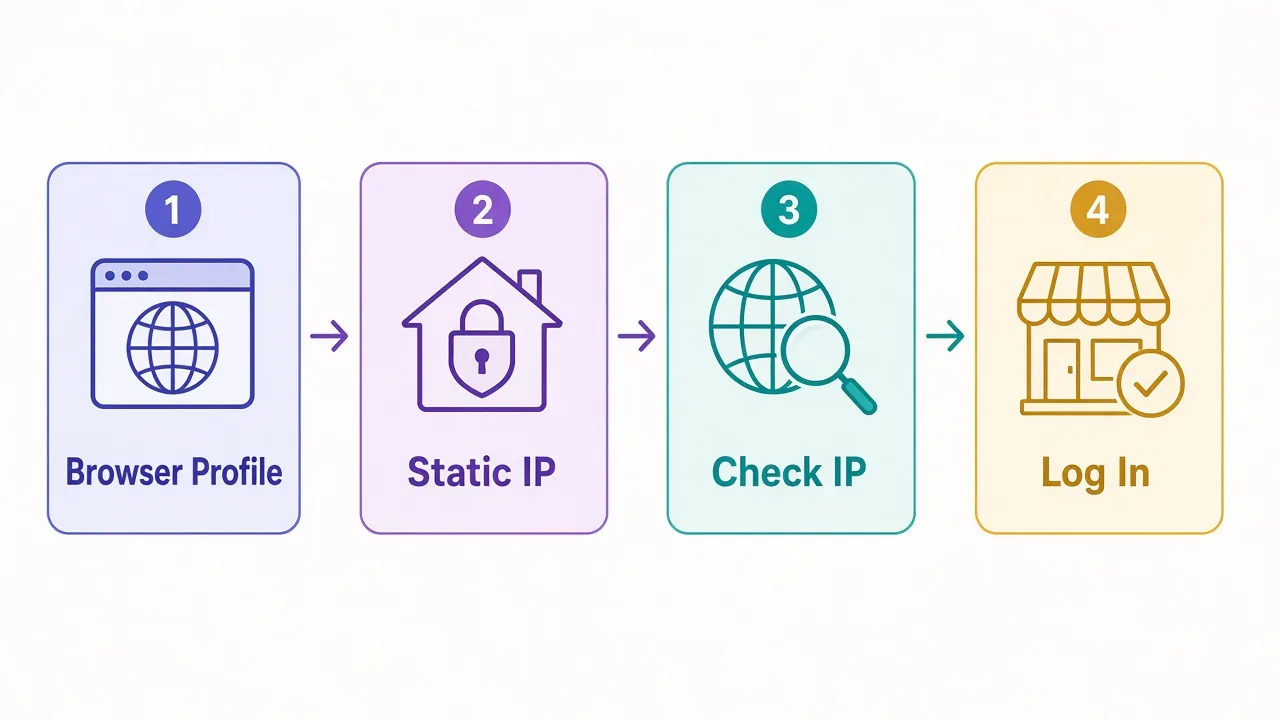
How do you set up one store, one profile and one IP?
Here's the setup we'd use. It takes about 15 minutes per store the first time.
- Create one browser profile per store, in an antidetect browser or a separate browser profile.
- Assign one static IP to that profile, in the country the store is registered.
- Check the profile's IP and location with our IP lookup tool before you log in.
- Log in, and only ever open that store from that profile.
- Share the profile, not the password, with anyone who helps you.
Why the separate profile? Because cookies and fingerprints travel with the browser, not the IP. An antidetect browser keeps each store's data in its own sealed box.
Etsy's help page even suggests using different browsers for different shops, since most browsers won't keep two accounts signed in at once. A profile per store is the tidy version of that tip.
Our antidetect browser roundup covers which ones are worth paying for, including team sharing features.
Step three matters most
A misconfigured profile can quietly connect without the proxy. Our guide to checking that a proxy works covers DNS and WebRTC leaks, the two usual culprits.
Sticky or static: how long should a store keep one IP?
For a store, the answer is "as long as possible".
A sticky session holds the same residential IP for a set time, often 10 to 30 minutes. That covers one login. It doesn't cover a store you open every day for a year.
Think about a normal seller. They work from the same home connection for months, with the odd phone login mixed in.
Now picture a store that appears from a new neighborhood every morning. Every IP might be residential, yet the pattern still looks strange.
That's why we keep coming back to ISP proxies for store work. The address doesn't change unless you change it. Our sticky vs rotating guide goes deeper on session settings.
A simple rule
Logging in to a store? Keep one IP for months. Just reading public listings? Rotate freely.
Should you scrape eBay and Etsy or use their official APIs?
Start with the official APIs if they cover what you need.
eBay offers developer APIs through the eBay Developers Program, including search and listing data. Etsy has its own Open API for shop and listing information.
APIs are stable, documented and plainly allowed. They also save you from fixing a scraper every time a page layout changes.
So when do proxies come in? Usually when you need public pages the APIs don't serve well, or a view of search results from another country.
In that case, rotate residential IPs, keep request rates gentle and cache what you've already fetched. Hitting one search page from 500 IPs at once is still a pattern.
Our guides to the best proxies for price monitoring and Amazon scraping cover the same problem on similar marketplaces.
Why do stores with clean proxies still get restricted?
Remember the habit from the intro, the one that triggers more checks than any IP? It's switching things around.
Sellers buy a good proxy, then undo the benefit with small inconsistencies. These are the ones we'd watch for:
- Logging in once from your home IP "just to check something"
- Swapping a store to a new proxy every few weeks to save money
- Letting an assistant use their own browser instead of the store's profile
- Picking a proxy country that doesn't match the store's address
- Opening two stores in the same browser tab, one after the other
Each one tells the marketplace that something about the store changed. Do it often enough and you'll see more verification prompts.
Behavior counts too. Late shipments, unanswered messages and duplicate listings hurt a store far more than its network ever will.
And if eBay restricts one account, its policy says the limits can spread to your linked ones. The fix there is the boring one: get the first account back in good standing.
Our guide on why proxies get banned covers the network side in more detail.
So, which proxy should you actually buy for eBay and Etsy?
Start with the job, then the price.
Running stores you want to keep? Give each one its own static ISP IP in the store's home country, from a provider like Live Proxies. Never share it between stores.
Tracking prices or sold listings? Rotate cheap residential traffic and keep your pace gentle.
You don't need the priciest plan. You need a steady IP, a clean browser profile and the discipline to stick with both.
Still comparing? Browse the residential providers we've reviewed side by side and pick the one that fits.
Frequently asked questions
A static residential (ISP) proxy, one per store, is the best fit for store logins. It gives each store a stable home-style IP that doesn't change between sessions, which looks like a normal seller.
No. Etsy lets you run several shops, but it asks you to list every shop in each account's Public Profile. Proxies keep each shop's network steady; they don't make linked shops invisible.
Yes. eBay's multiple accounts policy allows separate accounts for buying, selling or different product lines. You can't use extra accounts to avoid fees, limits or a suspension, and restrictions can spread to linked accounts.
It's possible, but we wouldn't. VPN exit IPs are shared by many strangers and change often, so they carry mixed reputations. A dedicated static IP gives a business account a steadier history.
Rotating residential proxies are best for price tracking and sold-listing research. They spread requests across many IPs so no single address hits a rate limit. Check eBay's developer APIs first, since they may cover your data needs.
Usually not. A single store run from your home broadband already has the most believable IP it can have. Proxies help once assistants, travel or several stores make your logins inconsistent.